REPORT OF THE DECEMBER 18, 2008 ADVANCED
ENGINE TECHNOLOGIES, INC. ANNUAL SHAREHOLDER MEETING
Carroll Shelby
Enterprises, Inc., 19021 S. Figueroa St., Gardena, California 90248 (310)
538-2914
Advanced Engineering Technologies, Inc. held its
annual shareholder meeting at 11:00 am on Thursday, December 18, 2008 at Carroll
Shelby Enterprises which houses OX2 engine development facilities.
Attending the meeting were John Luft, Chief Operating Officer; Neil Cummings,
Secretary and Legal Counsel; a Gilderman & Associates accounting firm
representative; a Robert E. Petersen Trust Fund management representative from
Whittier Trust Company; Mike Edwards, Chief Engineer; David Lee, an engineering
consultant from Weant Engineering; plus 4 AET shareholders. No members of
AET's Board of Directors were present.
The meeting began with a vote for the AET Board of
Directors. Out of 33,885,000 AENG shares outstanding, 13,652,804 shares
were voted including 13,000,000 shares representing the Petersen Trust.
This was only 40% of outstanding shares and failed to meet the 51% quorum
required by AET bylaws to hold a valid BoD election. Carroll Shelby,
Alexandria Phillips, and Noel Holmes continue as the AET Board of
Directors. The issue was raised that many AENG shareholders whose shares
are held in "street name" are not receiving proxy statements. John Luft
claimed AET is properly mailing out proxy statements to all listed sharholders
and it is the responsibility of the financial institutions holding shares in
"street name" to forward proxy materials to their clients. It was asked
how many shares are held in "street name", and John Luft replied it was about
9,000,000 shares. Clearly those 9,000,000 were not represented.
After some discussion, it was decided that any shareholder holding AENG shares
in "street name" may call AET, (310) 538-2914, to have proxy statements directly
mailed to their address provided they also fax or mail copies of statements from
their brokers to AET which offer some proof of AENG share ownership. If,
in the future, it becomes necessary to actually replace BoD members, those
9,000,000 shares need to be reached to be able to hold a certifiable
election. This still leaves the question of why proxy statements are
failing to reach shareholders unresolved, and shareholders who did not receive
their AET proxy statements need to call AET to drive home this
point.
Following, the vote, John Luft gave a brief
overview of AET's operations and goals. The immediate goal is to get to
and demonstrate a stable and reliable Design Level #3 OX2 engine and a
marketable 30 kw genset as quickly as possible. Operating costs have been
held under control by reducing permanent engineering staff to just one engineer,
Mike Edwards. Supporting staff also includes a fulltime CNC machinist and
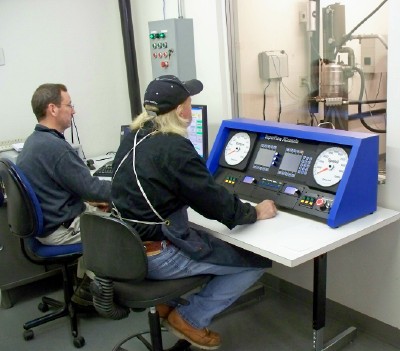
a couple of mechanics including technician Steve Wells who runs the dyno
testing. Engineering consultants are contracted as needed for CAD,
electrical, and engine control systems. Monthly operational costs are
about $80,000 a month. AET continues to retain Gilderman & Associates
for accounting, the same firm employed by AET for SEC reporting prior to
delisting AENG stock. Some failures during engine and generator testing
have resulted in delays and the need for additional engineering expense.
Because of a failure of one of the control electronics units provided by Dynotek
for the Dynotek generators, a new, more reliable control electronics unit needs
to be sourced and purchased which will require more than $200,000 in necessary
added expense. It is also necessary to develop a suitable electronic
throttle control to maintain optimal OX2 engine speed. Other engineering
issues and durability testing need to be resolved and completed. AET
reserves are currently just under $500,000. Hence, AET will need to raise
additional funds through the sale of AENG stock. Up to less than 17
million shares could be sold limited by a 50 million total share cap. John
Luft pledged his fiduciary responsibility to try to increase AENG share price to
obtain the most favorable terms for current AET shareholders when raising
funds. There are a number of potential investors who are open to funding
AET, including Carroll Shelby. A presentation has been made to Whittier
Trust, managers of the Petersen Trust Fund, which was well received. Neil
Cummmings has been separately involved with the development of a Maglev rail
system, to operate between Anaheim and Las Vegas, and brought up the OX2
generator in discussions with General Atomics engineers who became very
interested. General Atomics is responsible for the development of
propulsion and electrical delivery systems for the Maglev rail system, and the
small, lightweight OX2 generator is a very suitable and attractive package for
General Atomics applications.
Mike Edwards began his presentation by summarizing
some of the advantages of the OX2 generator. For one, it is a variable
speed generator, so if the electrical demand is less than 30 kw, the engine
speed is automatically reduced consuming less fuel to produce the lower kw power
needed. The electronic controller always maintains the correct voltage and
frequency independent of engine speed. In hybrid cars, the engine to run
the generator is always run at one speed, the speed at which the engine is most
efficient, always consuming fuel at the same rate. The latest OX2 Level 3
engine is able to run smoothly down to about 400 rpm, producing 10 kw at about
500 rpm. On the higher power end, while AET is currently developing a 30 kw
generator, in free spin tests, the Dynotek generator produces over 50 kw at
around 1200 rpm, opening the possibility of developing a 60 kw generator using
the same Danotek unit at higher rpm.
The main attraction of the OX2 generator is that it
is 1/3 the size, 1/2 the weight, and runs at lower rpm than typical industry
standard diesel generators. Cost-wise, diesels currently run about $350/kw
and the Capstone Microturbine generator runs around $1000/kw. OX2 is
shooting for $500/kw, with its small size making it the desirable choice.
Upcoming environmental regulations may significantly raise the cost of diesel
generators. In 2007 rules requiring scrubbers to reduce diesel soot and
particulates went into effect. California regulations requiring controls
for NOx emissions begin to go into effect in 2010, and in years shortly beyond,
these rules will be stiffer and retroactive forcing many diesel trucks and
equipment out of service. Caterpiller recently signed a deal with Navistar
and will no longer build and furnish diesel engines to other on-highway diesel
truck builders. NOx controls for diesel are expensive and reduce engine
efficiency. EGR systems to reduce NOx add heat and wear. NOx
selective catalytic converters require using and storing an extra fluid,
meaning extra maintenance to keep diesel powered pumps and generators running in
remote fields and locations. The current AET OX2 and GM powered variable
speed generators will run on propane.
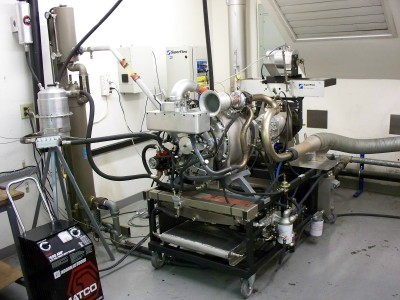
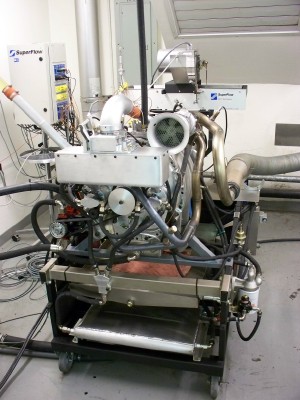
Over the last year, AET has fully installed and is
using its new dyno for testing, and AET has built its second and third Level 3
OX2 engines. Engine 1 has been scrapped with its case and turbo going to
Engine 2, leaving two engines for development and testing, Engine 2 and Engine
3. Distribution of oil in the engine has been a problem, with air bubbles
becoming trapped in the oil, foaming as the oil is thrust and slapped to the
sides of the engine by the spinning cylinder block. The foam impedes oil
flow and leads to engine overheating. To prevent formation of foam, a
2-stage dry sump oil pump system has now been employed. One stage, the
scavange pump, sucks oil from the oil pan through filters into a canister where
the oil settles and air bubbles released. The second stage pulls oil from
the canister and pumps it back into the engine. This system seems to
maintain oil temperature okay, but the engineers have decided to experiment with
operating the OX2 in a vertical position, with the heavier generator side facing
down, to more evenly distibute oil and to keep oil out of the cylinders for
better ignition and firing. In the horizontal position, oil tends to get
into cylinders near the bottom slowing firing in those cylinders. A
reliable, proven triple seal should prevent oil from dripping into the
generator. Engine 2 will be tested in vertical test stand which has
already been built. During horizontal testing, a turbo on Engine 2 failed,
likely due to low oil pressure. Another separate stage may be added to the
oil pump system to provide higher oil pressure to the turbo, or a mechanical
supercharger with lower boost might be used. The vertical orientation also
means an OX2 genset would have the selling advantage of an even smaller
footprint using less floor space.
Previously, Engine 1 achieved 320 ft-lbs at 48
hp. For a 30 kw generator, only 250 ft-lbs at 45 hp is required.
Engine 2, using high compression ratio pistons, achieved 265 ft-lbs.
Engine 3, using lower compression ratio pistons, has achieved over 300 ft-lbs
and also runs quieter and smoother at lower rpm. Danotek generator testing
is currently being done using the GM propane engine powered variable speed
generator with a mechanical speed governor. During this testing, one of
the power electronics units failed due to a voltage spike and arcing. It
was determined that Danotek had sourced the power electronics from Youtility and
that the unit is basically a benchtest version, lacking the durability required
for field use. Youtility no longer makes such units for applications less
than 100 kw, so AET engineers have had to source a new power electronics
company. First AET looked at Morey Corp who makes proprietary electronic
controls for Caterpillar. Then AET determined the proprietary systems use
electronics designed by ECE, Electronic Concepts and Engineering, Inc., a
company established in power generation control. ECE now appears to be the
source AET will be using for its power electronics.
While current variable speed generator testing is
being done with a mechanical speed governor, AET plans call for an Electronic
Throttle Control (ETC). AET has determined that no suitable off-the-shelf
stand-alone throttle control system is available. Automobile makers incorporate
their ETC systems into the car's ECU, electronic control unit, and thus it is
not available as a separate unit. It is necessary for AET to design and
develop its own ETC. To that end, AET has contracted with Weant
Engineering, owned by Bob Weant who has a prior relationship with Carroll Shelby
International. (This appears to be Bobby Ray Weant of Vehicle Enhancement
Systems, Inc., Rock Hill, SC, a heavy hitter with lots of patents to his
name.) David Lee, a Weant engineer, discussed the ETC design at the
meeting. The ETC will have a variety of inputs and outputs and will be
controlled via a feedback loop which includes a generator output power
controller and an interface controller (supplied by ECE) to maintain the correct
engine speed and electrical power output. The ETC may be built in two
versions, one version for commercial gensets and one version for
high-performance automotive use, both of which AET could sell as a stand-alone
product in addition to the OX2, the OX2 genset, and the GM powered variable
speed generator package. (Note AET is also considering a Ford 4 cylinder propane
engine in addition to the GM engine.) The computerized control system also
provides the potential to remotely monitor and control OX2 powered generators
and pumps in the field from an office computer.
The problems AET has encountered over the last year
has delayed 100 hour durability testing. Another problem that still must
be corrected before the 100 hour testing begins is excessive blow-by gas
accumulating at the top of the engine. Plans call for simultaneous
endurance testing of Engine 3 on the new dyno and component development and
generator integration using Engine 2 on the vertical test stand during the first
half of 2009. Simultaneously Weant Engineering is to develop the ETC
during the first half of 2009. Power and interfacing electronics
development will take place at ECE during the last three quarters of
2009.
A thick handout including charts, photos and
outlines summarizing the content of the annual shareholder meeting was passed
out to shareholders. The content of this handout will be available on
AET's official http://www.ox2engine.com
website. John Luft also stated a press release summarizing the meeting
will be issued in January 2009 followed by additional press releases during the
course of the year.
The presentations were followed by running
demonstrations of the OX2 Engine 3 on the new dyno and the GM powered variable
speed generator. Engine 3 was only run briefly due to an unexpected
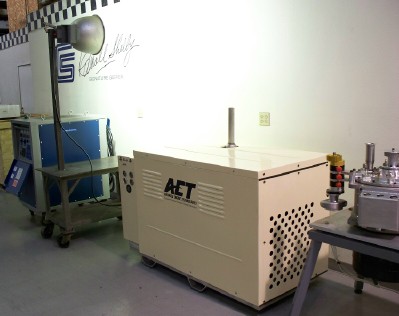
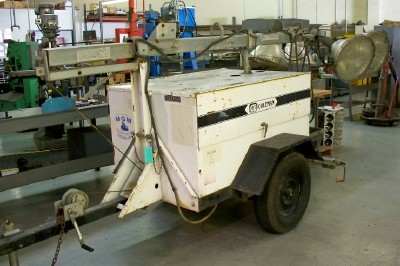
technical problem. The AET 30 kw variable speed generator was run hooked
up to a 1000 watt metal halide flood light and compared to a portable Coleman 6
kw diesel generator powered 4 flood light construction site plant of similar
physical size. For the same size, the AET variable speed generator can
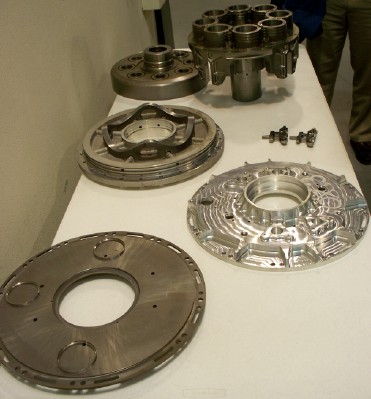
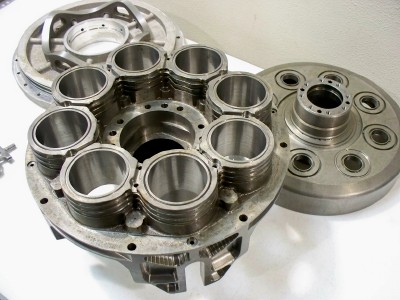
power more than 20 such flood lights. Also on display was Engine 2
configured with the Danotek generator in the vertical test stand, as well a a
display of various Level 3 parts and components.
Despite the problems and delays, AET is still on
course to create world class quality products. By utilizing the
engineering services of such highly competent and respected firms as ECE and Bob
Weant, along with the high competence of AET's own engineer, Mike Edwards, AET's
goals for the OX2 are well within reach.
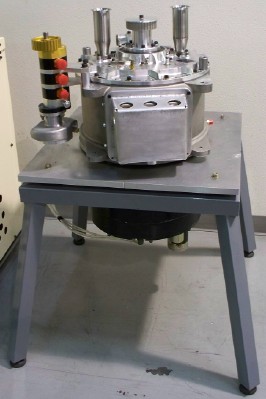
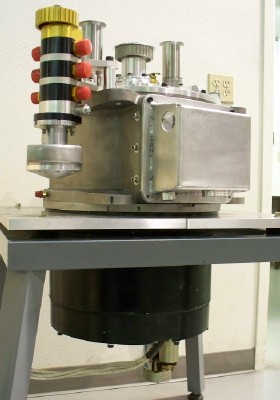
OX2 Engine #2 and Danotek Generator on the Vertical
Test Stand - Note Oil Pump at Left
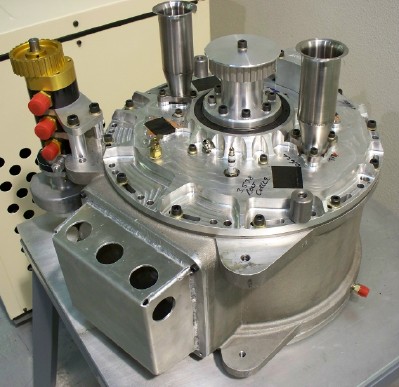
OX2 Engine #2
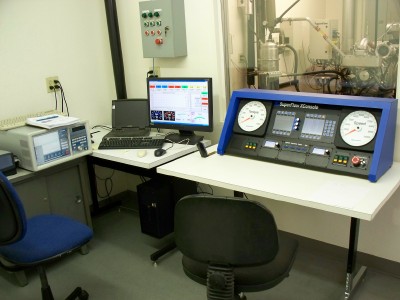
New Dyno Console
Mike Edwards and Steve Wells at the New Dyno
Console
OX2 Engine #3 on the New Dyno - Note Oil Canister
at Left
OX2 Engine #3 on the New Dyno
Various Parts from OX2 Engine #1
Various Parts from OX2 Engine #1
AET 30 kw Variable Speed Generator Running and
Powering Flood Light
Coleman 6 kw Diesel Generator 4 Flood Light Power
Plant