 |
SIBER, Computer Studies |
DEPARTMENT OF COMPUTER STUDIES
Information Technology (IT) is a collection of tools and
techniques for fast collection, storage, processing and
transmission of information and knowledge which is ultimately
used for strategic planning, timely decision making, assessment
of risks, quality service and improved quality of life. It is an
amalgamation of many other technologies including computer and
communication technologies. The later two technologies have given
rise to Internet, which inturn has affected the way, the
organizations conduct their activities resulting in e-commerce,
e-business and now, e-governance. These three together encompass
all walks of life giving rise to new problems regarding security,
privacy and authenticity and cyber crime ingernal. It itself
again comes to rescue in solving this problems and many more.
Needless to say, IT opens up new job opportunities at all levels
on the one hand and on the other the existing manpower has to be
reoriented to meet the requirements of IT enabled organizations.
The major challenge is for the educational institutes to chalk
out varieties of courses to meet the requirements of different
sectors; and also to maintain high standards while conduct to
these courses. In this connection, it is important to note that a
single course or few courses will not be suitable for all needs
because the subject of IT is vast and interdisciplinary. E.g.
different orientation of IT training is required for jobs in
Governments, Software Industry, Financial Institutions,
Educational Institutions and other organizations. While IT as a
discipline is relatively new, the management of SIBER has felt
the need for computer education way back in early eighties and
accordingly establish the Vasantraodata Professional School of
Computer Training at SIBER to provide basic training in computer
usage and to provide EDP services to co-operative banks, Sugar
Factories, and Kolhapur Municipal Corporation in the region. The
computer department has subsequently started a regular Diploma
Course (DCM in 1983) and a Post Graduate Course in Computer
Management (MEM in 1986). Many alumni of the Department are
presently working in reputed organizations in India and Abroad.
In Recognition's of its success in providing management and
computer education of high standard, the University Grants
Commission granted autonomous status to the SIBER in 1995 and
simultaneously permitted to DISCONTINUE the MCM course and START
MCA course.
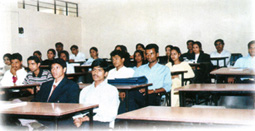 |
It is important to mention that, the courses places emphasis on how to "think" of a solution to a problem, and how to identify efficient solution. The course is not about lust learning the syntax of languages, navigation of packages. There are components of the course in which students are given topics for self study on which they prepare reports and present the material at seminars. The contents of the course and its presentation to the students is good to the extent that the MCA students of the schools never faced any problem in finding placements either for six months projects in an organization or for permanent jobs in reputed companies. So far, three batches of MCA students of School of Information Technology have passed out and performing extremely well in their jobs. Even the co-curricular activities of the school are worth replicating elsewhere. |
The MCA course conducted by the Department is unique in many
respects. The course emphasizes both theory and practicals.
Practicals consist of usual practice exercises, exercises that
bring of the finer points of languages and mini projects; the
theoretical topics are a proper mix of topics in Computer
Science, Management and Mathematics. The topics thought include
the latest trends such as Data warehousing and Datamining. UML,
Internet Programming and Applications such as designing
e-Commerce applications, VB and VC++, Oracle and JAVA and various
scripting languages.
Apart from the MCA course, the IT courses for students of other
deceplies in SIBER as well as IT literacy and IT Education
courses of both long and short terms for students in the Region.
The school conducts to Diploma courses DCM and ADCA, a
certificate course in IT. Some other courses are being formulated
so that computer literacy spreads in the region and any persons
of any qualification are employable or self employed.
Proper IT training cannot be imparted at any level without
laboratory, library and qualified and quality conscious faculty.
There three requisites are always taken care by the management of
the SIBER. The Department of Computer studies has about 100
computers assigned for training alone. The School has all latest
license software and has one of the best collection of computer
books in the library. The faculty trained at various places in
the country and abroad are academically oriented and collectively
have up-to-date expertise in all theoretical and practical
aspects of Information Technology.
PLACEMENT CELL
The Deparment had received excellent response for project as well
as a campus recruitment programmes from software organizations.
Alumni of the SIBER are appointed in leading companies. Some of
the companies who have recruited our students are Tata
Technologies Ltd., Mahendra British Telecom, HCL, NIC, XLNET,
Kale Consultancy, L&T, NAL, Wipro, Simens and TIFR. SIBER
will continue to support industry by offering current batch of
students for placements.
| Normally students get placement through campus
recruitment programme of Kale Consultancy and
L&T. MCA students undergo project training in their 6th semester. In order to familiarize the students with real world solutions, it is imperative for them to work in various types of organizations. Therefore, each student spends 10 days in a business organization and learns from the field experience. The project is a crucial part of the program and provides the students with a valuable opportunity to fully realize his acquire knowledge in real working arena. During the project planning period students will be visiting their assign organization to undertake any necessary preliminary work, initiate any research required and submit a plan for the completion of the project. Faculty makes at least one supervisory visit to each students during the project period. They inspect the student's log when they visit. |
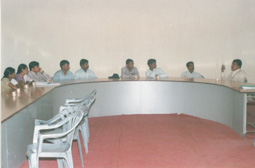 |
Most of the organizations are conducted aptitude
test for the placement, the institute has also started conducting
aptitude tests for fourth and fifth semester students. The
Placement Cell has developed a special test on the lines of GRE
and the test conducted by Infosis, Wipro, TCS and Satyam. These
tests have help the students in campus interviews and regular
employment. In December 2000, final year MCA students have joined
Software Organizations in Pune, Mumbai, Benglore and New Delhi
for their organizational training. Most of them are placed in
well known IT companies and they are also getting stipend for the
project period.
The MCA Placement Cell has organized many seminars and
colloquiums, for the benefit of the students and faculty.
| General
Rules & Regulations Students are admitted various the course subject to the Institute's rules as to eligibility, grant of terms etc. Rules in the prospectus are binding on the students and changes made from time to time will be displayed on the notice board. The total amount of fees for the course must be paid as per the schedule. Failure to do so can result in cancellation of admission. If a student is entitled to any Government scholarship, the Freeship amount will be refunded to him/her when it is received by the Institute. No student shall be considered to have pursued the regular course of study unless he/she is certified to have attended at least 80 percent of the tutorial and seminar work held and to have otherwise pursued his/her studies to the satisfaction of the Director. The student who have not fulfilled the requirement of 80 percent attendance are not eligible to appear for the term end examination. In case of illness, it is mandatory for the student to produce an attested certificate from the hospital where he/she has undergone treatment. Every student must pay particular attention to the practical work prescribed under the course (case studies, project work). He/She must report to the faculty incharge of the Practical Work regularly and follow the instructions received. The project report must be submitted on or before Submission Deadline of the academic semester. The internal credit marks will be assigned to the students strictly on the basis of his/her performance in seminars, debates, quiz, assignments, tests and extra co-curricular activities. The Institute shall notify the various state and national holidays in confirmation with its regulation. Apart from these holidays, no student shall be permitted to abstain from regular classes. A very high standard of discipline and punctuality is expected from each student, which will have a direct bearing on the assessment of his/her performance. It is mandatory for every student to wear formal dresses, while participating in college activities, especially during seminars. The student must submit an application for eligibility along with the original mark list, Transfer/Migration Certificate and attested Xerox copies thereof and prescribed fees within a fortnight from the date of admission. Failure to comply with this rule can result in an outright rejection of his/her candidature. |