
(NORTHERN NEGROS)
Popular Mountaineering Entrances
Precautionary Measures
Waterfalls
Peaks
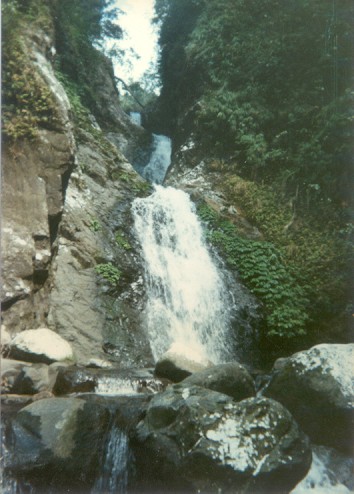
Area: 80,500 has.
Location: Negros Island, the Philippines
Boundaries: Murcia, Talisay City, Silay City,
E.B. Magalona, Victorias City,
Manapla, Cadiz City, Sagay City,
Escalante, Toboso, Calatrava and
Don Salvador Benedicto
Forests: Mainly second-growth forest with mossy
dipterocarps in Mt. Mandalagan and
Mt. Silay
Highest Peak: Mt. Mandalagan (alt. 6,168 ft.)
- discovered by the SB in 1997 in Sicaba-Wala, the left head-branch of Sicaba River.
* Kampuestuhan - 21.9 kms from Talisay City. 30-minute AUV ride to Concepcion, 15-minute tricycle ride to Pajo and 1-hour hike to the barrio. Secure barrio chairman's permit. Guide (P150.00 fee) is required while a porter (P150.00 fee) is optional. Construction of a cable system and the structure for bungee jumping is underway.
* Patag - 20 kms from Silay City. 1-hour ride to the old Patag Hospital. Secure mayor's permit. Guide/porter (P150.00 or P200.00) for every five mountaineers is required.
* Gawahon - 18 kms from Victorias City. 1.5-hour ride toBarrio Gawahon on scheduled trips by M's Canter (5:00 a.m, 7:00 a.m. and 11:00 a.m. departures). Inform the military detachment. Guide hiring is not yet established.
* Don Salvador Benedicto - about 45 kms. from Bacolod City. 1-5-hour ride from Bacolod. Inform PNP municipal detachment. Look for guides among the locals.
PRECAUTIONARY MEASURES
Biological Hazards (Wildlife)
There are many types of poisonous snakes in the NNFR like the `dupong' (diamondback pit viper) in Patag and the common `maninina'; the big snake, the python, can still be found in the Sicaba region. Stories of hunters mauled by the wild pig (the Visayan Warty Pig) involve situations when the wild pig is cornered and turns agressive. Another mammal, the deer (the Philippine Spotted Deer) is generally harmless and evasive. Colonies of monkeys are present in Patag, Calatrava and possibly in Don Salvador Benedicto. Aside from the colony of monkeys that have grown accustomed to human contact in Calatrava, this wild and territorial animal when in great numbers may turn very viscious to man.
Some plants, especially the tubers, contain toxic substances. As a precaution , it is advised not to ingest any plant of doubtful edible value. Meanwhile, skin contact with `alingatong' or `dalamo' (probabaly the Australian sting tree) causes severely painful irritation that last for days.
Except on World War II, there are no reports of malaria being acquired in the forests and mountains of the NNFR.
Peace and Order Situation
Although there are still a few operating RPA's in the Northern Negros, the place has experienced a respite from insurgency-related troubles after the EDSA Revolution. At any rate, it is necessary to inform the military detachment covered by an itinerary plan.
Rescue Plan
Most of the NNFR interiors remain as an outback. Even with the old logging trails and the presence of several rescue organizations in the province (there is a Negros Rescue Federation, Inc. in Negros Occidental) , any M.O.S.A.R. operation utilizaing terrestrial navigation remains a difficult and sluggish undertaking. At present, the island of Negros doesn't have a helicopter on stand-by for resue.