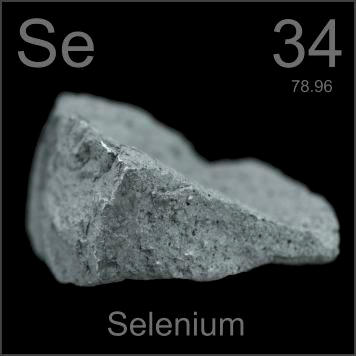
Selenium is a chemical element with symbol Se and atomic number 34. It is a nonmetal with properties that are intermediate between those of its periodic table column-adjacent chalcogen elements sulfur and tellurium. It rarely occurs in its elemental state in nature, or as pure ore compounds. Selenium (Greek σελήνη selene meaning "Moon") was discovered in 1817 by Jöns Jacob Berzelius, who noted the similarity of the new element to the previously-known tellurium (named for the Earth).
Selenium can be prepared with either an amorphous or crystalline structure. Crystalline monoclinic selenium is deep red; crystalline hexagonal selenium, the most stable variety, is a metallic grey (see picture above). Elemental selenium is relatively nontoxic and is considered to be an essential trace element. However, hydrogen selenide (H2Se) and other selenium compounds are extremely toxic, and resemble arsenic in their physiological reactions. Hydrogen selenide in a concentration of 1.5 ppm is intolerable to man. Selenium occurs in some soils in amounts sufficient to produce serious effects on animals feeding on plants such as locoweed (an American plant) grown in such soils.