Calcium is the fifth most abundant element in seawater with a nearly conservative distribution. High precision measurements made by Horibe et al. (1974) demonstrated a slight surface depletion in the Pacific that is produced by uptake of calcium and incorporation into CaCO3 shells that sink from the surface layer. More recently, high precision measurements of calcium by isotope dilution mass spectrometry (de Villiers, 1998) have also suggested a maximum concentration near 2500 m depth, coincident with the depth of the mid-ocean ridge crest. These results suggest a calcium source from low temperature hydrothermal sources.
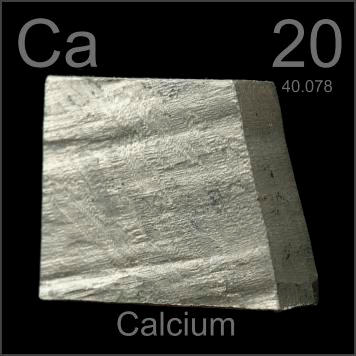
Calcium as the element is a grey silvery metal. The metal is rather hard. Calcium is an essential constituent of leaves, bones, teeth, and shells. Calcium is the fifth most abundant element in the earth's crust and makes up more than 3% of the crust. Calcium does not occur as the metal itself in nature and instead is found in various minerals including as limestone, gypsum and fluorite. Stalagmites and stalactites contain calcium carbonate. Calcium carbonate is the basis of the cement industry.