CD (Compact
Disk) Writer
A CD is a standard medium for
distributing large quantities of data.
In 2000, Napster
(file-sharing program) became one of the
biggest news stories around. With Napster and other file-sharing programs, you
could obtain an MP3 version of any song you wanted at no cost. Recording companies distributing their
products weren’t making any profit.

http://mynapster.sourceforge.net/
As profit for
music CD(s) plummeted, electronics manufacturers
and retailers soon discovered that around 1999, 2000 and early 2001, sales of
CD burners and blank CD-recordable discs skyrocketed.
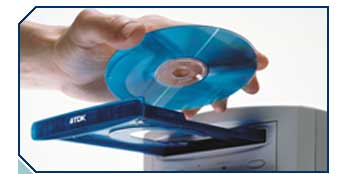
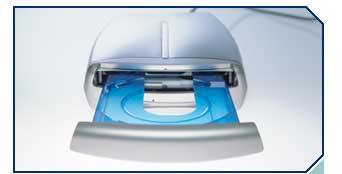
Companies were now making
money by selling, not song CD(s) but more blank CD-recordable discs and CD
burners.
http://www.tdk.com/cdburners/index.html
http://www.tdk.com/cdburners/index.html
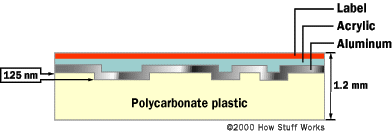
The CD: Most of a CD is
consisted of injection-moulded piece of clear polycarbonate plastic.
The process
of writing data into a CD: The plastic is
hard-pressed with a high-powered laser to etch microscopic bumps into photo
resist material. The bumps are set as a single, continuous, extremely long
spiral trail of data. Once the clear piece of polycarbonate is formed, a thin,
reflective aluminium layer is sputtered onto the disc, covering the bumps. Then
a slight acrylic layer is sprayed over the aluminium to guard it. The label is
then printed onto the acrylic.
http://www.howstuffworks.com/cd1.htm
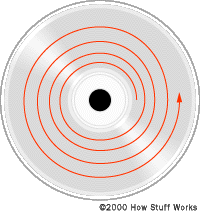
A CD has a single spiral
track of data, circling from the inside of the disc to the outside.
http://www.howstuffworks.com/cd1.htm
Reading Data: A laser is sent across the CD through the
polycarbonate layer in finding and reading the small bumps of data. The laser
while passing reflects off the aluminium
layer and hits an electronic device that detects changes in light. If the laser
comes across the bumps, it reflects light differently than the "lands" (the rest of the aluminium layer), and
the electronic sensor detects that change in reflectivity. The electronics in
the drive interpret the changes in reflectivity in order to read the bits that
make up the bytes.
Storing
Data:
A CD can store up to 74 minutes
of music, so the total amount of digital data that must be stored on a CD is:
44,100 samples/channel/second x 2 bytes/sample x 2 channels x 74 minutes
x 60 seconds/minute = 783,216,000 bytes
To fit more
than 783 megabytes (MB) onto a disc only 4.8 inches (12-cm) in diameter
requires that the individual bytes be very small. By examining the physical
construction of a CD, you can begin to understand just how small these bytes
are.
To write to
a CD, much software is available on the market, which help to store Data in
supported format. It is quite useful, and ultimately very cheap to store, and
to transfer files across.
References:
http://wt.xpilot.org/publications/linux/howtos/cd-writing/html/
http://www.howstuffworks.com/cd-burner.htm
Moe A. Khorasanee