IT PROFESSIONALS
The principles of information
technology
Principle is a fundamental rule,
guideline or motivating idea that, when applied to a situation, produces a
desirable result.
The first
principle of information technology describes the purpose of IT: Information
technology’s great usefulness is as an aid in solving problems. In Unlocking
creativity and making people more effective than they would be if they did not
apply IT to their activities.
Another principle is, Always fit
information technology to people rather than asking people to adjust to
information technology.
The
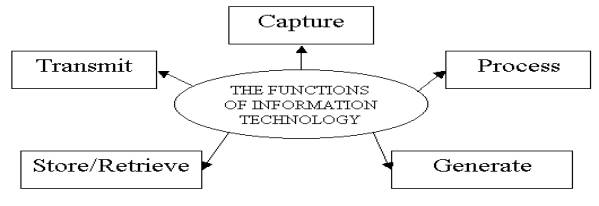
Functions of Information Technology
What exactly can IT do? It performs six information-handling functions: captures, processing, generation, storage and retrieval and transmission. The way these functions are applied determines the impact IT will have.
CAPTURE:
It is often useful to compile detailed records of activities. This process,
called data capture, is performed when it is expected the data will be useful
later.
Here
are some common examples of data capture:
·
Whenever a book is checked out of the library, the name (or
identification number) of the borrower and the title (or call number) of the
book are captured.
·
The theater box office records the assignment of every seat to an
attendee as it is sold.
·
A monitor records the pulse, heart rate, and white blood cell
count of a hospital patient.
·
When Madonna performs live her singing is some times captured and
transferred to a cassette tape or a compact disc (CD) for listening at a later
time.
·
The voice and data recorders in aircrafts cockpits capture the
pilot’s conversation and record flight data about the aircraft’s location
and performance.
PROESSING:
The activity most often associated with computers, processing, is usually the
purpose for which people and organization purchase computers. The processing
function entails converting, analyzing computing and synthesizing all forms of
data or information.
Once of the earliest business applications of computers, data processing
focuses on taking data (raw, numbers, symbols and letters) and transforming them
into information. An example of data processing is calculating the balance in a
checkbook by taking the starting balance for the month, adding all deposits and
subtracting all checks written (that is, the data), and determining the current
balance.
Information
processing is the transformation of any type of information into a different
type of information. Text (reports, correspondence), sound (voice, music,
tones), and images (visual information such as charts, graphs, drawings and
animated drawings) can all be processed. Multimedia systems, which are one type
of information processing, have recently captured interest. These systems
process multiple types of information simultaneously--- for example, an animated
presentation displayed on computer screen will use information retrieved from
within the computer, perhaps accompanied by music, voice or other types of
sound.
Other
types of processing include these:
·
Word processing--- the creation of text-based documents, including
reports, newsletters, and correspondence. Word processing systems allow people
to enter data, text and images into a computer and transform them into a useful
and attractive format.
·Image
processing--- converting visual information (graphics, drawings and photos) into
a format that can be managed within a computer system or transmitted between
people and other computers. A process called scanning converts a print or film
image into a form that a computer can use.
·Voice
processing--- the transformation and transmission of spoken information.
Currently, voice information is most frequently entered into a computer system
through a telephone, but other systems that enable people to speak directly into
a computer system to instruct it to take specific actions are emerging.