| I pulled my rod foward and let my running line shoot through my guides along the gin clear river. I was drifting egg flies on a tandem rig, feeling it tick off the bottom and run freely down the river. The river was littered with salmon, from every pool to riffle. The weather was beautiful but the water cold, the thoughts of fish kept me casting. Then all of a sudden my line paused as if it were snagged and as I pulled my line, I felt some resistance against it. I pulled the rod back, hoping to un-snag the fly. Then to my amazement my reel started screaming; line and backing came off faster than I could imagine, my rod was bent to the butt, and my line strteched. I fought the fish but within seconds the sound became silent. I looked several yards downstream at my line and what was left of my leader. I was on the Pere Marquette, pursuing the mighty steelhead, a fish reconized as the "wise one". That is what a steelhead will provide for you........a battle that's fought to the end! Whats better than wading the river as you cast to these fish, any time of the year? Steelhead are a species of rainbow trout that live in a sea or a lake, and return to spawn in surrouding rivers. Thses fish were not originally found here, but rather planted by the DNR in our Great Lake's fishery. They have adapted and are pursued by many anglers today. .There are many strains of steelhead in our waters, and can be found in our rivers during every season of the year. The Little Mainsitee strain and Skamania strain are the most popular. To this day, I can't get over the Great Lake's steelheading DISEASE, and I never will! Oncorhynchus mykiss are truly a angler's dream as they will provide excellence for any angler wishing to achieve battle with them. |
Great Lakes flyfishing for steelhead requires strong and stout tackle. When a large fish strips off line, hold on, the battle will be long. Long rods that are 9'-11', in the 6-8wt range are best, although using long spey rods that are 12'-14' are better for long distance casting, mending, and larger rivers. A premium, disc drag fly reel is a must. These fish are powerful and make long runs, and a flyreel loaded with at least 100yds. of backing is critical. Large Arbor designs are beneficial because they allow line to be picked up at a faster rate.There are many ways to present your patterns to these bullets. The most popular method in Great Lake's steelheading is drift fishing or what some refer to as "chuck and duck". This method is the most effective as you use a simple running/shooting line and heavy amounts of lead(i.e. slinky's, pencil lead, splitshot) to get the fly down. For a more traditional mehtod of flyfishing using a sink tip line or full sinking line to swing the pattern can be deadly. Floating lines are best for nyphing and indicator rigs. Indicator methods let your fly supsend in the water column, making it easier to fish pocket water or shallow to mid-depth runs easier. Rio and Scientific Anglers make several lines appropriate for Great Lakes steelheading. Leaders can vary. Typically the simpler, the better. When indicator fishing, long leaders are usually necessary to fish the deeper runs. Typically a 10' leader is an all around good choice. I prefer fishing indicator methods with a shorter two handed rod, one that has a medium/fast or fast action. When doing so, I use a leader up to 15' at times which enables to fish the deepest lies. Drift fishing requires a 6'-8' section of 12lb mono to a swivel, then drop tippet to flies. When using sink tips, a shoter leader is required. Leaders from 3'-6' are best. Many anglers use tandem rigs, the standard is an egg fly as the point fly and nymph as the dropper. Sometimes two nymphs are ran, or two eggs, depending on the situation. Patterns such as eggs, caddis, hex, stonefly nymphs, egg sucking leeches, big streamers, and colorful spey flies have become the standard. |
| (Indicator Nymphing) Rod: Redington Wafayer 10ft. # 7wt.(mid flex) Reel: Redington AL with 150yds of backing Line: Rio(Floating) Tippet: Maxima an PLine Flouro- 4lb and 6lb. Flies: stone, hex and caddis nymphs, eggs Presentation: Indicator nymphing involves mending and roll casting. Cast upstream, mend and drift fly downstream, use rod to advantage by holding it high. After fly has completed the drift, strip line and roll cast or single spey back upstream. |
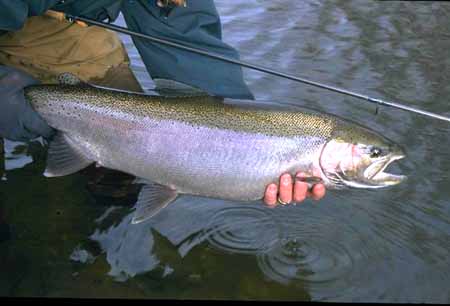 |
| A Muskegon River Chromie!!! |
| Michigan Steelhead Rivers |
| Muskegon, Pere Marquette, Au Sable, Manistee, Two Hearted, Bestie River, Platte River, Huron, White, Au Gres, etc. |
| Productive Steelhead Patterns |
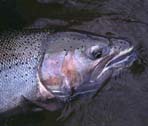 |
| Fresh Lake Michigan Steelie |
 |
| The passion of casting to magnificent Oncorhynchus mykiss in the crystal clear waterways of the Great Lakes!!! |
 |
 |
 |
 |
 |
| Fishing Steelhead Water |
| When steelhed enter the rivers, they have spawning or eating on thier minds, and holding lies are important when targeting fish. Fresh fish will usually be more active and are more likley to strike a fly out of aggresion. Targeting faster pocketwater and riffles is best, with the exception of fishing in the colder months. Holdover fish, or fish that have been in the river for awhile will usually be staging in deeper pools, flats, tailouts, and runs. Often these fish will be less likley to take a fly but with warm weather and high baro pressure, it can sometimes put the fish on the bite. Wooded areas or areas with larger rocks act to deflect water and provide securtiy, and these lies should be fished as well. |
