"...it's not a passion, rather an obsession. A disease of the mind, for only true anglers who will rage against war, as they pursue the mighty father of freshwater...." - Dan Szubielski |
| Flesh filled the banks of the river, the smells of decaying carcus's was present. The river was flooded with fish, it was a spectacular sight. I took out the seven weight rod my guide, provided me with. I lobbed the lead and the tandem egg rig into the deep pool near a log jam. The fly drifted along the bottom across the beautiful river. Nothing, I made another lobb into the pool and then without a pause my rod began to bend. The reel was screaming, the sounds of a freight train going at full speed. I fought and fought, putting resistance against the rod, offering every amount of strength I had! Then I realized the fish was heading towards the log jam. My eyes lit up, I fought harder, then I saw it, abeauty in my eye, a large Chinnok was on the end of my line. I tightend the Tibor Large Arbor reel, I had to stop this fish. Then, amazinly the fish leaped into the air over the jam , my breath was warm, sweat poured from my body. I knew I was hopeless, the salmon would get caught on the other side of the jam, my line was sure to break. I would have to hurry and run down the river, hopefully my guide could get the net, and take the lug. Minutes past, and I still was nervous, this was a fish of a lifetime. After getting him into the shallows, and 8 minutes of battle, the fish was captured.. Now the buck laid im my hands, a whopping 32lbs. of aggression, might, and power. The fish was worth the trip to the Pere Marquette, as it still lies in my memory and will forever! |
| Flyfishing for salmon was once unheard of in the Great Lakes region. Small rivers with monster fish swimming didn't allow many options forthe fly angler. Broken rods and reels became common. As time passed, flyfisherman excelled, and now is very popular. Taking this fish on the fly requires heavy flytackle. A long rod is benificial, such as ones 9'- 11' in the 7-10wt range are best. Spey fishing is a better way to cover larger rivers, and control drifts. Rods that are 12'-14' in length rated for 7-11 weight line are most used for spey fishing. Fly reels must be strong, have a superior drag, and have a large backing capacity while withstanding the salmon on long runs. Large Arbor designs are best although you don't necessarily need one. There are many methods to present the fly to salmon. The most effective and popular way is drift fishing or "chuck and duck". This method will get the fly down quickly. A thin diameter running line and heavy amounts of lead(i.e. slinky's, pencil lead, splitshot) are essential. For more traditional methods, a sink tip or full sinking line is ideal when stripping streamers or swinging speys. Long leaders are necessary to fish deeper lies. 10' leaders are used most often, shorter 3'-6' leaders for swining with sink tips. Spey fishing calls for a either a double taper line for roll casting or a sink tip line for swinging flies. Angler should have bright spey flies, and an assortment of nymphs and egg patterns in their box. When chasing big salmon, large streamer patterns stripped across graveling fish, such as bunny leeches can offer rewards from time to time. |
| Drift fishing Rod: Trident TL 9'6" 8 wt. rod (mod/fast action) Reel: Redington LA with 250yds. of 30lb. backing Line: Airflo Polyshoot running line Tippet: Maxima and Cortland 6 - 12lb. Flies: Nymphs, leech patterns, eggs, bright spey flies Presentation: Bring rod behind you, lobb upstream, allow fly to drift dowtsream. Mend line if needed. Make sure you cover entire water column. |
 |
| A few productive salmon patterns. |
 |
|
|
|
|
|
 |
 |
 |
 |
 |
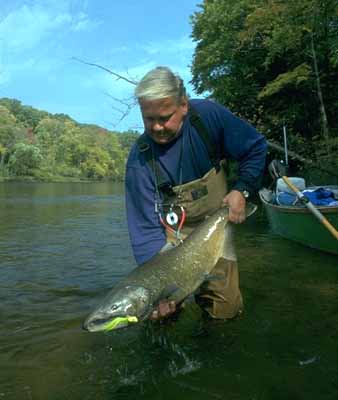 |
| Below: A long battle fought to the end as guide Matt Supisnki brings the beast in! |
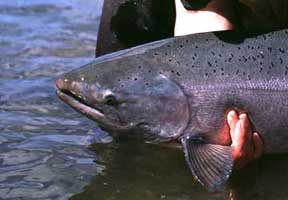
| Salmon were introduced to the Great Lakes region in the mid 1900's to limit the alewife population.. In the Great Lakes region, there are pink, chinook, coho, and atlanitc salmon. Great Lake's salmon can get big... up to 30lbs. or more, but the average is anywhere from 15-25lbs. Many anglers target salmon offshore or in rivers. Salmon will enter rivers in late summer and fall to spawn. Females will begin to dig redds on gravel for the spawn. Males become aggresive and develop a kype, and will fertilize the eggs once released. Some anglers believe salmon stop eating once they are instream. While scientific evidence proves that they cannot digest food, a salmon will strike out of aggression, to protect the redd, or out of instinct. |
