Grindal Worms - A Fishie's Favorite Food
Grindal worms are a common, nutritious, easy to grow live food for all carnivorous and omnivorous fish. High in protein, they make excellent treats for tropical fish and fancy goldfish, and can be a staple for larger fry. Frequently called mini white worms, they reproduce and are cared for in much the same way.
Acquiring a Starter Culture:
Usually, you can find a nearby aquarist that has a culture going, and get a starter from them. They can be ordered online as well.
I can send you some at a fairly minimal cost, probably under 4 dollars.
Setting up the Culture: Grindal worms need some sort of bedding to dig and lay eggs in. Peat moss, coconut fiber, all-organic compost, or a mixture of these will do well. This can be held in a margarine tub or like container with holes punched in the top. Peat moss must have some garden lye added to it, for it is acidic and grindal worms will only reproduce in neutral or basic bedding. I have had good luck with my mom's all-natural hippy compost stuff. Add some water, not much, to the culture and stir it some. Keep adding water until it is wet, but little excess water can be found. You can then just drop the starter in. The grindals must now be fed.
Feeding the Culture: Grindal worms normally feed on decaying vegetable matter. For our purposes, oatmeal or another grain will work best. Just about any grains will work, but something vitamin-fortified and high protein is best. Many people use cat food or baby cereal. I use Gerber baby oatmeal. Depending on the size of the culture, you'll need anywhere from a teaspoon to a tablespoon. Drop the teaspoon in the center and shake the culture gently to level out the lump of food. Then use a spray bottle to moisten it to the same moisture as the culture. All the food should be gone in a few days. If it lasts more than this, you run the risk of developing fungus. Most starters will only need a teaspoon. If it gets to the point where you need a table spoon, it's time to split the culture.
Growing the Culture: Now that you have the culture set up and fed, it'll start to multiply rapidly. My culture has roughly quadrupled in size in less than a week. Grindal worms have a very rapid reproduction system: each worm has both male and female reproductive systems. 2 worms will encase themselves in a mucous layer and impregnate each other. Both worms will now lay eggs. Increasing the temperature to a certain extent will speed this process, and yield many worms. These worms, however, are smaller. The largest worms are grown at lower temperatures. I have read reports of extremely high-productivity cultures being operated at over 90 degrees, but when heated from below, all the worms in my culture scramble for higher ground. I just leave mine at about room temperature. After about a week or two, the culture should be quite large. At this point it is a very good idea to split the culture, so that if one is destroyed for some reason you won't need a new starter. Just create a new bedding, add food, and scoop some worm-rich dirt out of the original culture. Drop this into the new culture and maintain normally. To expand the culture, wait until all the food is gone and dump the soil bedding into a larger container. Fill the unoccupied areas with new bedding. Sometimes the bedding will need to be replaced. If production trails off, it is usually because the bedding had become acidic. If this occurs, harvest as many grindals as you can and create a whole new culture.
Harvesting the Worms: When your culture has been up and running for a few weeks, you will be able to start harvesting. If you start harvesting too soon, consumption may outpace production and set your culture back. The most common method of harvesting is to put a small piece of glass on the soil with a little bit of food on it. As soon at the worms congregate on it, they can be scraped off with a plastic fork or anything else with a straight edge. As long as no dirt is picked up with the worms, they can be dumped in. Dirt in the tank can fowl it.
Alternative Harvesting Method: If you put the blob of oatmeal next to the side or corner of the container, some of the worms will crawl up the side. You can push these into a mound with a toothpick or your finger, then poke the mound fairly
hard with your finger. Most of them should stick. Then you can dip your finger into the tank to be fed.
You can also poke the mound and drag them up to the top of the container and
out, like lifting a penny off a table.
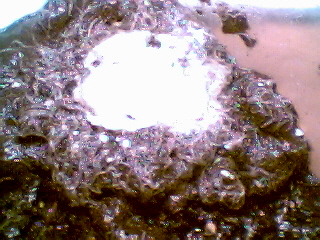
A bunch of grindals around a blob of oatmeal. You can blame Logitech for the poor quality.