Betta Splendens, aka Siamese Fighting
Fish
WARNING: Male (the normal pet shop find)
Betta Splendens should NEVER be kept together. They are extremely territorial
and will KILL all other male bettas. Female bettas (short-finned) are tolerant of
each other, but males and females do not usually get along.
If you have purchased a Betta and Peace Lily setup, I implore you, PLEASE read This
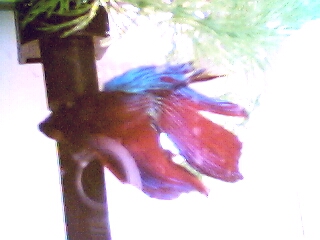
Betta Splendens, pronounced bet-uh splen-dens, is Latin for "Beautiful Warrior." They most certainly live up to this name. While they are almost always dull and sometimes ugly in pet stores because of the conditions they are kept in, within a month of proper care their colors will be spectacular. Mine came to me with a gray body and dull red fins with dull blue strips in it. Now, about a month later, his fins are a rich red, his body has turned into a reddish-gray, and the blue in his tail has turned into shimmering turquoise and has progressed to sequins on the body. Heinrich has become a gorgeous fish.
Care: Bettas are incredibly
tolerant fish. The only more tolerant fish I have is Cat, who is strongly determined to be completely ignored.
Mine lived in over 5 ppm ammonia in his bowl in the store before I saved him.
Through the cycling of he tank, he never acted or became sick. I changed the
water only once because of some ammonia buildup. Betas need special food, and a
jar of Betta Bites, which will last literally about a year, can be purchased
for $3. They need to have a plant or something to rest on, as they
intermittently patrol and rest. You'll seem him wander around his tank for a
while, then drape his fins over a plant and doze. Betta tanks should be about
1-5 gallons. They are not particularly active fish, they breathe air so they
don’t need a lot of oxygen in their water, and they are happy as long as they
have a decent-sized territory to patrol. I read somewhere that over 10 gallons
stresses them out because they feel they need to patrol the entire tank. Bettas
need a cover on their tank, as they occasionally jump and breathe air. A cover
will ensure that the air betta is breathing does not change greatly in
temperature. The rest of the tank setup is widely debated. I, as well as some
other people i know, feel that betta tanks should have filters. Eclipse
Explorer tanks are ideal, as well as any bowl or vase equipped with a corner or
sponge filter. The primary counterargument to this is that bettas hate water
current. Bettas' large, flowing fins have a strong tendency to go wherever the
current does, regardless of Betta's will. The current in my Eclipse Explorer
bugs Heinrich sometimes, but if it gets excessive you can stuff a sponge in the
filter uptake to slow it down. If you opt to leave it the filter off, I
strongly recommend that you have a relatively large tank (1.5-2+ gallons) and
lots of gravel. Without the space, ammonia and nitrite will build up quickly,
with little water to dilute it. Extra gravel will allow more biological
filtration to develop. Without filtration, water changes are needed every 2 to
three days. This dissipates any ammonia and nitrite that would build up without
filtration. I like to use filtration because 1. I'm too lazy to do water
changes all the time, and most importantly 2. I don't want my betta living in
ammonia water all his life. With filtration, weekly or bi-weekly water changes
are needed to keep nitrates low.
Community
placement:
Bettas are generally not considered good community fish. Their long flowing
fins are very attractive to any fin nipper, and being nipped at leaves them
open to disease. Only one can be kept in a large tank, so if more than 1 is
wanted, 2 community tanks would have to be set up. It has also been said that
if a betta is in a large tank, it feels it needs to patrol the entire thing,
stressing it out. In a very docile community tank, a betta would probably do
fine. Most livebearers should ignore it, but many tetras and barbs will nip at
it. Most people, however, prefer to keep them in smaller tanks because the
larger tanks can be put toward fish that need them (Larger tanks are more
valuable "real estate"). Tank dividers can make a large tank into a
sort of "betta barracks," and allow for large-scale filtration
without much bother to the fish. This is the ideal setup for a betta lover.
Attributes: Bettas are naturally very
long finned fish. Their fins are not rigid, and most of their propulsion comes
from their quick pectoral fins and wriggling of their abdomen. They are
anabantids, which means they can breathe air and water. Bettas need to do both,
as their gills will not suffice to supply them will all the oxygen they need,
and they need to be able to dive to satisfy their territorial instincts. They
have 5 fin sections: a thin, long dorsal fin that sticks straight up at first
and curves slowly back, a caudal fin that comes in many shapes, and an anal fin
that drapes down almost along the entire underside of their body. Two "tassels,"
if you will, dangle down from two spots immediately under the pectoral fins. A
pair of small, rigid, colorless pectoral fins allow the betta to move backwards
and turn. Their mouth is strongly upturned, optimized for eating food off the
surface of the water. They are STRICLY carnivores, and must be fed a special
betta mix. They will most likely eat any gnat-sized bug that happens to land on
their water. Bettas are very tolerant to water conditions, and even high
amounts of ammonia have failed to kill them. They should still be kept in good
conditions for the sake of their health and happiness. The water changes
required are detailed in the care section.