Basic Fish Care
Fish care is really entirely different than most people think. The common conception seems to be that taking the tank completely apart every month is good cleaning practices. This is NOT TRUE. It is, in fact, just about the WORST thing you can do for your fish. If this is your regular maintenance practice, please stop now. An well-established aquarium will essentially clean itself. It is therefore reccomended that you ONLY do the following:
1. Buy a gravel vacuum, available at most pet stores, under 10 dollars. Use it to siphon out about 1/4 to 1/3 of the water once every 1-2 weeks.
2. Replace water with tap water of the SAME TEMPERATURE. The tap water should be treated with a dechlorinator that removes chorine and chloramine. If you KNOW for sure that your water district does not use chloramine (some don't) you can use plain dechlorinator.
That's it. Don't do anything else for routine maintenance, 'cept the occasional rinsing of the filter cartridge in removed tank water, NOT TAP.
This is assuming you have a filter of adequate size for your tank running. If not, you're in trouble. Read on to find out why.
The primary waste product of fish is ammonia. This is released from a fish's bloodstream through the gills. It is the liquid waste of aquatic animals. It is also EXTREMELY toxic. In an averagely-stocked aquarium, it will take about 5 days for ammonia to build to toxic levels. Toxic, however, is a relative term subject to the hardiness of the fish. There are two ways to remove ammonia: Constant water changes or "cycling" your tank.
"Cycling" your tank involves developing a colony of bacteria capable of eating all the waste of your fish. This requires 2 things: a filter and stable tank conditions. If you have no filter, you'll either have to buy one, do CONSTANT water changes, or let your fish suffer. A filter for a 20 gallon tank can be bought online for about 20 bucks, shipping included. Make the investment.
A filter is necessary to the "cycle" because the nitrifying bacteria (bacteria that eat ammonia) need water circulation to bring their food to them. The filter also provides extra surface area for the bacteria to grow. This surface area is crucial, for nitrifying bacteria must anchor itself to a surface. It can be provided by the gravel in the aquarium, the floss or other mechanical filtration in the filter, any special bio-wheel or bio-foam the filter has, and anything added to the tank or filter like crushed lava rock.
The Nitrogen Cycle:
The Nitrogen Cycle is comprised of 3 stages:
1. Ammonia - Ammonia is released into the water by fish, decaying leftover food, and decaying waste. Ammonia is extremely toxic; it causes gill damage and burns the fish's skin. Levels of 2 ppm or more are toxic to many fish, above 5 ppm is abolsutely lethal to nearly all fish. Readings on ammonia should ALWAYS be 0 on a cycled tank, for the health and happiness of your fish. With effective filtration, this is easily attainable.
2. Nitrite - Ammonia is consumed by forms of nitrifying bacteria, and Nitrite is produced. Nitrite is taken into the bloodstream, bonding with hemoglobin (the oxygen-carrying agent in blood) and creating a substance called methemoglobin, which does not carry oxygen. This effectively suffocates the fish. Nitrite is poisonous to some fish at about 5 ppm. It is lethal to most at about 10 ppm.
3. Nitrate - Nitrite is decomposed by different forms of nitrifying bacteria into Nitrate. This is effectively the end of the nitrogen line. Luckily, nitrate is not very toxic. Levels of 1000 ppm and above have been shown to not be lethal to some fish. Other fish, however, are quite sensitive to it.
Tank Cycling:
To cycle your tank, you must have a source of ammonia. Here you have 2 choices: Fish, or an artificial source. Using an artificial source, called "fishless cycling," is much more humane than regular cycling.
To "cycle" your tank fishlessly, you need to add a source of ammonia. Fish food is the best way to produce it. Use a high-protein food, NOT goldfish food. The protein is the agent that, by decaying, creates ammonia. Add some in just as you would if you have fish. You'll have to buy 2 test kits: ammonia and nitrite. The ammonia should go way up, then drop just as soon as the ammonia-eating bacteria catches up. Then the nitrite will shoot up, as the ammonia-eaters create nitrite. The nitrite will go up, just like the ammonia, until the nitrite-eaters catch up. As soon as nitrite drops, your tank is cycled. Keep putting food in until you have your fish, or are just about to get them. Then vacuum the gravel real well to get all the food out. Change about 90% of the water this way, and add the fish.
You can also use pure ammonia, although this does not work quite as well. Make ABSOLUTELY sure you have PURE ammonia, with no perfumes. If you shake it and it bubbles, it probably has perfumes in it. With the pure ammonia, add just a little to the tank at a time. Once you reach about 4 or 5 ppm, record the amount you used to get there. Add exactly this much every day, or, even better, half that much twice a day. You'll get the same effects as the fish food cycling. This is not as good a system, as the sudden spike in ammonia caused by adding in the pure ammonia hurts the nitrite-eating bacteria, slowing down that phase of cycling.
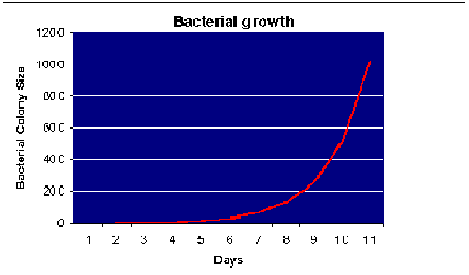
Lastly, and leastly, you can use fish. This puts them through a period of misery and causes some fatalities. It is not a very humane way of cycling. If you choose to, start with VERY few fish, one or 2. The very beginning of the cycle is hardest, because of the exponential nature of the bacteria growth. See the graph below. Afterward, more fish can be added about a week apart, faster and faster.
Speeding the Cycle:
For the impatient, or to save your fish some misery, (if you cycle with fish) you can "seed" the tank with bacteria from a tank that has already grown it's bacteria. This speeds the cycle enormously by starting the tank off with a population of bacteria, as demonstrated below:
As you can see, the growth of the bacteria is exponential: It doubles in a certain period of time. While I have no idea how long this period is, I guessed at a day for the purposes of illustration. I also used "units" of size in 200's, for lack of a better measurement. The yellow line, at about 100 "units," represents the population of bacteria in a tank after seeding. As you can see, it saves a huge amount of time to grow the colonies. Ideally, the tank should be seeded twice. If you seeded at the very beginning, there would be little or no food for the nitrite-eating bacteria, and the high ammonia levels would hurt or kill them. Therefore, it is best to seed at the very beginning, right after you start adding ammonia, and just as soon as the nitrite starts to rise.
For a FAR more complete explanation of all the facets of fish keeping, please Click Here. It's much better than anything I'll ever do.
