Goldfish
WARNING: Goldfish should NEVER be kept in bowls. There is not waste management in a bowl, and deadly ammonia will build up in the bowl. Goldfish have a natural lifespan of up to 30 years, so you are NOT lucky to have one for a year or 2. Please read on to find out how to keep these fish healthy and happy, and please do remember that they are living things.
Goldfish are beautiful fish. Many
vibrant colors, exotic body shapes, and unusual appendages have been bred into
many different strains. They do, however, require a large amount of space and
are NOT suggested for an aquarist with limited space.
Attributes: Goldfish are really
quite needy fish. They do not require a lot of special care, just a lot of
work. They are huge waste producers, as their body mass is enormous when they
are full grown. They are, however, quite active and playful fish. Goldfish are
one of the few fish that, instead of looking at their environment, they interact
with it, like little children. They are really very intelligent, but because of their
independent mindedness and the awful conditions they are so often kept in, it
does not show. Mine bump their plants around, sift through gravel, and play with
and tumble over each other. They need lots of mental stimulation, best provided
by a partner goldfish and lots of tank ornaments that are moved about
frequently. They will quite often
beg for food, and for the sake of maintaining interesting tank activities, this
should be discouraged. (I hang a towel over the front of my tank to eliminate
their people=food association) They are a quite agile fish, but the fancier
varieties are substantially slower than the normal and comet varieties. If you
are looking for a fish for a small tank or bowl, try an all male livebearer
tank, like guppies and swordtails.
Care:
Goldfish are, full grown, truly massive fish. They therefore require a large
amount of space, at LEAST 10-20 per fish, more for the Common and Comet
varieties. This size generates a very large amount of waste. Weekly water
changes of 20-30 percent are a highly advised, more frequent during cycling. A
gravel vacuum is a very good idea. Heavy filtration is needed, with emphasis on
biological filtration. Beyond this, care is fairly simple. Feeding pellets is
best, as no little bits are left uneaten in the tank. Soaking food in a little
water is a good idea. I take a small medicine cup, the kind you get on top of a
Nyquil bottle, take some water from the tank, and dump a little food in. Wait
minute, just so it’ll get soaked, and dump it in. This prevents them from
gulping air when trying to gobble floating foods , gets rid of all the bubbles
that could cause fermentation in the intestines. Gulping down air can cause a
fish to become unbalanced and float uncontrollably. Feeding three small doses a
day is best, for it prevents constipation by spreading out the lumps of food in
the intestines. Fancy varieties are very prone to this, because of their
modified torso.
Community Placement: Goldfish are coldwater fish. There are few other fish that
can live with them. The very best companion for a goldfish is another goldfish
of the same general type. Comets and commons would go well together, Orandas,
ryukins, lion heads, and pearl scales go well together, and bubble eyes and
celestials (the EXTREME varieties) go well together. Most fish in the aquatic
hobby are tropical, and therefore would not go very well with goldfish. Zebra
danios, leopard danios, and weather loaches are coldwater as well. The danios
present a problem, however, because they so heavily outrun and outnumber (they
must be kept in schools) the goldfish during the big food scramble. Weather
loaches are the best non-goldfish companion. Goldfish will eat plants
voraciously, so if you want to keep live plants, make sure you have plants that
will grow just as voraciously. They can eat all the plants they want and you wont
have to worry about overfeeding, because the plants are mostly roughage.
Fancy Goldfish and Ich: Many varieties of fancy
goldfish have a headgrowth, or "wen." This will break out in white
bumps while growing, and look very much like ich. You should not be alarmed
unless you see the spots on areas that shouldn't get headgrowths. The white
stuff on the wen should be left alone, it's like a scab. Unfortunately, the only
place you can see ich on a red cap oranda goldfish in particular is the wen. The
rest of the body is white, as you can see in the picture below, the wen is the
only part on which ich could be seen. The only way to distinguish between ich
and head growth is the consistency of the white lumps. If they're fuzzy, like
cotton, and start to break up into strings after a while, it's headgrowth. If
it's a solid little ball that just fades into itself after a while, it's ich.
The white lumps may also look like fungus. If it starts to spread over larger
than normal areas, a strong salt bath is a good precautionary measure. If the
whiteness covers more than 1 square centimeter and/or takes a distinct bread
mold-like appearance, you have fungus.
Varieties:
The common and comet goldfish are very similar. If you imagine what you drew to
represent a goldfish as a child, you've got a common goldfish. Comets simply
have longer tails. There are many fancy varieties, some of which can look quite
nice. You can look through them
here.
Beware of the more extreme varieties, though.
Those with more compacted and bulging abdomens, like the oranda, are prone to
constipation. The EXTREME (bordering on cruel, in my opinion) varieties should
really never be kept. These include telescopes, celestials, and bubble-eyes.
Bubble eyes are EXTREMELY delicate, and are usually kept in totally bare tanks.
Telescopes and celestials have delicate eyes because of the way they protrude,
and have some trouble seeing.
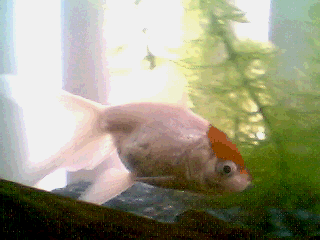
My premature Red Cap Oranda goldfish, Cheezee. The brown thing is a chunk of driftwood.
Back to
the Index