Endler’s
Livebearer, Endler’s guppy, Endler’s poecilia
Care - The Endler's Livebearer is a very easy to care for fish. Their care is almost identical to that of the guppy. To distinguish guppies from endlers, look at the fins. If the anal and dorsal fins seem to come straight out, then straight back in, like /\, then it's an endler. It is an extremely active and fun to watch fish, but does not need a particularly large amount of room to swim. They mostly dart quickly in one direction, then dart again in another. Water current does not bother them, and I have actually seen some playing in the stronger currents, but appreciate a more sheltered area to sleep. Endlers sleep very hard: most of them sink, a few float, they look DEAD. They seem to like to clump in groups anywhere from 3-6 at times, but feel fine and can be kept on their own. They are exceptionally placid; they playfully chase sometimes, but have completely ignored their tank mates. The only aggression that may be caused will be resultant of a high male to female ratio, as breeding demands will be high. Endler's will tentatively accept regular tropical flake foods, but only really like livebearer foods all live and once-live foods. I have some Nutrafin max livebearer food, a mixture of livebearer flakes and tubifex worms, that they just LOVE. They like spirlinia too, but don't actually eat a whole lot. A chunk the size of a housefly will fail to be consumed by about 10 fish, so be very conservative with it. Java moss and najas are perfect tank mates. They contain plenty of hiding places for the fry, as well as many microorganisms perfect for fry consumption. They like quite hard (high kH and/or dH) water, as well as slightly basic water, which works well in high-kH conditions. Mine seem to like water under 80 degrees, above about 79 they seem to just hang at the surface, not playing anymore. They are sensitive to any sizable jolt to whatever their tank may rest on, but will tolerate most normal movement and vibration. They like distinct dark-light times; mine went straight into sleepy time as soon as I turned out the lights. Endler's will live for up to 2 years if well cared for.
Note: Endler's orient themselves completely to the light. If you see them swimming sideways, check the light sources. Light coming in through a window will make them swim at almost 90º to the gravitational "down."
My Endler's going nuts over a spirlinia tablet. Despite their best efforts, they hardly
put a dent in it, and Cat (my Pleco)
gets most of it. But this, I have been repeatedly assured by my new ramshorn snail, is the
Way of Things.
Community placement - As very peaceful fish, they make a very good tank mate to any fish that wont eat them. Most cichlids will make quick work of adults. If you wish to breed them, I suggest you not use any other fish with a conventional mouth, and the fry will be eaten. (Non conventional mouths being those of plecostomus, otto, ect.) They will inhabit all levels of the tank, but mine seem to like the top the best, followed by middle and then bottom. With a large group all parts of your aquarium will be very active. With their greatly varied and very bright coloration, in addition to their active nature, any decently populated tank will look vibrant and busy in all areas. They seem to be very clean, as when I added 12 fry to a tank with only a small very plecostomus in it, the bioload didn't raise in any detectable level, despite the near 50% increase in fish volume. If kept with the guppy, sterile hybrids will be produced between the two. Mine have eaten snail egg clusters, so they may prove to be adequate snail control.
Breeding - Breeding Endler’s livebearers is not really an action, more of a lack of action They will breed like mad as long as there are males and females present, and usually do not eat their fry, although in some cases they have been reported to do so. If a large, phenotypcially varied sample is bred; many many traits may show up, such as lower, upper, and double lower swordtail; lyretail, and nearly infinite color patterns. Some of the more unusual include orange (more than 50% of the body bright orange) and neon blue. (large patch of bright, shiny sky blue) Just watching the results of a large breeding population can be a fascinating lesson in genetic probability. Acquiring a fairly narrow selection will most likely end up with near uniform color patterns after several generations. Fry drops increase with the females' age, and will reach 40+ fry at full maturity. You can expect fry drops approx. every month, (with full grown females) so you may have several generations of fry growing at the same time. Fry start out mostly eating microorganisms present in any live plants as well as baby brine shrimp, specially prepared livebearer fry food, daphnia, and/or any other typical fry food.. After only a week or so they will do fine on ground up flakes, but continued partial reliance on live foods is a good practice. Higher temperature creates a tendency toward growth. The males get their spectacular coloration in about 3-5 weeks, the females stay looking very nearly the same.
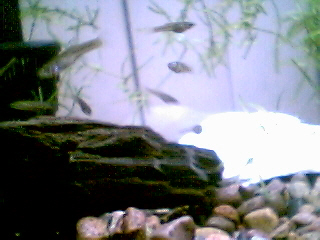
My Endler's, ranging from one to four weeks. This is the batch of fry that Clint sent to
me originally (see bottom)
Origin - The Endler's Livebearer, very close relative of the common guppy, was actually first discovered in 1937 by Franklin Bond. Word either was not or failed to spread about them, and they remained relatively anonymous until Professor John Endler, their namesake, discovered and took samples of them in 1975. They were discovered in Laguna de los Patos (Lagoon of the Ducks) in northeaster Venezuela. They were heavily mixed with the wild guppy in their natural habitat. (Environmentally, not genetically) Endler took a collection of them back with him. They started to gain popularity in Germany, then spread through aquarists throughout the world. Their proliferation is a lucky break for the species, for a city dump was build adjacent to Laguna de los Patos. Various nutrients seeping into the lagoon put the entire ecosystem of the Endler's in danger.
Genealogy - The Endler's Livebearer is very close to the guppy, poecilia reticulata, and can produce offspring with the common guppy. However, these offspring are not fertile, and therefore, by definition, the Endler's is NOT of the same species as the guppy, and many believe. The Endler's probably evolved from the Guppy species, but must have become isolated at some point, and through divergent evolution became too genetically different from the guppy. It could also have been a spontaneous mutation in one guppy's zygote, which was parent to all of the fry in one drop. This drop would create a new line far enough from the guppy to be a new species. Endler's have not been assigned a species name, and are therefore called poecilia sp. Either way; the Endler's is nearly identical to the guppy with regards to care. Overall, I think the Endler's livebearer is a great fish, worth a dedicated species tank. A stable breeding colony is easily created from only 3 pairs, they will fill any tank given time, as well as replacing all of their losses. They are absolutely enthralling to watch and have gorgeous coloration. If you can get a hold of these I would definitely invest, and Clint has some available. I got mine from him and they arrived (and stayed) in great condition. They are of the peacock variety, which is, in my opinion, the best looking of the endlers. See his Stock Shop to order, and his article for info on them. Nick also has some fry available in his Stock Shop.
One of my Endler's who is just developing his
coloration. Notice the black spots developing first. Judging from the peacock
pattern, these will stay black and different colors will develop around it.
Back
to the Index.

