| Method Two [Fish Tank Bubblier] |
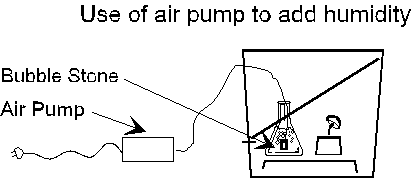
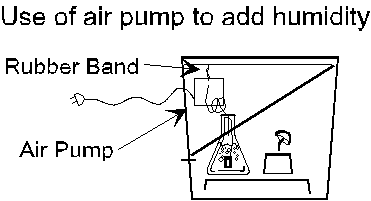
| The basic portion of this system was originally pioneered by Psylocybe Fanaticus There are several improvements and adaptations in this section that were not included in the original method. The idea is to create humidity by bubbling air through water. A small fish tank air pump and bubbling stone are used to accomplish this. This method is inexpensive and allows the terrarium to exist without your constant attention. It's major limitation is that depending on how it is implemented, it can only raise the humidity by 15% over ambient. The minimum acceptable amount of humidity needed by the fungus is 85%. If ambient humidity is going to be less than 70% during the growing cycle, you will experience problems even with a fully optimized setup. If you have more than a few mushrooms growing, it is possible this system will fail to keep the humidity high enough. You still need to hand spray the terrarium occasionally to boost the humidity above what the bubblier can do. Several times a day is sufficient. All of the materials needed can be obtained at any pet store or pet department in a department store. Materials needed: suitable container for water Fish Tank Bubblier 3 feet of 1/4 inch air line for fish tanks bubblier stone optional submersible 50 watt fish tank heater Adaptation-13 optional Angel Hair or plastic steel wool Adaptation-14 The basic strategy is to place a container of water inside the terrarium and slowly bubble air through the water. A hole should be cut in the drip shield to allow the container to stick up through it. The top of the container should be above the drip shield to protect the fungus from water droplets that will get produced. There are several ways the system can be implemented. If the air pump is setup outside the terrarium with just an air line going into the terrarium, the humidity will be raised less than 10% over ambient. The one benefit to this setup is the fact that air is constantly being exchanged and the home cultivator does not need to eliminate CO2 every day. A small hole can be put at the base of the terrarium to let CO2 and water escape. The hole should be just big enough that water does not bead up and plug the hole. A 3/8 inch hole will accomplish this nicely. Note that a small, snug hole needs to be drilled in the side of the cooler to allow the air line to get inside the cooler. You can not just loop it over the side of the cooler and slam the lid on it. You will not get enough humidity if the lid does not fit tightly. See the following diagram: Example A second method to implement this strategy is to put the air pump inside the terrarium. This way the same air is constantly recirculated, constantly increasing its humidity. This can increase the humidity to close to 15% over ambient. This implementation has several disadvantages. First, the key to getting the higher humidity is recirculation of the same air over and over again. This means no hole can be placed at the bottom of the terrarium to allow water and CO2 to escape. You will need to eliminate CO2 at least once a day. The second disadvantage is the fact that the air pump generates some heat and can warm the terrarium by over 10 degrees F. This may or may not be acceptable. One point needs to be noted. The air pump will create some vibration. It is best to suspend the air pump from a rubber band to absorb this vibration. A stiff piece of coat hanger wire can be suspended from one side of the terrarium to the other and the air pump hung from it. Instead of the air tube going through the side of the terrarium, the power cord for the pump goes through the side. Also note that the positioning of the stiff wire to hold the air pump is not critical. It may be better to rotate it 90 degrees from what is shown in the following diagram so that it is easier to remove the drip shield when servicing the terrarium. Also, the power cord and air tube should have some slack in them so that are not being pulled on as the pump vibrates. The ideal scenario is to tie wrap them to the supporting wire. See the following diagram: Example Two |
 |