Solar Powered Lamp and Engine
Introduction
The goal of this project was to produce a self contained reading lamp that
could be used by students in rural areas for reading at night. The circuit
can be used for a wide variety of lighting applications. The scope of the
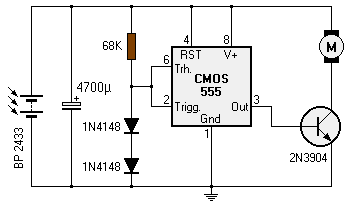
circuit was further extended by use of IC555 to tap the solar energy to drive
a simple motor.
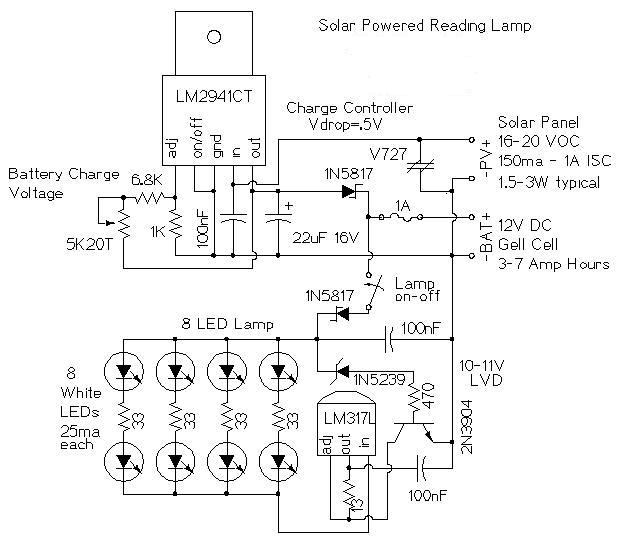
The reading lamp consists of a small solar panel, a standard UPS style lead
acid battery, and an LED circuit board. The circuit board contains a low power
solar charge controller (regulator), a set of 8 white LEDs, a switch, an LED
current regulator, and a low voltage disconnect circuit. The circuitry will
insure a long battery life by preventing over charging and excessive discharging.
The circuit should also work with a string of 10 NiCd cells. Both the charge
controller and LED regulator circuits can be used independently for other
applications. The other part of the circuit, i.e. a solar engine can be accessed
by a switch. The motor is switched on after the capacitor is reasonably charged
to trigger the IC
Specifications
Solar charging current: 150 ma - 1 Amp
Voltage drop through charge controller: 0.5V typical
Nominal battery voltage: 12 Volts
Battery rating: 3-7 amp hours
LED lamp current: 100ma regulated, 25ma per LED pair (1.2W nominal)
LED regulation range: constant light level from 11V to >15V
Low voltage disconnect: gradual current drop from 10.8V to 9.8V
Night time battery current drain with LED off: almost zero
Light duration: approximately 70 hours with a 7AH battery
Charge time: approximately 40 hours max, several hours typical
Theory
Charge Controller:
The charge controller section consists of an LM2941CT low dropout voltage
regulator and a 1N5817 schottky diode. The regulator determines the battery
full voltage, this set-point is adjusted by the 5K 20 turn trimmer potentiometer.
The 1N5817 schottky diode prevents the battery from discharging through the
voltage regulator during the night. It also protects the circuitry against
reverse battery connection. The V727 part is a transzorb, it absorbs lightning
induced voltage spikes above 27V. The fuse prevents short circuits from burning
up the battery wiring.
LED Circuitry:
The 8 white LEDs are connected in series with an LM317L IC that is wired as
a constant current regulator. The 13 ohm resistor sets the regulated current
to 100ma. This current is split evenly through the four pairs of LEDs. The
33 ohm resistors help to keep the current through the four LED pairs balanced
evenly. The 2N3904 transistor, 1N5239 zener diode, and 470 ohm resistor form
the Low Voltage Disconnect (LVD) circuit. Current through the LED starts to
drop when the battery voltage drops below 10.8V, the circuit shuts off almost
all of the current when the battery drops below 10V. The 1N5817 schottky diode
blocks current flow in the event of a reverse battery connection.
Construction
The lamp consists of a small wood battery box and a vertical board for holding
the LED assembly and solar panel. A small carrying handle protrudes from the
top of the vertical board. The LED assembly consists of a small printed circuit
board and the various parts. It is sandwiched between a piece of hard-board
and a piece of clear plexiglass to protect the circuitry from physical damage
and short-circuiting. The battery used for this device can be a string of
5-10 NiCd rechargeable batteries or a standard 12V-7 Amp-hour gell cell UPS
battery. The solar panel is home-made, two or three parallel-wired GM-684
12V 60ma solar panels.
Use
Daytime: Place the solar panel in a location that gets at least a few hours
of direct sunlight each day. Turn the LED switch off. If the battery is extremely
discharged, it may take several days in the sun to fully recharge.
Night: Use the lamp as you would use any other reading lamp.If the lamp starts to dim, the battery is almost completely empty,shut the light off. If you forget to shut off the lamp, the LVD circuit will shut the lamp off when the battery is nearly empty. If the lamp is recharged daily, the battery should rarely reach the Low Voltage Disconnect (LVD) point
Use the switch provided to switch between the lamp and motor.
Project By:
" Srinath G Iyer
" Akshay Kakar
" Pratik Maheshwari
HOME