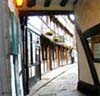
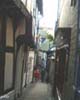
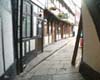
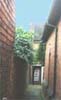
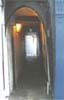
The passages and shuts in Shrewsbury provide the pedestrian with the opportunity to take many short cuts. There is the aura of times past in many of these narrow alleyways which have stood the test of time. Although the word "Shut" implies a cul-de-sac, this is not so, the word may have derived from the Shutte family who once owned a dwellling in Drayton's Passage. Miss Georgina Jackson writing in "The Shropshire Word Book" published in 1879, suggests that such passageway enables a pedestrian to "shoot" or move quickly from one street to another.
Gullet Passage
The Gullet Inn (now the Hole in the Wall hostelry) may have given it's
name to Gullet Passage. During the Middle Ages a stream ran down Gullet Passage
from the Square (originally a boggy pool) to Mudholes near Welsh Bridge. The
Middle English word for stream was "Golate" hence the possible alternative
derivation of Gullet Passage.
Grope Lane
In 1324 this passage was recorded as "Grope Counter Lane"; a
narrow dark passage that one had to grope one's way through. Other names given
to the passageway are Le Grope Lane and Gropealone.
Return to top
Barracks Passage
This name is supposed to have derived from the timber framed soldiers
residence sited herin. It was also known as Elisha's Shut after the family
of Samuel Elisha, the mayor of Shrewsbury in 1725, whose house was in the
passageway. On the wall in front of the Wyle Cop entrance to the passage is
a plaque which reads:
"Ye ancient house in
which King Henry 7th
lodged when he went to Bosworth Field
Aug. 1485."
Drayton's Passage
Originally called Eddowes's Shut as it led to Eddowes Printers until the
works closed in 1750, when the name changed to Drayton's Passage. During 20th
century restoration, the lower floor of a 14th century building was discovered.
The passage is alleged to have continued to the Square, going under a house
with an application to the owner Alderman Hughes for the passage to go through
his wine cellars.
Return to top