vincent van gogh
Next Page
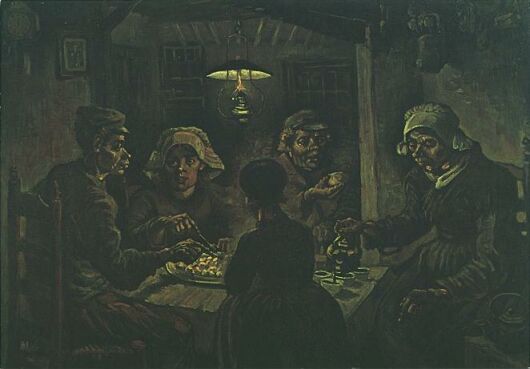
Early Works: Van Gogh's early drawings and paintings tend to centre on the lives of peasants and poor labourers, as well as on the bleak landscapes in which they find themselves. This is not to say that these works are bleak themselves or offer no signs of hope. Not at all. While Van Gogh's early use of darker colours may suggest a melancholy atmosphere (as can be interpretted in The Potato Eaters), Vincent himself had a great admiration for the field workers and weavers he captured on canvas.
The Potato Eaters, 1885
Home
Next Page
Home
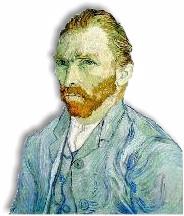
Vincent van Gogh (1853 to 1890)

Vincent van Gogh was born in Groot Zundert, The Netherlands on 30 March 1853. Van Gogh's birth came one year to the day after his mother gave birth to a first, stillborn child--also named Vincent. There has been much speculation about Vincent van Gogh suffering later psychological trauma as a result of being a "replacement child" and having a deceased brother with the same name and same birth date. This theory remains unsubstantiated, however, and there is no actual historical evidence to support it.
In 1869, he got a position at the art dealers, Goupil and Co. in The Hague, through his uncle, and worked with them until he was dismissed from the London office in 1873. He worked as a schoolmaster in England (1876), before training for the ministry at Amsterdam University (1877). After he failed to get a post in the Church, he went to live as an independent missionary among the Borinage miners. He was largely self-taught as an artist, although he received help from his cousin, Mauve. His first works were heavily painted, mud-colored and clumsy attempts to represent the life of the poor, influenced by Millet (one of his artistic heroes). He moved to Paris in 1886, living with his devoted brother, Theo, who as a dealer introduced him to artists like Gauguin, Pissarro, Seurat and Toulouse-Lautrec. In Paris, he discovered color as well as the divisionist ideas which helped to create the distinctive dashed brushstrokes of his later work. He moved to Arles, in the south of France, in 1888, hoping to establish an artists' colony there, and was immediately struck by the hot reds and yellows of the Mediterranean, which he increasingly used symbolically to represent his own moods. He was joined briefly by Gauguin in October 1888, and managed in some works to combine his own ideas with the latter's Synthetism, but the visit was not a success. A final argument led to the infamous episode in which Van Gogh mutilated his ear. In 1889, he became a voluntary patient at the St. Remy asylum, where he continued to paint, often making copies of artists he admired. His palette softened to mauves and pinks, but his brushwork was increasingly agitated, the dashes constructed into swirling, twisted shapes, often seen as symbolic of his mental state. He moved to Auvers, to be closer to Theo in 1890 - his last 70 days spent in a hectic program of painting. He died, having sold only one work, following a botched suicide attempt. His life is detailed in a series of letters to his brother (published 1959).
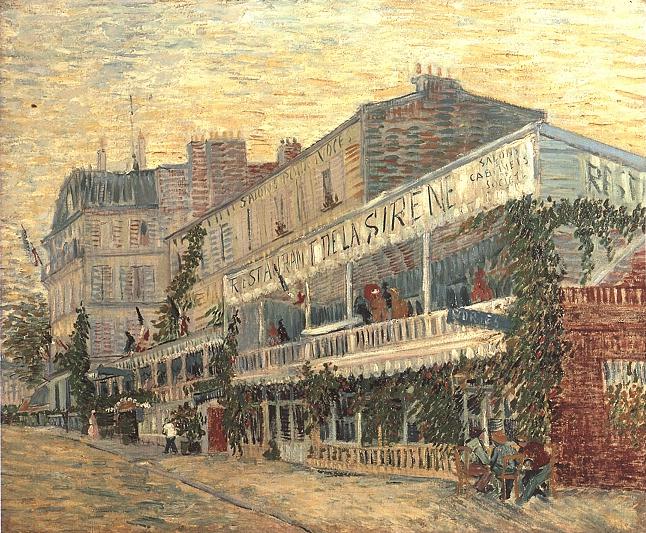
Vincent's move to Paris in 1886 brought about a profound change in his approach to art. A number of Van Gogh's works at the time are not only noticably more adventurous in their use of colour, but also adopt a pointillist approach. In just a short period, we see Van Gogh's style move from the dark to the vibrant; from the worker bent over a loom to a pair of lovers strolling through a park.
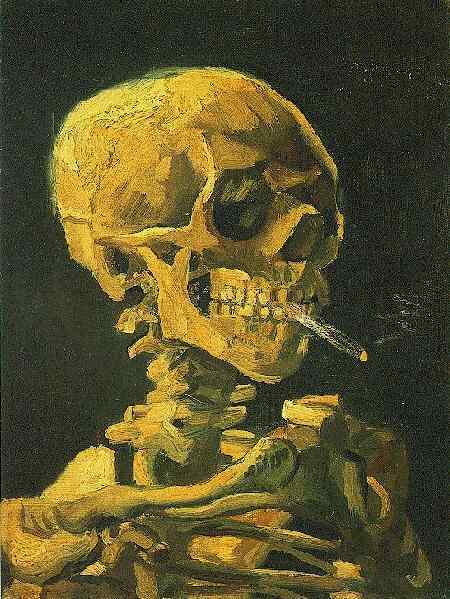
One of Van Gogh's most macabre works, this is probably the most distinguished of his paintings from the Antwerp period. It's likely that the work was painted from a skeleton in an anatomy class while Vincent was studying art. The work - a stark momento mori - was produced in a time when Van Gogh's health was poor (due to stomach ailments and rotting teeth) and may reflect Vincent's own concerns about his state of well-being.
Restaurant de la Sir�ne at Asni�res, 1887
Skull with Burning Cigarette, 1885/86
Hosted by www.Geocities.ws

1