 |
| m. c. escher |
 |
| aurits Cornelis Escher was born on June 17, 1898 in Leeuwarden, Netherlands. At a young age, Escher was encouraged by his father to learn carpentry and other craft skills. Though he was not a very good student in general, his artistic talent was apparent early in his schooling and he was encouraged by his family and friends to pursue this interest in a regular career, namely architecture. However, once at the School for Architecture and Decorative Arts, Escher realised that his true passion lay in the graphic arts. He spent the next two years at art school, where he mastered graphic and woodcutting techniques. Upon completion of his schooling, he traveled extensively through Southern France, Spain and Italy. Escher was fascinated by the art of structure throughout his career as an artist, and although his early work tended toward realistic portrayals of the landscape and architecture observed during his travels, it reflected a greater fascination for structural constructs than for the landscape itself. Escher visited the Alhambra in Granada several times, as he was |
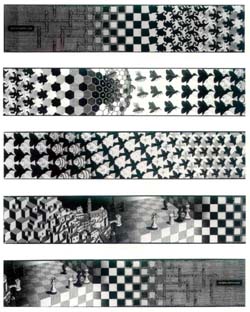
| Metamorphose II, 1938-40 |
 |
|
|
 |
| M |
| captivated by the Moorish ornamentations that filled the entire space on the walls. The inspiration there lay the foundation for his work after 1937, for which he is most famous. These works involve repeated patterns and regular divisions of the plane, impossible constructions, and infinite space. His work from then until his death in 1972 was driven by a unique understanding of mathematical concepts. |
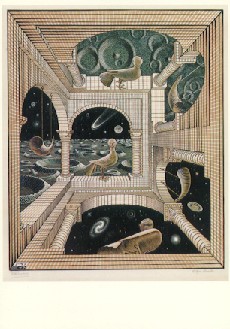 |
| The interior of a cube-shaped building has openings in the five visible walls, giving views of three different landscapes. Though the topmost pair one looks down, almost vertically, onto the ground; the middle two are at eye-level and show horizon, while through the bottom pair one looks straight up to the stars. Each plane of the building, which unites nadir, horizon and zenith, has a threefold function. For instance, the rear plane in the centre serves as a wall in relation to the horizon, a floor in connection with the view through the top opening and a ceiling so far as the view towards the starry sky is concerned. |
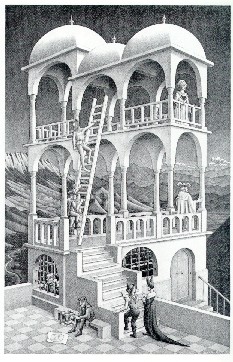 |
| In the lower left foreground there lies a piece of paper on which the edges of a cube are drawn. Two small circles mark the places where edges cross each other. Which edge comes at the front and which at the back? In a three- dimensional world simultaneous front and back is an impossibility and so cannot be illustrated. Yet it is quite possible to draw an object which displays a different reality when looked at from above and from below. The lad sitting on the bench has got just such a cube-like absurdity in his hands. He gazes thoughtfully at this incomprehensible object and seems oblivious to the fact that the belvedere behind him has been built in the same impossible style. On the floor of the lower platform, that is to say indoors, stands a ladder which two people are busy climbing. But as soon as they arrive a floor higher they are back in the open air and have to re-enter the building. |
| Another World II, 1947 |
| Belvedere, 1958 |
 |
|