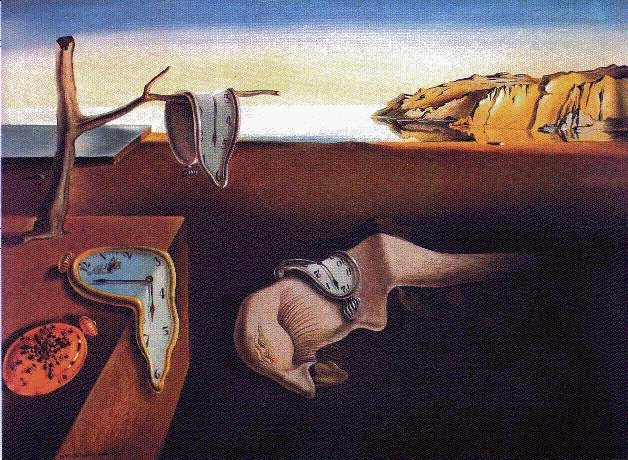
Many of Dal�'s paintings were influenced and inspired by the landscapes of his youth. Several in particular were painted on the slopes of Mount Pani, which was covered in beautiful umbrella pines at the time. Many of the strange and foreboding shadows in the foreground of many Dal� paintings is a direct reference to and result of Dal�'s love of this mountain near his home. Even long after he had grown up, Dal� continued to paint details of the landscape of Catalonia into his works, as evidenced by such works as The Persistence of Memory, completed in 1931.
Note the craggy rocks of Cape Creus in the background to the right. One of Dal�'s most memorable Surrealist works, indeed the one with which he is most often associated is The Persistence of Memory. It shows a typical Dal�nian landscape, with the rocks of his beloved Cape Creus jutting up in the background. In the foreground, a sort of amorphous self portrait of Dal� seems to melt. Three Separate Melting Watch images even out the foreground of the work. The melting watches are one symbol that is commonly associated with Salvador Dal�'s Surrealism. They are literally meant to show the irrelevance of time.
When Dal� was alone with Gala and his paintings in Cape Creus, he felt that time had little, perhaps no significance for him. His days were spent eating, painting, making love, and anything else he wanted to do. The warm, summery days seemed to fly by without any real indication of having passed.
One hot August afternoon, in 1931, as Dal� sat at his work bench nibbling at his lunch, he came upon one of his most stunning paranoiac-critical hallucinations. Upon taking a pencil, and sliding it under a bit of Camembert cheese, which had become softer and runnier than usual in the summer heat, Dal� was inspired with the idea for the melting watches. They appear often throughout Dal�'s works, and are the subject of much interest. In short, this particular work, is an important referral back to Dal�'s Catalan Heritage, that was so very important to him. |