| o Limited territory � Certain areas of the house are off limits, such as the kitchen and the bedroom. This establishes physical boundaries. Close doors or use baby gates. Only the elite (humans) will be able to enter. |
| Nothing In Life Is Free |
| This is in no way to replace formal obedience training or professional help from an animal behaviorist. Basic obedience training is the foundation of the dog-human relationship. If your dog has bitten, threatened to bite, or you suspect it may be inclined to bite, then seek professional help immediately. Do not put your dog in a situation that may provoke it to bite. |
| Dogs are social animals by nature. In any pack there are leaders, and there are followers. You and your family are your dog�s pack. If you don�t fill the roll as the leader of this pack, then your dog feels obligated to assume the position. Some dogs are more inclined to be social climbers, and may be more motivated to reach this status. Being alpha has nothing to do with size, so don�t let that Chihuahua fool you into compliance with his desire to rule the roost. Many dominant dogs are great pets- until someone tries to make it do something it doesn�t want to do. A dog that knows its place should not growl or bite at its owner, even during nail trims and other un-pleasantries. Being leader of the pack is not accomplished with violence or force. It involves quiet confidence and being gentle but firm. Body language is important in communicating with dogs. Stand tall. Use a deep, firm voice to give commands, but you should never need to raise your voice to demand respect. This should sound like a command, not a request. |
| Your dog needs to learn it�s a dog, NOT your equal, or worse, your superior. Rules need to be set and followed with consistency. You, and all other family members, are to be treated with the respect deserved of the senior pack members. You are to be the provider and controller of all things good. Many privileges the dog has enjoyed up to now need to be removed until this social order is established and accepted. |
| These restrictions may seem militant and cruel, but if your dog does not understand it�s position in the pack then this can lead to serious consequences. A dog that knows its place, and what is expected of it, is more relaxed and happy to fill its role as a �dog.� When your dog has accepted its subordinate position and follows your rules, then privileges may be returned. You still need to maintain your role as leader and continue with obedience exercises. When pack order is established you and your dog are free to enjoy each other. |
| It is important to avoid any physical or threatening interactions. Wrestling and tug-of-war games should not be played. Should your dog show aggressive behavior towards you, do NOT react with aggressive behavior. You must use your brain to defuse the situation. |
| o Dogs are not to rush through doorways � This may be prevented by turning and facing into a dog, or it may require a leash to prevent this from happening. A �sit-stay� then release command can also be incorporated. o You should not have to walk around your dog. The subordinate member should get out of the way. o Any pushy demands for attention (pawing, nudging, whining, etc) will be ignored - You decide when the dog is deserving of attention. First though, the dog must obey a command. o No leaning or jumping on the alpha members - This is pushy and disrespectful behavior. Try walking into the dog or turning away. Tell the dog to sit, and then calmly pet if it complies. Later, jumping up can be permitted, but by invitation only. o Owner is to initiate all activities (meals, attention, play, going inside/outside) and end periods of play and attention - Make sure to end a play session before your dog gets bored. Do not chase a dog to get something back. Ignore it or offer a trade (a toy or treat) if necessary. o Practice basic obedience exercises 10 minutes a day - Use praise and treat rewards for correct behaviors. Long �down-stays� are very good exercises to establish dominance. The reward for the �down-stay� is the freedom to get up and move around. Obedience training must continue and be incorporated into daily routine. |
| The New Rules: |
| o No free choice feeding- Meals will be provided 2-3 times a day, but only after following a command. After 15-20 minutes, the bowl will be picked up. Dogs should be fed away from other animals in a quiet, stress-free area. |
| o Senior pack members eat first, and begging is not allowed. � Initially the dog should not be in the room. Later a �down-stay� can be used. o Must obey a command before any and all rewards (meals, treats, petting, toy.) - The command will be given only once. There will be no reward for non-compliance. After 10 minutes, or so, it can be tried again. |
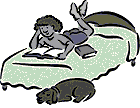
| o Not to be allowed on furniture, especially the bed� This is a power position. Furniture is a desirable place to be and physically puts one up higher. |
 |
 |
 |
 |
 |
| Articles |
| Sandra Wickwire, DVM |
 |