(Click on pictures to enlarge)
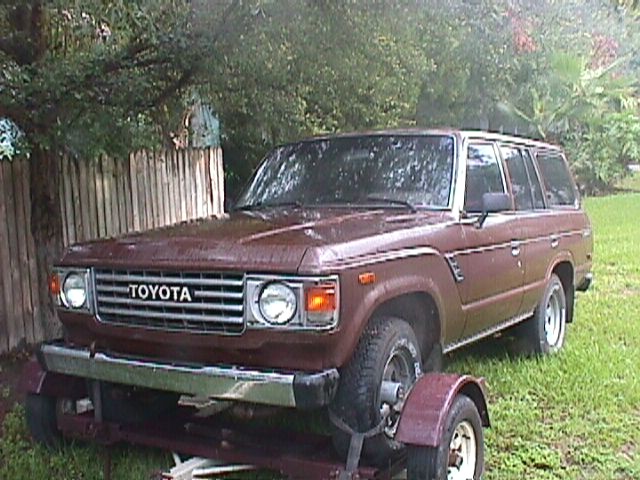
First arrival home
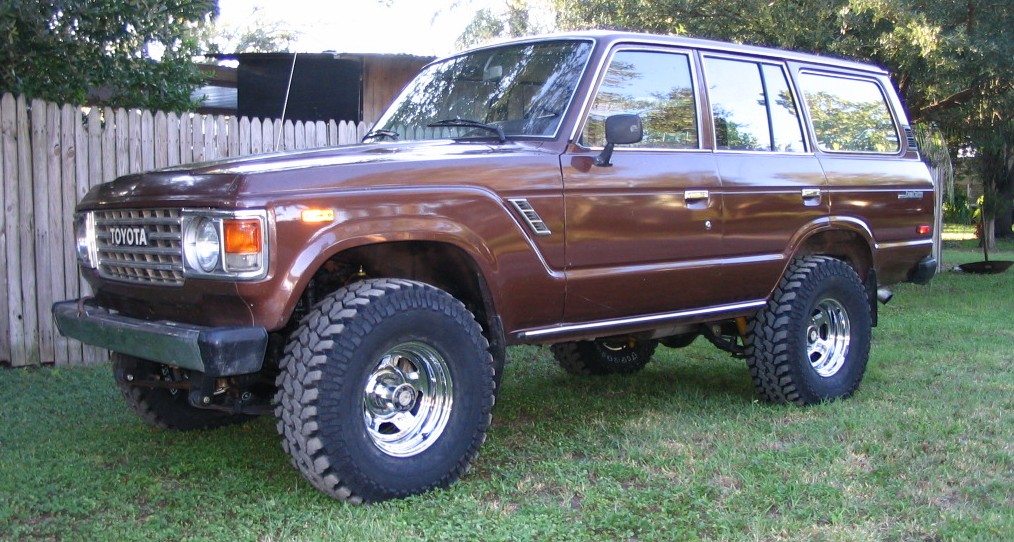
After a good buff job, 3.5" lift, some 33" tires and my home built roof rack.

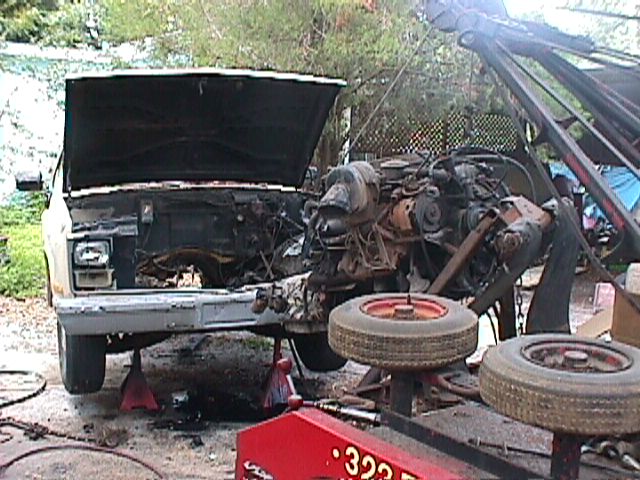
The 6.2 diesel after it was first installed.
Never to be this clean again.
| I've always
wanted an FJ60. To me it has most the rugged aspects of the FJ40, but more
comfortable. It was made before the Land Cruiser became a Mall cruiser.
I finally found one, made the deal and brought it home. A decent family
owned, non abused or modified, original paint, probably never mudded
beauty. A good solid body. A couple very small rust spots, a few dents.
It had sat, and not been started in over a year. Nice enough so I won't
be spending many hours on the body.
I wanted a vehicle that is
economical and practical to drive, one I can take on long trips. FJ60's
are heavy, and in stock form came with a four speed, 3:70 gears and gas
mileage is typically in the 10 to 12 MPG range. All the Land Cruisers I've
been around growing up were diesel. A Land Cruiser just doesn't doesn't
seem like a Land Cruiser to me unless there is a diesel under the hood.
So decided to go diesel and 5 speed.
|
|
First arrival home |
After a good buff job, 3.5" lift, some 33" tires and my home built roof rack. |
The 6.2 diesel after it was first installed. Never to be this clean again. |
| Fuel mileage: It's
currently getting 16 Mpg city driving, and 18.5 highway MPG.
I kind of expected a couple more MPG. I see claims of 23 MPG on up with this combo all over the net. It hasn't achieved what other people are getting or claim to get with their similar diesels. Some diesel owners must exaggerate their MPG's. Power: It has more acceleration than I expected. I don't have to put my foot ibnto the pedal much to accelerate up grades or keep up with traffic. It doesn't accelerate like a gas V8 for passing situations, but feels similar to the 2F. Even though it's horsepower specs are the same as a 2F, but it feels slightly more powerfull. I've driven some 6.2 diesel vehicles that were sluggish, and others that were ok. Mine is fine. Luck of the draw I guess. I can cruise down the interstate 75 MPH without having my foot into the accelerator. Not something you can count on with all light duty diesel engines. I had originally planned on adding a turbo, but now feel I'm ok without it. Noise: The 6.2 is slightly
louder and doesn't have the smooth purr of a Toyota 6 cyl diesel like the
2H or 1HZ.
Driving: First gear doesn't
get used at all. It feels like a granny gear. Engine is turning 2200 RPM
at 65 MPH (speedo not corrected for lager tires). The 5th gear is 27% OD.
I have 3:70 gears with 33" tires, it's geared perfect.
My opinion on these conversions
is: You do it because you like diesels or want something different. Not
because you expect to recoup the cost of a conversion in fuel savings.
I doubt my fuel savings will recoup the $4K plus time & labor I have
invested in this project even if I were to get 25 MPG. At least not
for a long time. Most conversions cost substantially more than $4K.
The engine runs fine on veggie
oil. Can't really tell a difference in power until the filters start to
clog. The first time I flipped the switch, I couldn't believe it was running
on WVO. I had to go go out and pinch off the the diesel fuel line off to
verify it was in fact really running on the WVO. It felt like instant success!
|
| New
Drive Train
Getting the 6.2 diesel engine, NV4500 tranny, AA adapter & transfer case ready (Click on pictures to enlarge) |
`
My new (used) 6.2 gets pulled from donor truck. A good running 1982 County school board utility truck with 101K miles. Bought the truck for $75, what a deal! |

Ok, spent my money here. Bought a brand new NV 4500 5spd tranny and AA adapter to mate it to the stock Toyota transfer case. |

Replaced all seals, gaskets and water pump, and painted the engine. (Chevy orange of course!) |

Ready to drop in! |
| I
made some engine mount supports out of 3/16" steel and welded them to the
frame. Found some rust spots on the radiator support and inner fender wells.
Welded some new metal in, sandblasted the frame & rad support, and
painted. I positioned the engine over to the drivers side like the original
engine was. I did this not so much to keep drive shafts at original
angles, but it makes room on the passenger side for a turbo if I get one
in the future and it kept from cutting the floorboard for the transfer
case shifter. Left exh manifold was close to the steering shaft. I probably
could have left it, but put a half inch steel plate between the steering
box and frame to space it. The right exh manifold's stud hit the firewall,
had to do a minor mod there. Drive shafts had to be shortened/lengthened
3 1/2". If my cruiser had been an 85 or newer, no drive shaft mods would
have been needed at all. Welded a patch over the hole where the original
throttle linkage came through the firewall. Put a square hole the size
of Chevy's throttle cable higher up on the firewall even with the end of
the accelerator arm. The Toyota accelerator arm even had the extended rod
with a cable hookup just like it was made for using with a cabled throttle
system.
Caution:Frame rails will bend way easier than you think when heat from welding is applied. Go easy! I've learned this from vehicles previously worked on. The front of the frame rails will move up from the weight of the vehicle. If you have the vehicle supported by jack stands behind the front axle, the rails will bend down. Temporarily bolt in your radiator support while doing any welding and weld a little bit at a time to keep the heat down! I knew this before I started and thought I was careful and still got a 1/3" movement on one of the frame rails. Next time I will bolt in my radiator support before doing any welding. |

I preferred to keep the truck brown so I wouldn't have to paint door jambs. My wife wanted a Champaign color. Too girlie for me. So went with a lighter different brown. It will also keep my friends from putting toilet paper globs on it. Or putting on TuRD stickers on it. |

I cut the back part off an old Toyota booster that had had the studs and used it as a mounting plate for GM Hydro Boost. Clutch cyl is a Wilwood 3/4 bore unit. Skinner valves are for anti theft. Without 12v applied all wheels are locked. |

I managed to keep my heater. Just won't have ducting directs heat to the driver & passengers feet directly due to shifter being forward. I live in Florida. Don't use it anyway.The cover will need modifying. |
I
Engine fits. Now in the process of wiring and plumbing |

Transmission cross member out of 1" X 2" rectangular tubing |

Getting close. Just need cooling system and exhaust |
 |

Got some mandrel bends, 2 into 1 collector and made the exhaust system myself. 2.5" primary pipes, 3" tailpipe and Dynomax 3" muffler |
| So much for simplicity.
I ran lots of oil and cooling lines. Not much room in the front to put
a large oil cooler. I'm put a race car heat exchanger type oil cooler between
the frame rail and rocker panel on the drivers side to cool the engine
oil. I also put one at the back of the vehicle to heat the veggie oil I'll
be using for fuel. Hot water goes through a loop of three heat exchangers
I ran 5/8 marine hose for the coolant to get to the heat exchanger in the
back. Hot water is directed there first. Then somewhat cooler, the water
returns to another heat exchanger near the front of the vehicle to cool
the motor oil . Then passes through another smaller Sen-Dur heat exchanger
to heat the veggie oil once again before the inj pump. I scrounged all
the fittings I could from friends that are plumbers or Gas line repairmen,
but still had to buy some. I've spent lots of $$ at the Good Year hydraulic
store on just hoses and fittings. Hope to only do this once so got
marine reinforced water hose and Parker 836 hi temp pushlok hose for oil
lines. It really wouldn't be much more for aeroquip SS oil lines, but they
don't bend as easy and the added pressure against the fittings on the engine
with the vibration can cause the pipe nipples & fittings to eventually
break. It seems like pipe fittings & nipples are made in China now
and I don't trust them. I put ball valves at both ends of my frankenstein
water system, so they can be shut off in event of say leaks or problems
and I can still get down the road.
I'm almost done with the veggie conversion. The stock radiator is pretty big. The 6.2 runs plenty cool with it. Even here in Florida. I modified and repositioned the fan shroud opening to accommodate a GM 7 blade fan and fan clutch assy. I will have to see how it does this summer pulling a trailer. The Chevy's hyd line from the steering pump to Hydro boost worked, but I had to have a high pressure line made to go from the hydro boost to the steering box. . I put a race car oil cooler near the back of the vehicle near the tank. I'm using it as a heat exchanger. It has a tremendous heating capacity. Before I flip the tank switch, I turn on the WVO electric fuel pump , I heat and circulate the veggie oil through all the filters and lines first. I put a solenoid valve just before the tank switch up front between the supply line and return line that allows veggie oil to return to the tank via the return line. That way there isn't any cold pockets of WVO. When I flip the tank switch, the solenoid closes at the same time. I put a temp sensor on the solenoid that connects to gauge in the vehicle that lets me know what the WVO temp is warm enough to switch tanks. It also lets me know the temp at all times. I have a 30 micron Racor filter before the electric fuel pump, then a 10 micron and another 6 micron filter after that under the hood. 1 year review: I would encourage
more than discourage anyone wanting to do this. But there are some obstacles.For
something so simple, it sure can be time consuming. At times it seemed
like it was consuming my life. If your life is filled with activities and
hobbies, one of your other hobbies will have to take a back seat. It's
not hard work, but interesting, fun and rewarding if you don't mind getting
your hands dirty. I now feel most of the hard work is over. Before starting
this project, the WVO conversion route seemed like it would be easier and
less hassle than going the biodiesel route. Now biodiesel doesn't look
quite so bad. It still looks like lots of work too, but less vehicle risks,
and no pulling over for filter change outs. But now with all the time involved
with WVO behind me, it is the course I'll maintain.
|

Race car oil cooler works great for heating veggie oil.They are pricey new, but can be found on Ebay for around a $100 |

A friend gave me this Harvard bypass filter. Extra oil filtering can't hurt. It filters down to one micron. I'm running out of room under the hood for all this stuff. |

Parker Hi temp oil lines and marine coolant hose lines & fittings |

Using a 15 gal stainless tank for now. Will try to come up with an external tank later. Racor 30 micron filter |

2nd heat exchanger is a Sen-Dur marine after a 10 micron and a 2 micron filter |

Pumping & filtering station |
| Not that much to wiring.
Just have to wire up the glow plugs, sender units, alternator,starter and
a 12v wire to the inj pump. That's about it. Not much electrical for an
older diesel. The alternator needed a larger gauge wire for voltage sensing.
The original 16 or 18 gua wire was too thin and source too far away. Alternator
would overcharge to compensate for what it thought was low voltage. A 14
gauge wire cured that.
I'm using a push button momentary switch to heat the glow plugs. I'm using a Ford type starter solenoid for a glow plug relay. I ran the wire that goes from the momentary switch to the relay through a coolant switch that goes open when the engine is hot for people not familiar with glow plugs & diesels that might be driving it. I also wired up the choke light to light when the glow plug button is pushed. The choke light is actually the glow plug lamp on an HJ60. Kind of factory like. I have a GM factory automatic glow plug controller I could have used, but I don't like them. The toyota oil pressure sender screwed right in, but I had to get an adapter to use the Toyota water temp sender. Man-A-Fre sells the adapter for $6. |
Adding a tach pickup so the factory in dash tach works. Click on pic |
| I
was originally very much wanted to find a 12HT or 1HZ Toyota diesel.
Searched for 6 months, but was unable to find any at a price I was willing
to pay. I've had earlier Toyota diesel Land Cruisers in the past, and am
a big fan of them. But Toyota diesels are very expensive and scarce in
the US, especially in the southeast. Diesel Land Cruisers were never sold
new in the US.
I went with a Chevy
6.2. I feel comfortable with that. I've never owned one, but family members
have had them and I've known people that have had them, and I did a short
stint as a mechanic at a GM truck dealership, so I'm familiar with them.
They fall short of expectations for people that think just because it's
a diesel, it should pull 10,000 lb trailers with ease up mountains. They
are a lighter duty diesel and aren't designed for that. Their reputation
lags behind Cummins and powerstroke just because they aren't as powerful
or heavy duty. They don't stand up to competition and extreme extended
demands as other heavier duty diesels. But they are reliable and just fine
in a 1/2 ton or 3/4 ton truck and usually give years of reliable service
used within their limitations. There are heavier duty and more durable
diesels out there, but I think a 6.2 or 6.5 is well suited for a Land Cruiser.
I feel confident of a 250K miles sevice life without major repairs.
After a year and a half since the installation, the only repair needed
had been a new injection pump.
Any reliability issues that
I see are problems with a 6.2 are minor and perifreal and can be overcome.
Make sure the harmonic balancer
is in good shape. The rubber between the inner and outer portion isn't
cracked or warped. The cranks have been known to break if the balancer
is bad. Otherwise the cranks are ok. GM should have used forged cranks
instead of cast ones though.
What year??:
|
 |
 |
 |
 |
 Engine
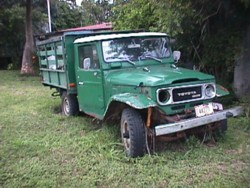
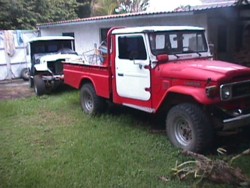
from this 75 pickup Engine
from this 75 pickup |

will go in this BJ73 |