
History
----------------------
Origin
----------------------
Weapons
----------------------
Graduation System
----------------------
The Art
----------------------
SKRN in Japan
----------------------
SKRN in Brazil
----------------------
Representatives
----------------------
Videos
----------------------
Links
----------------------
References
----------------------
Trained in Japan and Brazil, Sho Kumo Ryu Ninjutsu is a Japanese
martial art that involves combat concepts, strategy, corporal knowledge,
spirituality and philosophy. Enclosing all these aspects, this style has
18 specializations that makes the complete development of its practitioner
possible.
|
Created by Yoshiaki Yamato (in memorian), in 1956, based on a regrouping of traditional school of ninjutsu Fujiwara Koga Ryu’s techniques, the traditional Tenshin Shoden Katori Shinto Ryu and Kobudo. It has as its maximum representative Toshiro Yamato, the founder's brother. The essence of Sho Kumo Ryu Ninjutsu is the Shinobi Tai Jutsu, wich literaly means "The furtive man's technique", that is, the Art of the Body, the way of the ninja warrior to fight with his bare hands. Shinobi Taijutsu technique’s secret is the way to involve the opponent as if it was surrounded by a spider web, and then to attack by the flanks and his back, aiming specially the Spine structure and his vital points (kyusho), beyond other sensible points of the body (atemi). |
|
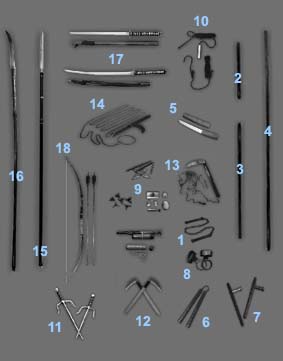
Another aspect worked in a massive way in Sho kumo Ryu are Japanese traditional weapons’ use (Juhakei Bugei) and some other deriving ones of Okinawa's Kobudo. There is an amount of 18 weapons worked, which have an enormous variety of techniques.
[Top]
Sho Kumo Ryu Ninjutsu was born in a mystic way, resulting in experiences of a critic man, such a dreamer as traditionalistic: Yoshiaki Yamato.
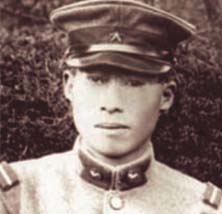
Yoshiaki Yamato Sama (the Great Soshi Founding Master) was born in Nara, Japan, in the year of 1926. Raised on an important family, he learned to unsmask the martial arts' secrets with his uncle, since childhood.
When 22 years old he was graduated in Fujiwara Koga Ryu Ninjutsu and when 25 years old, received his diploma from the old and traditional Bujutsu school of martial art (war techniques) Tenshin Shoden Katori Shinto Ryu - specialized in katana techniques (sword) and naginata (halberd). However, passed 5 years of his graduation, Yamato Sama started to disagree with definitive rules imposed by his clan. The first indications that Yamato Sama's destiny wouldn't follow this way appears. Something was about to happen, but not even him could know this. Thus, in 1956 during a training on the mountains, Yamato sighted what it would be the biggest experience of his life. Ahead on his way, linking two distant trees about 4 meters one of the other, confided in impressive way, an enormous spiderweb, with all certainty, the beggiest one he has ever seen. The gigantic web was product of thousands of tiny spiders' work so that they could feed of much bigger animals than theirselves.
Taken of sudden energy, Yamato Sama fell in position of seiza and, kneel in the place, meditaded for hours until being able to feel the nature's message. He discovered the direction of the existence of the mankind, the doravante objective he would follow until the last days on this world. “We must be as small spiders (sho kumo), that weave its great webs, as for defense, as for feeding. The web will be our defense, our strategy, our way to surpass difficulties. From our enemies we will feed. Thus we will be fortified, on all crossed and conquered difficulties.”
Inhaled in this central idea, and regrouping the original techniques of the Fujiwara Koga Ryu Ninjutsu, Tenshin Shoden Kattori Shinto Ryu and Kobudo, The so called Soshi Yoshiaki Yamato founds in 1956, being 30 years old, the Sho Kumo Ryu Ninjutsu (Small spider's Ninjutsu Style). In the end of the 60th decade, Soshi was to Brazil with intention to approach to his family that inhabited the country. He started to live later in São Paulo and in Brasilia. Yamato Sama exceeded of this life, evolving certainly for superior spheres, when deceased being 65 years old, on April 1991. His leached ashes rests forever on the family's mausoleum in Nara - Nihhon.
[Top]
|
[Top]
|
The graduation system used is the one named Kyu/Dan, in its inincial structure. This, until reaching the black belt first Dan, the pupil passes by 20 kyu - white belt, green belt, blue belt and red belt and, between each belt, more 4 tags colored with the following belt's color - totalizing something around 10 years of trainings. After the first Dan (initial degree of teaching), the system becomes the traditional Menkyo (licenses) - first Dan: Sensei; 2o. to 5o. Dan: Shidoshi. ; 6o. to 9o. Dan: Shihan; 10o. Dan: Menkyo Kaiden.
[Top]
Sho Kumo Ryu Ninjutsu is a BUDO, a traditional martial art that tries to keep alive old Japanease self-defense’s techniques and, different of a martial sport of contact, this is a martial art without competitions. We practice with the main objective of self-defense and complement this physical training with exercises that try to develop the mind and to fortify the spirit. Another important factor is that nowadays ninjutsu is very different of XIII century's ninjutsu. We are not a private society of spies and also we do not manufacture ninja; we are NINJUTSUKA (practitioners of ninjutsu). Our intention, beyond the ones above, is to teach people to be better on their social environment. To be winning, but always with honor. To honors his family, his parents, his master, his technique and all the good things we all belive.
[Top]
Sho Kumo Ryu Ninjutsu in Japan
In Japan the Sho Kumo Ryu Ninjutsu is transmitted inside of Yamato´s family. There, it is a family system, very different from the great Ninjutsu´s institutions existent.
[Top]
Sho Kumo Ryu ninjutsu in Brazil
In Brazil Rodrigo Müller Shidoshi received authorization to be a representative of Sho Kumo Ryu Ninjutsu and to teach the style. Different from Japan he preferred an open system, where he could pass the tradition for a larger number of people.
[Top]
- Maximum representative: Toshiro Yamato Soke;
- Brazilian representative: Rodrigo Müller Shidoshi ([email protected])
[Top]
[Top]
Sho kumo Ryu Ninjutsu in Brazil:
- Official Website in Brasil
- Saiken Dojo (Rodrigo Müller Shidoshi) - Cuiabá/MT - Brazil
- Tengu Dojo (Rogério Lima Shidoshi) - Brasília/DF - Brazil
- Shishi Kutsu Dojo (Rômulo Lima Sensei) - Brasília/DF - Brazil
- Kenshin Dojo (Renan Zerbini Sensei) - Brasília/DF - Brazil
- Renketsu Dojo (Saulo Santos Sensei) - Brasília/DF - Brazil
[Top]
- Ninjutsu - A Arte da Guerra das Sombras by Shidoshi Rodrigo Müller (ISBN 85-87013-42-4)
- Manriki Gusari - A Corrente de Combate by Shidoshi Rodrigo Müller (ISBN 85-87013-48-3)
- Manual Técnico: Sho Kumo Ryu Ninjutsu by Shidoshi Rodrigo Müller
[Top]