|
To explain the spectral line puzzle, Bohr came up with a radical model of the atom which had electrons orbiting around a nucleus.
In order to explain the "signature colors," Bohr came up with an extraordinary rule the electrons had to follow: Electrons can only be in "special" orbits. All other orbits just were not possible.
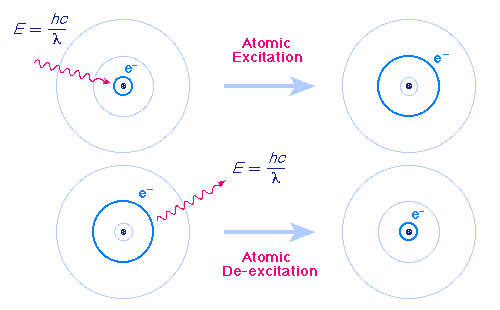
When applied to Bohr's atomic model, the energy of an emitted photon equals the difference between the energies for each accepted electron orbital, where electrons in higher orbitals have greater energies than those in lower orbitals. This explains why atomic spectra of excited gases produce discreet lines - the electrons make transitions between distinct, well-defined energy levels and lose distinct, well-defined amounts of energy during their "jumps."
When does an electron absorb a photon? emit a photon?
Photons are absorbed during excitation when the electron jumps to a higher energy level. Photons of EXACTLY the same energy are then re-emitted when the electron undergoes de-excitation and falls back to its original energy level.
What produces an absorption spectra ?
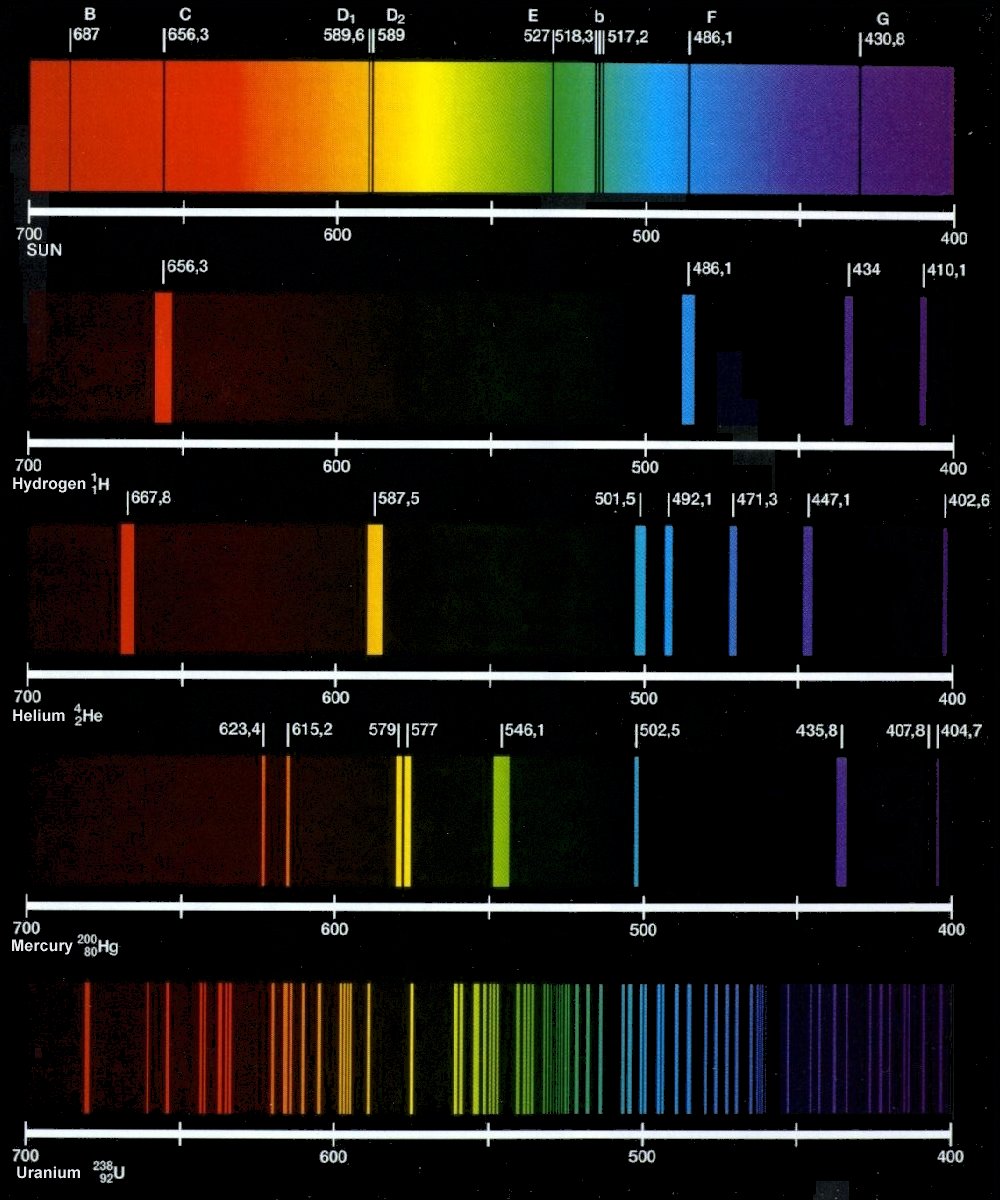
An absorption spectra is formed when the continuous spectra emitted from an incandescent solid passes through a cool gas. The electrons in the gas absorb the exact frequencies that when excited they re-emitted. These vacancies show up as "black lines" in the solid�s spectrum.
When are spectra continuous? When are they discreet line spectra?
Incandescent, high temperature, solids emit continuous spectra since electrons can fall into neighboring atoms during de-excitation and emit all possible frequencies. Excited gases emit discreet spectra which can be used to identify one gas from another since electrons must remain within ONE ATOM when undergoing energy transitions in gases.
As the peak frequency, fo, shifts to the right, from red to green to blue, the temperature of an incandescent solid increases. The left radiation curve would indicate a "red hot" object. The middle curve would represent a "white hot" object. And the last curve, would represent a "blue hot" object. Therefore, a red hot flame is cooler than a blue flame which is why your chemistry teacher always told you to use the "blue" portion of the bunsen burner's flame to heat your test-tubes. Red hot stars are cooler than yellow stars (our sun) which are cooler than blue stars. There are no green stars since equal amounts of longer red wavelengths and shorter blue/violet wavelengths are also emitted, producing the color white, not green.
|
|