
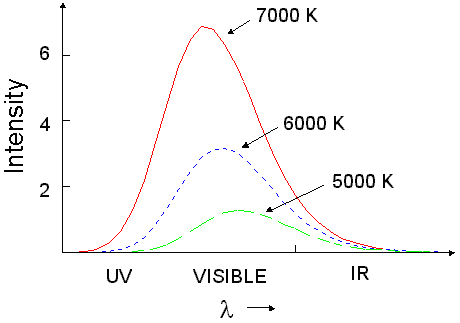
To find out what is the peak of the black body curve we can apply Wien's Law, it says simply that the peak wavelenght is inversely proportional to the temperature; if we use the Kelvin scale of temperature ( see box below) we have:
lpeak= 2..8 cm / T
where T is the temperature of the source.
The Stephan-Boltzmann law tells us that the unit area Energy of a black body ( a perfect emitter-absorber of light) is proportial to the fourth power of the temperature
E=s T4
where s is a costant called the Boltzmann constant.As an example if two stars with equal area surface have temperatures T1 and T2 and let's say T1 is 2 times hotter than T2 we have that:,
E1/ E2= s T4 1 / s T4 2 =(T1 / T2)4=24=16
So even if the temperature is just 2 times bigger for the first star, the total Energy is 16 times bigger ! Finally, the total Energy over the entire area of the star will be the energy as given by the equation above time the area of the star. This total Energy is called Luminosity. The area of a sphere is 4 p R2. So if we known the temperature of the star and its luminosity we can estimate the Radius (size ) of the star. To summarize observing carefully the light of a star we can derive such quantities as its distance, velocity, temperature, chemical composition, total energy and size. All from a little dot of light; it is not that amazing !!