
TOURNAMENT OFFICIALS |
||
| Match area measurements and positioning of Referee, Judges, Arbitrator and Contestants. | 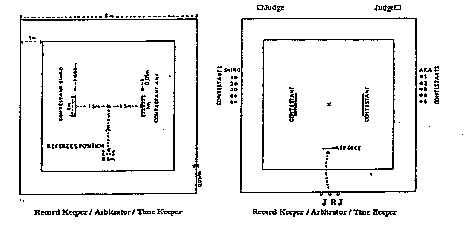 |
Pre and post match line up positions for Arbitrator, Referee, Judges and Contestants. |
| [] | KACHI | WINNER | JK | JOGAI KEIKOKU |
| � | IPPON | IPPON | K | KEIKOKU |
| O | WAZAARI | WAZA ARI | HC | HANSOKU CHUI |
| s | HIKIWAKE | DRAW | MC | MUBUBI CHUI |
| X | MAKE | DEFEAT | H | HANSOKU |
| J | JOGAI | EXIT | S | SHIKKAKU |
EXPLANATION :
There must be no advertisement hoardings, walls, pillars etc. within one metre of area's outer perimeter.
The mats used should be non-slip where they contact the floor proper but have a low coefficient of friction on the upper surface. They should not be as thick as judo mats, since these impede Karate movement. The Referee must ensure that mat modules do not move apart during the competition, since gaps cause injuries and constitute a hazard.
Contestants and their coaches must wear the official uniform as herein .defined.
The Referee Council may debar any official or competitor who does not comply with this regulation.
REFEREES
CONTESTANTS
(b) Notwithstanding paragraph 1a. above, the Directing Committee may authorize the display of special labels or trademarks, of approved sponsors.
COACHES
EXPLANATION:
The contestant must wear a single belt. This will be Aka if he is the red fighter and white if Shiro. Belts of grade should not be worn during the bout.
White protective mitts with not more than one centimeter of padding and an uncovered thumb must be worn. The padding must not be capable of displacement.
Mitts must be approved by the Homologation Commission
Gum shields must be properly fitted by a dentist. Groin protectors using a removable plastic cup slipped into a jockstrap will not be permitted and persons found hearing them will be penalized.
There may well be a religious basis for the wearing of certain items such as turbans. Persons wishing, by virtue of their religion, to wear what would otherwise be construed as unauthorized clothing must notify the Referee Council in advance of a tournament. The Referee Council will examine each application on it's merit. No accommodation will be made for people who just turn up on the day and expect to participate.
!f a fighter comes into the area inappropriately dressed, he or she will not be immediately disqualified; instead the fighter will be given a minute to remedy matters.
If the Referee Council agrees, Refereeing Officials may be allowed to remove their blazers.
EXPLANATION:
A "round" is a discrete stage in a competition leading to the eventual identification of finalists. In an elimination Kumite competition, a round eliminates fifty, percent of contestants within it, counting byes as contestants. In this context, the round can apply equally to a stage in either primary elimination or repechage. In a matrix, or 'round robin' competition, a round allows all contestants in a pool to fight once.
The use of contestants' names causes problems of pronunciation and identification. Tournament numbers must be allotted and used.
When lining up before a match, a team will present the actual fighters. The unused fighter(s) and the Coach will not be included and shall sit in an area set aside for them.
The fighting order form can be presented by the Coach, or a nominated contestant from the ream. If the coach hands in the form he/she must be clearly identifiable as such, otherwise it may be rejected. The list must include the name of the country/club, the belt color allotted to the team for that match and the order of the ,fighters from one to five. Both the fighters names and their tournament numbers must be included and the form signed b the coach, or nominated person.
If through an error in charting, the wrong contestants compete, then regardless of the outcome, that bout/match is declared null and void. To reduce such errors the winner of each bout/match must confirm victory with the control table before leaving the area.
EXPLANATION:
At the start of a Kumite match the Referee stands on the outside edge of the official match area. On his left and right stand the judges.
After the formal exchange of bows by contestants and Referee Panel, the Referee takes a step back, the Judges turn inwards and all bow together.
Changing the Referee Panel. The departing Officials take one step forward turn around and face the incoming Panel. They bow to each other on the command of the incoming Referee and in one line (facing in the same direction) leave the competition area.
When individual Judges change, the incoming Judge goes to the outgoing Judge, they bow together and change positions.
EXPLANATION:
The time-keeper shall give signals by a clearly audible gong, or buzzer indicating seconds to go" or "time-up". The "time-up" signal marks the end of the bout.
ARTICLE 6: SCORING
EXPLANATION:
A score of three Ippons achieved either directly or cumulatively determines the bout. Therefore if Aka has already scored five Waza-Aris and goes on to score a further Ippon, his maximum score will not exceed the three Ippon ceiling. This very basic rule is sometimes overlooked when scoring a team event that has tied on bout victories.
Though two Waza-Aris equal one Ippon in scoring value, in technical terms, a Waza-Aris equal to 90% of an Ippon.
A technique with "good form' is said to have characteristics conferring probable effectiveness within the framework of traditional Karate concepts. Correct attitude is a component of good form and refers to a non-malicious attitude of great concentration obvious during delivery of the scoring technique. Vigorous application definer the power and speed of the technique and the palpable will for it to succeed; nothing is held back. Zanshin is that criterion most often mused when a score is assessed. It is the state of continued commitment which endures after the technique has landed and the ability to continue with proper form, other continuing techniques. The contestant with Zanshin maintains total concentration and awareness of the opponent's potentiality to counter-attack.
Proper timing means delivering a technique when it will have the greatest potential effect. Proper distancing similarly means delivering a technique at the precise distance where it will have the greatest potential effect. Thus if the technique is delivered on an opponent who is rapidly moving away, the potential effect of that blow is reduced
Distancing also relates to the point at which the completed technique comes to rest on or near the target. To score, the technique must have the potential to penetrate deep into the target, so straight arm punches are seen as having a low potential in this respect and must be evaluated accordingly. For example, a punch which comes somewhere between skin touch and 2-3 centimeters from the face and where the punching arm is not fully straight has the correct distance. However Jodan punches which comes within a reasonable distance of the target and which the opponent makes no attempt to block or avoid will be scored provided the technique meets the other criteria.
A worthless technique is a worthless technique - regardless of where and how it is delivered. Thus a Jodan kick which is badly deficient in good form will score nothing, much less an Ippon. However, in order to encourage technically difficult techniques, the Referee should lean toward awarding Ippon for them, even if there is a slight deficiency in good form; as long as it is only slight. As a simple rule-of thumb, techniques which would normally merit a Waza-Ari are scored as Ippon if they are scheduled as
"technically difficult ". Deflecting an attack and delivering a good technique to any unguarded target area of the opponent's body can be scored as Ippon - not just attacks to his/her unguarded back.
A sweeping technique need not require the contestant to fall to the floor; to merit Ippon, it is sufficient if he/she is merely unbalanced as a scoring technique is delivered. Referees must not be too quick in halting a bout. Many potentially successful sweep and strikes have been defeated by the Referee calling "Yamei" too early. Two seconds should elapse after a sweep or throw for it is during this time that the committed and coordinated attacker will have demonstrated his/her follow-through.
Combination attacks are those sequences of techniques which each individually merit at least Waza-Ari, occurring in rapid succession.
Techniques which land below the belt may score, as long as they are above the pubic bone. The neck is a target area and so is the throat. However, no contact whatsoever to the throat is permitted but a score may be awarded for a properly controlled technique.
A technique delivered with good form and which lands upon the shoulder blades may score. The nonscoring pan of the shoulder is the junction of the upper bone of the arm with the shoulder blades and collar bones.
The time-up bell signals the end of scoring possibilities in that bout, even though the Referee may inadvertently not halt the bout immediately. The time up bell does not, however, mean that penalties cannot be imposed. Penalties can be imposed by the Refereeing Panel up to the point where the contestants leave that area after the bout's conclusion. Penalties can be imposed after that, but then only by the Referee Council.
True Aiuchis are rare. Not only must two techniques land simultaneously but both must be valid scoring techniques - each with good form etc. Two techniques may well land simultaneously, but seldom are both - if indeed either - effective scores. The Referee must not dismiss as Aiuchi, a situation where only one of the simultaneous pair is actually a score. This is not Aiuchi.
ARTICLE 7: CRITERIA FOR DECISION
EXPLANATION:
When scores are unequal, the contestant who completes the bout satisfactorily a Waza-Ari or Ippon ahead of the opponent shall be given the victory.
Taking the above criteria into account, when a superiority can be established, it is quite in order for one contestant to be given the victory, even when the score situation is equal.
When deciding the outcome of a bout by Hantei, the Referee shall step outside of the ring and call "Hantei " followed by a two-tone blast on his whistle. The Judges will indicate their opinions by means of their flags, the Referee should acknowledge the Judges decision by a one-tone blast of his whistle, then move forward to his original position and announce the majority decision.
The Encho-Sen is an extension of a bout; it is not a separate bout. Penalties awarded in the bout proper will therefore carry over into the Encho-Sen. There must be a decision after an Encho-Sen, taking performance in the whole bout into consideration.
Where a team match has tied bout victories and points, an additional bout is then fought between selectees. The selectees must be nominated within one minute of the announcement of this bout and the persons making the nomination will be those who signed the original fighting order form for that match. If the extra bout ties, an Encho-Sen will be fought and as in common with all Encho-Sens, a decision must be reached at its conclusion.
ARTICLE 8: PROHIBITED BEHAVIOR
The following are forbidden:
EXPLANATION:
Any contact to the throat must be penalized unless it is the recipients own fault (MUBUBI etc.).
Techniques to the face may 'touch " and still score, but touch does not mean a solid impact. When assessing the contact force used, the Referee must take all the circumstances into account. Did the victim exacerbate the impact of an otherwise controlled technique by an injudicious movement? This is the reason most often give for scoring what would otherwise appear to be excessive contact but it must not be used as a justification for a bad assessment. The Referee must consider the effects of a marked disparity in size between contestants - as can occur in a team match, or in open weight bout.
The Referee must constantly observe the injured contestant. The latter's behavior may help the Referee in his assessment. A short delay in giving a judgment allows injury symptoms such as a nosebleed to develop. Observation will also reveal any efforts by the contestant to aggravate slight injury for tactical advantage. Examples of this arc blowing violently through on injured nose, or rubbing the face roughly with the back of a mitt. Pre-existing Injury can produce symptoms out of all proportion to the degree of contact used.
The trained Karate-Ka can absorb strong impact over muscled areas such as the abdomen, but the breastbone and ribs are vulnerable to Injury. For this reason. reasonable control over body contact must be exercised
The accidental kick in the groin can reduce the opponent's potential for winning as surely as a deliberate one. Therefore the Referee should award a penalty in either case. Foot sweeps that land high on the leg can cause knee injury. The Referee must assess the validity of any sweep-attack to the leg; ineffectual but painful attacks of this son should be immediately penalized,
The face is defined as covering an area which begins one centimeter above the eyebrows, extending down and including the temples, narrowing from the cheekbones and finishing just under the chin.
The two open hand techniques referred to are merely examples of the class of prohibited techniques.
Different Karate-Ka have different abilities at controlling techniques and for this reason, there is no actual classification of "dangerous techniques ". The contestant must perform all techniques with control and good form. If he/she cannot, then regardless of the technique misused, a warning or penalty must be imposed.
The point at which "Yamei " is called is helpful in determining if Jogai has occurred. If Aka delivers a successful technique and then exits immediately afterwards, "Yamei " should occur at the instant of score and the exit therefore occurs outside of bout time and may not be penalized. If Aka's attempt to score is unsuccessful, "Yamei " will no be called and the exit will be recorded. If Shiro exits just after Aka scores with a successful attack, then "Yamei" will occur immediately on the score and Shiro's exit will not be recorded. If Shiro exits, or has exited as Aka's score is made (with Aka remaining remaining the area). then both Aka's score will be awarded and Shiro's Jogai penalty will be imposed.
Movements which waste time include pointless circling, where one or both contestants do not engage in combat. It is expected that they will initially test each other but within a short time, deliberate and effective attacks and counters should occur. If for any reason this does not happen after a reasonable interval, the Referee must stop the bout and caution the offender(s). The contestant who constantly retreats without effective counter, rather than allow the opponent an opportunity to score must be penalized. This often occurs during the closing seconds of a bout.
An example of Mubobi is the instance in which the contestant launches a committed attack without regard for personal safety. Some contestants throw themselves into a long reverse punch, and are unable to block a counter. Such open attacks constitute an act of Mubobi and cannot score. For the contestants own safety, he/she must be warned at an early stage.
As a tactical theatrical move, some fighters turn away immediately in a mock display of dominance to demonstrate a scored point. They drop their guard and lapse awareness of the opponent. The purpose of the turn-away is to draw the Referee's attention to their technique. This is a clear act of Mubobi. In order to score, Zanshin must be preserved.
Feigning of an injury which does not exist is a serious infraction of the rules. Exaggerating an injury which does exist is less serious. Shikkaku can be imposed on the contestant feigning injury i.e., when such things as collapse and rolling about on the floor are not supported by evidence of commensurate injury as reported by a neutral doctor. A warning or penalty can be imposed for exaggerating injury.
The Coach will be assigned a specific place by the Referee Council in conjunction with the tournament organizing officials. This area will be close to the competition area and the Coach allowed a free and uninterrupted access to contestants between bouts. To assist the contestants, a visible scoreboard must be employed. Which can be clearly viewed by Coach and contestants.
ARTICLE 9: PENALTIES
The following scale of penalties shall operate:
ATENAI YONI: May be imposed for attended minor infractions or for the first instance of a minor infraction.
KEIKOKU: This is a penalty in which WAZA-ARI is added to the opponent's score. KEIKOKU is imposed for minor infractions for which a warning has previously been given in that bout, or for infractions not sufficiently serious to merit HANSOKU-CHUI.
HANSOKU-CHUI: This is a penalty in which IPPON is added to the opponent's score. HANSOKU-CHUI is usually imposed for infractions for which a KEIKOKU has previously been given in that bout.
HANSOKU: This is imposed following a very serious infraction. It results in the opponent's score being raised to SANBON. HANSOKU is also invoked when the number of HANSOKU-CHUIS and KEIKOKUS imposed raise the opponent's score to SANBON.
SHIKKAKU: This is a disqualification from the actual tournament, competition, or match. The opponent's score is raised to SANBON. In order to define the limit of SHIKKAKU, the Referee Council must be consulted. SHIKKAKU may be invoked. When a contestant commits an act which harms the prestige and honor of Karate-do and when other actions are considered to violate the rules of the tournament.
EXPLANATION:
A penalty can be directly imposed for a rules infraction brut once given, repeats of that particular infraction must be accompanied by an increase in severity of penalty imposed It is not, for example, possible to give a Keikoku for excessive contact then give a warning for a second instance of excessive contact.
Penalties do not cross-accumulate. This is to say that a warning for the first instance of Mubobi will not be followed by an automatic Keikoku for the first instance of Jogai. The general penalties imposed are those of Keikoku, Hansoku-Chui, Hansoku and Shikkaku. The infraction should be indicated by prefacing the Hansoku-Chui or Keikoku with an explanation such as 'Jogai (or Mubobi) Hansoku-Chui/Keikoku'.
When the penalties incurred in any one bout through various infractions total Sanbon, then the offender will be declared the loser end the winner announced as "Aka/Shiro no Kachi'.
Warnings are given where there has clearly been a minor infraction of the rules, but the contestant's potential for winning is not diminished (in the opinion of the Referee Panel) by the opponent's foul.
A Keikoku may be imposed directly, without first giving a warning. Keikoku is normally imposed where the contestant's potential for winning is slightly diminished (in the opinion of the Referee Panel) by the opponent's foul.
A Hansoku-Chui may be imposed directly, or following a warning or Keikoku and is used where the contestant's potential for winning has been seriously reduced by the opponent's foul.
A Hansoku is imposed for cumulative penalties but can also be imposed directly for serious rules infractions. it is used when, in the opinion of the Referee Panel for the bout, the contestant's potential to win has been reduced virtually to zero by the opponent's foul.
A Shikkaku can be directly imposed without warnings of any kind. The contestant need have done nothing to merit it - it is sufficient if the Coach or non-combatant members of the contestants' delegation behave in such a way as to harm the prestige and honor of Karate-Do.
If the Referee believe that a contestant has acted maliciously, regardless of whether or not actual physical injury has been caused, Shikkaku and not Hansoku is the correct penalty.
A public announcement of Shikkaku must be made.
EXPLANATION:
Self inflicted injury and those injuries caused by the athlete are easy to deal with but when assessing an injury caused by the opponent's technique, the Panel must consider whether the technique was valid. Was it properly, applied to the proper area or the correct time and with the correct degree of control? Consideration of this wil1 assist the Referee Panel in deciding whether the injured contestant should be declared the loser by Kiken, or whether the opponent should be penalized for a foul.
When the doctor declares the contestant unfit, the appropriate entry must be made on the contestant's monitoring card. The extent of unfitness must be made clear to other Refereeing Panels. A contestant may win through disqualification of the opponent for accumulated minor infractions. Perhaps the winner has sustained no significant injury. A second win on the same grounds must lead to the winner's withdrawal, though he may be physically able to continue.
The doctor is obliged to make safety recommendations only as they relate to the proper medical management of that particular injured contestant.
When applying the "Ten Second Rule " the time will be kept by a timekeeper appointed for this specific purpose. A warning bell will be sounded at seven seconds followed by the final bell at ten seconds.
The Referee Panel wil1 decide on KIKEN, HANSOKU or SHIKKAKU, as the case may be.
In order that the credibility of the sport be maintained, competitors who feign injury will be subject to the strongest penalties, up to, and including, suspension for life for repeated offenses.
Competitors who receive SHIKKAKU for feigning injury, will be taken from the competition area and put directly into the hands of the W.K.F. Medical Commission, who will carry out an immediate examination of the competitor. The Medical Commission will submit its report before the end of the Championship, for the consideration of the Referee Council.
EXPLANATION:
The protest must give the names of the contestants, the Referee Panel officiating and the precise details of what is being protested. No general claims about overall standards will be accepted as a legitimate protest. The burden of proving the validity of the protest lies with the complainant.
In case of an administrative malfunction during a match in progress, the Coach can notify the Match Area Controller directly. In turn the Area Controller will notify the Referee.
The protest will be reviewed by the Referee Council and as part of this review, the Council will study the evidence submitted in support of the protest. The Council will also study official videos and question Match Area Controllers in an effort to objectively examine the protest's validity.
If the protest is held by the Referee Council to be valid, the appropriate action will be taken. In addition, al! such measures will be taken to avoid a recurrence in future competitions. The deposit paid will be refunded by the Treasury.
If the protest is held by the Referee Council to be invalid, it will be rejected and the deposit forfeited to WKF.
A. The Referee Council's powers and duties shall be as follows :
B. The Match Area Controllers powers and duties shall be as follows:
C. The Referee's powers shall be as follows :
D. The Judge(s) ("FUKUSHIN") powers shall be as follows:
E. The Arbitrator will supervise the Time-Keepers and Score-Keepers. Records kept of the match shall become official record subject to the approval of the Arbitrator (Kansa).
EXPLANATION:
When explaining the basis for a judgment after the march, the Referee may speak to the Match Area Controller or the Referee Council. The Referee will explain to no-one else.
The good Referee will not halt the smooth flow of the bout unless it is necessary to do so. All halts with no outcome, such as "Yamei - Torimasen" must be avoided.
The Referee need not halt a bout when the Judges signal, if convinced the signals are Incorrect. The Referee's judgment in this instance is made "on the move ". Before over-ruling the Judges signal, the Referee must consider whether the Judges were better sighted. Judges will signal only by flag gesture, they will not use whistles.
When, however, the match has been halted and the Judges have a different opinion to that of the Referee. then the majority decision will prevail.
The Judges must only score what they actually see. If they are not sure that a technique actually reached a scoring area they should signal "Mienai".
EXPLANATION:
When beginning a bout, the Referee the contestants to their starting lines. If a contestant enters the area prematurely, he/she must be motioned off. The contestants must bow properly to each other - a quick nod is both discourteous and insufficient. The Referee can call for a bow where none is volunteered by motioning with his forearms as shown in Appendix 2 of the rules.
When halting a bout, the Referee does not merely call "Yamei', he/she also makes the appropriate signal. The Referee must first identify the scoring opponent ( "Aka' or 'Shiro"), then the scoring area attacked (Chudan, Jodan'). This is followed by the general classification of scoring technique used ('Tsuki', 'Uchi' or "Keri ") and finally the score awarded ("Waza-Ari' or 'Ippon').
When re-starting the bout, the Referee should check that both contestants are on their
lines and properly composed. Contestants jumping up and down or otherwise fidgeting must
be stilled before combat can recommence. The Referee must re-start the bout with the
minimum of delay.
ARTICLE 14: MODIFICATIONS
Only the WKF Referee Council and Technical Committee with the approval
of the Directing Committee can alter or modify these rules.
******************