|
Scientific Approach to the Yin-Yang Geometry by Sergey Yu.
Shishkov (RUSSIA, [email protected])
Here is given (below) the most generalized definition of the
astroid-like hypocycloid as the trajecory of a point P of a
rotating with angular velocity "omega1"=1 circle of radius
"radius1"=a, with centre of which also being rotating around the
origin by the circle of radius "radius2"=1-a , and angular
velocity "omega2"=-3, so that"radius1" +"radius2"=1, and
"omega2"/"omega1" =-3. Then for coordinates X[t], Y[t] of this
point P we have: X[t]=(a)*cos(t)+(1-a)*cos(3*t);
Y[t]=(a)*sin(t)-(1-a)*sin(3*t);
1-X[t]^2-Y[t]^2=factor(simplify(expand(1-((a)*cos(t)+(1-a)*cos(3
*t))^2-((a)*sin(t)-(1-a)*sin(3*t))^2)))=16*a*cos(t)^2*(cos(t)-1)
*(cos(t)+1)*(-1+a)=16*a*cos(t)^2*(cos(t)^2-1)*(-1+a)=16*a*cos(t)
^2*(sin(t)^2)*(1-a)=FULL SQUARE!=>
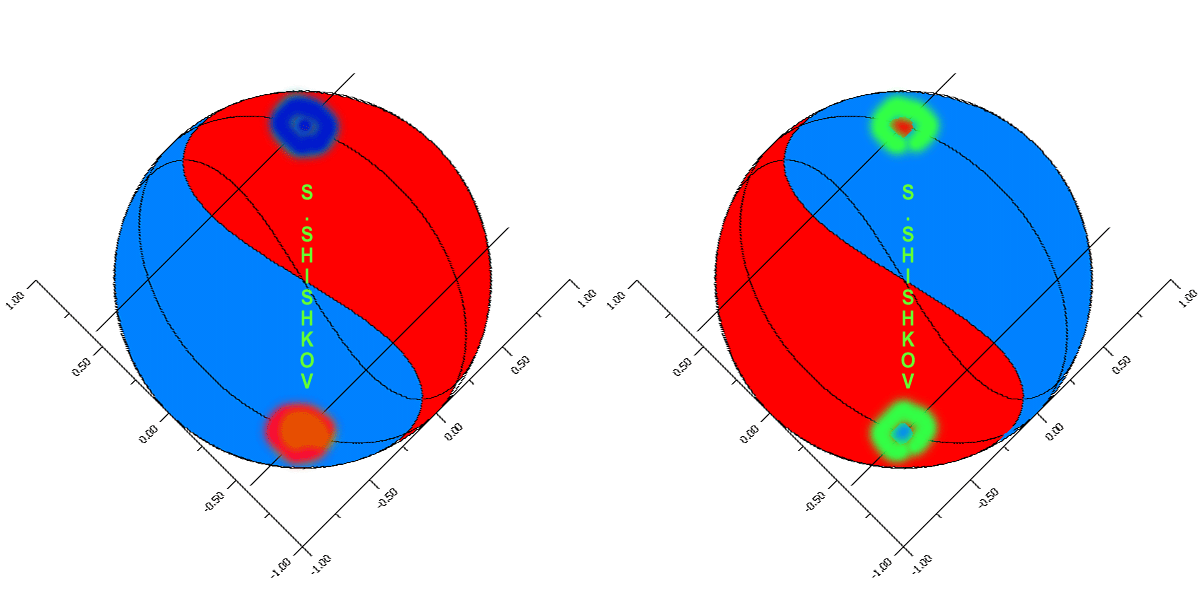
If Z[t]=4*cos(t)*sin(t)*(a*(1-a))^(1/2), then
X[t]^2+Y[t]^2+z[t]^2=1 ;(i.e., For every time t {X[t],Y[t],Z[t]} is on the unit SPHERE!!!).
With different values of the parameter a we obtain the
whole class of astroid-like hypocycloids with FOUR PARTS. Below
is given the Maple 5.4 Text programm for plotting of these
trajectories.;
> a=0.6339;plot([(a)*cos(t)+(1-a)*cos(3*t),(a)*sin(t)-(1-a)*sin(3*t)
,t=0..2*Pi]);
plot([(a)*cos(t)+(1-a)*cos(3*t),4*cos(t)*sin(t)*(a*(1-a))^(1/2),
t=0..2*Pi]);
plot([(a)*sin(t)-(1-a)*sin(3*t),4*cos(t)*sin(t)*(a*(1-a))^(1/2),
t=0..2*Pi]);
Look also in Maple 5:
> factor(simplify(expand(1-((b)*cos(t)+(1-b)*cos(3*t))^2-((b)*sin(
t)-(1-b)*sin(3*t))^2)));
> The Optimal Value for the parametr a is a=(1/2)*(3-3^(1/2))=0.6339, as will be
shown elsewher;-). It corresponds to the most "BEAUTIFUL" 3D-hypo-astroid. Such a configuration may serve also as the Yin-Yang
MAGNETIC TRAP for adiabatic freezing of Bose condensate in modern Atomic Beam Lasers and for hot plazma in thermonuclear fusion systems. However, this is beyond the scope of this site.
Let us call this unique value of the parameter a as "THE YIN-YANG PLATINUM SECTION", analogous to the famous "GOLDEN SECTION GS" (i.e.,GS=1/2*5^(1/2)-1/2=0.6180339887), suggested by Leonardo da Vinci!
>
[>a:=0.6339;plot([(a)*cos(t)+(1-a)*cos(3*t),(a)*sin(t)-(1-a)*sin
(3*t),t=0..2*Pi]);
plot([(a)*cos(t)+(1-a)*cos(3*t),4*cos(t)*sin(t)*(a*(1-a))^(1/2),
t=0..2*Pi]);
plot([(a)*sin(t)-(1-a)*sin(3*t),4*cos(t)*sin(t)*(a*(1-a))^(1/2),
t=0..2*Pi]);
|
 View Page Stats






 ����������� ������������� ������� "����� �����". ������ ���� ���� ���������, �����������, �������, �������...