Embraced by the Light
Betty J. Eadie, December 1992
- read in Grade 9 or 10, borrowed from library (Chinese translation version)
- didn't really want to read it; didn't look attractive and thinking that it was just one of those made-up story solely for the purpose of deluding those "strong religious believers" with the $money$, but read it anyway because I was quite free and bored and nothing else interest me from the Chinese shelf in the library at that time, so I borrowed this one to kill time.
- about a women (the author) who experienced near-death experience
- award-winning book/ best-seller (but didn't realised until year 2001)
- a very touching book, esp. with the really warm and comforting "imagry" of God described by the author
- absolutely glad that I read it, almost cried towards the ending, loved God more than ever ever since (disregarding the truthfulness of the story of course)
A Brief History of Time: From the Big Bang to Black Holes
Stephen W. Hawking, March 1988
- read during a time in high school (forgot which grade)
- read it because a lot of space-related books I had read recalled this book/ referenced this book
- gave up after reading the first few chapters, due to my stupidity or more elegantly, my lack of "solid background" in physics and mathematics and 4-D imagination. >.<
- Funny though, a few years ago, in an article I read in the newspaper, I realized that I was not the only one who hadn't finished the book. =p Many people had read it because it was very popular. For a space-science fans, saying that you've never heard of the book or haven't read the book would be quite odd and should probably be embarrassed; Saying that you've read the book before in front of the general public can at least give them the impression that you're really quite intellectual, given that something is kept out of the discussion. That something, for most people I dare say, is the percentage completion of the book, not to mention the comprehension part.
The Bible Code
Michael Drosnin, March 1998
- read in 1999-2000
- fasinating book about the claim that there were encoded secret messages in the Hebrew Bible, which foretold major events of the past 3000 years and prophesied what lies in the future
- "Drosnin resists the terms "prediction" and "prophecy" for his discoveries, saying, "I don't think the code makes predictions. I think it reveals probabilities."... which set it apart from vague prophecies like those of Nostradamus ... "I am not saying that The Bible Code is a crystal ball. You can not say 'Bible, please tell me the future' and find out anything. You have to know what you are looking for to find anything at all."" D. Trull, Enigma Editor, http://www.parascope.com/articles/0697/bibcode.htm
- hey, isn't this "physical" world ruled by probability?
- it was also a best-seller (knew it after reading, again =p)
- A bone-chilling and spine-tingling book. (hehe...as if I'm describing a horror book)
- I believed in the existence of Bible Code only if given that the statistical proofs (including the analytical method), Hebrew translation and the other references or what the author called proofs were true and not of his own make-ups. Well, that I would never know. However, I think I'll read the "Who Wrote the Bible Code" before making any further comments. There seems to have a lot of disagreements in the publics and some actually have scientific proofs. The author of the "Who Wrote the Bible Code", Ingermanson, is a theoretical physicist with a Ph.D. from the University of California at Berkeley, who can read Hebrew and has published scientific articles and reports in quantum field theory, superstring theory and plasma physics. He claimed to have statistically disproved the Bible code.
- no matter true or not, it was still a well written book (may just think of it as a science fiction if one wished)
Conversations With God: An Uncommon Dialogue, Book 1
Neale Donald Walsch, October 1996
http://www.kulshreshtha.org/cwg_contents_front.htm
Got the whole book typed online....can't believe it!!!
Conversations With God: An Uncommon Dialogue, Book 2
Neale Donald Walsch, April 1997
Conversations With God: An Uncommon Dialogue, Book 3
Neale Donald Walsch, October 1998
- read this during my 1st work-term at university because I was bored during lunch time, found this book in a bookstore.
- then I realised that there were also book 2 and 3, so I read those as well.
- very popular, best-sellers, and again, knew that when I finished book 1.
- this book was about the author who claimed that he had conversations with God and those conversations he had were written down in the book
- well, personally, it really didn't matter if he actually communicated with God or not. Who knew? (and that included himself) but what interested me about this book were the ideas he had given me.
- lots of interesting "ideas or proposal" about what God is, purposes of life, why we are here, even the topic about alien lives and the discussed The Ten Commandments were discussed. All of which he said that God had told him.
- basically, it tried to answer questions which I had asked myself so many times before and which the answers, I already had some ideas of . The ideas were more like philosophy due to my limited science (esp. physics) knowledge. The answers were of my own creations, which of course were affected by my experiences and knowledge, and they are still being constantly modified.
- I agreed with some of "His/his" ideas and disagreed some others.
- some parts were boring, repetitive and lengthy, so I did skip some pages.
- book I was the least boring one; I completed the others just to get all the ideas out of them.
- I guessed it was because of the way the titles sounded, whenever I recommend these books to my friends, not only did they not sound interested, they also got that "I would never read these kind of books." look in them. Oh well... sounded too spiritual? Hoax-like? Restricted by your own religion? Even if the author is just making everything up, I still like his ideas. Yes....to some people, I am quite misled and evil.. e..eka....kahhaaa..haha.ha ~ >_< hehe.hehehe..
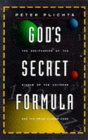
God's Secret Formula: Deciphering the Riddle of the Universe and
the Prime Number Code
Peter Plichta, April 1997
- recommended by a friend in university, read it just before 2nd work-term
- proofs and ideas started to get difficult and hard to understand in the midway of the book and yes, probably due to my lack of science background again.... >.<
- however, my friend who recommended me this book don't think so, and of course, he's very smart
- well, since I didn't understand the proofs and some of the ideas, I gave up after finishing 2/3 of the book
- but the beginning is very cool
- Do I believe his claims about the relation between prime numbers and this universe? Probably not ... mainly because it was written in 1997, might not be a best-seller, never heard of any controversies about his claims and haven't heard of any scientist or mathematician testing the validity of his ideas so far. Yes, I know something like this might take a really long time to prove if possible at all, but I still don't think all of his ideas are true.
- a world which is govern by purely Prime Number Code or mathematics seem "illogical" and cruel to me (I think of myself as an extremely illogical person when compared to almost all of my friends, and that's my real personallity =p But of course, I always try really hard to be logical during exams. Hehe...I can't believe I passed the programming course @_@)
- extremely cool book to read if you can understand all his proofs and ideas.
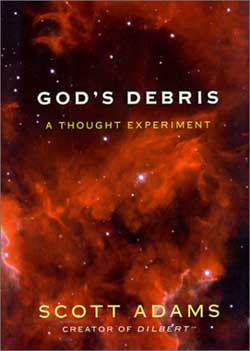
God's Debris: A Thought Experiment
Scott Adams, September 2001
- read during my 2nd work-term, bored at lunch time again
- nice little book that attracted me in a bookstore
- nice title and cover
- materials are easy to understand, large font, talks about what God is, why we are here, etc.
- very interesting philosophic ideas which some of them I had already believed, and some others which I didn't reject the possibility after reading
- to some people, provide a whole new way to look at the world
- doesn't require any mathematic or science background (although it would be best if you at least know what the big bang is)
- absolutely loved the whole book except the ending, which I absolutely hated and which seemed to have destroyed the beauty of the book as a whole. I think that the author, realized that he couldn't end the story logically after he had spilled out all his ideas, had decided to give the book a peculiar fantasy-like ending just to get it over with and publish it. So one can absolutely ignore the ending because it makes no senses at all.