
| Home | Who We Are | Activities | Sensei Unno | Links | Contact Us |
 LAY TEACHERS PROGRAM
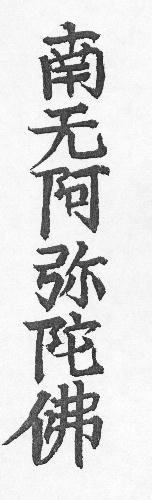
We will begin the 2nd year of our Lay Teachers Program beginning January 11, 2004. Anyone NEW who wishes to join the program as a first year student is welcome to join. It is well worth the effort to deepen one's appreciation of everyday living and its meaning filtered through the Dharma. It is a process of awakening to reality, here and now, and the stirrings of gratitude from deep within regardless of what "I" perceive as the experience. The words, Namu Amida Butsu, are no longer dualistic in understanding, but are the expressions of life itself as a gift calling/embracing me within this unrepeatable moment of living. This appreciation comes naturally as one listens to the Dharma and reflects, introspects, shares, and lives cherishing all that is interconnected as a part of all life. |
 Important Notes Important Notes |
 2004 LAY TEACHERS PROGRAM (LTP) SCHEDULE
Note: the 2003 assignments are still available in case you need to reference them. We shall begin the LTP for the New Year by discussing the book, The Coffinman, by Shinmon Aoki, at our January 11 and February 15 meetings, Room 234, Wright Hall, Smith College, from 2:00 - 5:00 p.m. The readings will be supplemented by selected passages from The Collected Works of Shinran. You should obtain a copy of The Coffinman (discount price, $15.00) and peruse it before our January 11 meeting. Copies are available at the Unnos. Please contact us if you need a copy. JANUARY 11 2:00-5:00 p.m. Since we had to cancel the December 14 meeting because of the snowstorm, we will review the questions posed for Ty's article, "The Practice of Jodo Shinshu." We will begin discussing The Coffinman and also see a videotape of the author's lecture given in California. Please write your response (a paragraph or two) to anything that strikes you as important in Chapter I of the book--it can be a word, a concept, a passage, or an inspirational idea. Due JANUARY 5. FEBRUARY 15, 2:00-5:00 p.m. POSTPONED, new date = March 21 MARCH 21, 2:00-5:00 p.m. We will take up Chapters II and III of The Coffinman for discussion. Please read the supplementary material by Shinran from The Collected Works, including his poems, exposition on the Name of Amida, and Chapter I of his major work, known as "Kyo-gyo-shin-sho" (KGSS). Please turn in a short response for these chapters. Due MARCH 15. APRIL 18, 2:00-5:00 p.m. Read Chapters 1 - 3 in Alfred Bloom's The Promise of Boundless Compassion. Focus on three topics: 1) Page 9, "Radical means going to the root. It also means redirecting insight." 2) Page 16, explain the idea of "mappo." 3) Page 38, two types of deep faith. Please turn in a short response for one of these topics. Due April 18. MAY 9, 2:00-5:00 p.m. Read Chapters 4 - 6 in Alfred Bloom's The Promise of Boundless Compassion. Focus on three topics: 1) Page 57, What does "exclusive practice" mean? 2) Page 61, "Faith is bestowed by Amida's Compassion" 3) Page 90, Explain "principle of selection." Please turn in a short response for one of these topics. Due May 4. June 27, 2:00-5:00 p.m. (this is a new date) Boundless Compassion, Chapters 7 - 9. Respond (one or two paragraphs) to one of the following questions. 1) In religion, "myth" is an ambiguous term and may connote a false story or a true story. The idea of "Pure Land" is a myth in the second sense. Explain. 2) Explain the main point of Shinran's statement in The Truth of Things as They Really Are. (p. 127) 3) Some people believe the goal of religion is happiness, and others that it is the pursuit of truth. (p. 141) What is the relationship between the two goals? 4) "Faith" in Shin Buddhism is not the result of human calculation, but the spontaneous manifestation of awakening. How is this distinction related to "self power" and "other power?" Please turn in responses by JUNE 22. July -- No meeting. August 29, 2:00-5:00 p.m. Boundless Compassion, Chapters 10 - 12. Respond (one or two paragraphs) to one of the following questions. Responses due by August 24, please. Be prepared to discuss ALL of these questions at our gathering. Chapter 10: Shinran's View on Faith and Practice 1) Explain the statement, "Rather (shinjin) is the True Mind of Buddha infused into our minds as trust in his Vow." (page 172) How is such an "infusion" possible? 2) Elaborate on the fact that "Amida's working is not viewed as an external force apart from, or outside, the self, like a god. Rather, the name Amida means infinite, eternal life and light, wisdom and compassion." (page 183) If so, is Amida inside of us? Chapter 11: The Assurance of Final Fulfillment 1) "It is the awareness or conviction that Amida's Vows guarantee that all beings are in principle already saved, even though they are unaware of their true destiny." (page 197) How is this related to our saying the nembutsu? Why do we say Namu-amida-butsu? 2) "In Buddhist tradition.....the last moment of life was a problem rooted in the concept of karma and religious practice. It was against this background Shinran asserted that the moment of faith placed the believer in the company of the truly assured." (pages 208-9) What is the relationship between the problem of karma and the moment of faith? Chapter 12: Faith, Joy, and Gratitude 1) What is the significance of "Joy" in the religious life of a Shin Buddhist? 2) Gratitude is a central teaching in Shin Buddhism, and yet the devout follower like Saichi wrote, "To be grateful, 'tis a lie, 'tis a lie. NamuAmidaButsu." Why did he reject gratitude as a virtue? September, 2004 -- No Meeting. October 3, 2004 Boundless Compassion, Chapters 13 - 15 Writing assignment: Select one of the following and write one or two paragraphs. Prepare responses for both to discuss in class. 1) Why is nembutsu ALONE sufficient when Buddhist schools encourage a variety of practices, especially meditation (pages 253-254)? 2) Select one poem from Chapter 14 and give your appreciation of the main points. November 7, 2004 Boundless Compassion, Chapters 16 - 18 Writing Assignment: Write one or two paragraphs on one of the questions. Prepare to discuss all of them in class. Chapter 14 - Myokonin: Models of Faith Myokonin which means a "person who is like a lotus flower" growing in muddy water is the ideal Shin practitioner. In premodern Japan, they came from the lowest class in society--peasants, merchants, carpenters, etc.--but they were known for their creative spirituality, spontaneity, openness, and frankness. Please select one poem from this chapter and comment upon it. Chapter 15 - The Ultimate End of Faith (1) Compare and contrast the "objective" view of Pure Land and the "religious" view of Pure Land. (2) Bloom writes that "Salvation depends not on human calculation and effort but on the invisible compassion of the Buddha." (p. 298) How are such terms as womb palace, embryonic birth, provisional body, land of sloth and indolence related to human calculation? (3) What is the significance of jinen-honi for the proper understanding of Shinran's thought? (p. 293) Chapter 16 - Shin Buddhism in Modern Society What is the primary challenge facing Shin Buddhists in the contemporary world, especially as it is introduced to the West? December 5, 2004 Boundless Compassion, finish/summary. Review the whole book. Writing Assignment: Write one or two paragraphs on what one thing you found significant within the whole book. Special Note: Ty will get cataract surgery in both eyes in January, 2005. He hopes to regain his vision so that he can read the summaries of the readings by those of you who have continued to send them in. He hopes to return them to you in February. It is not too late to send in your written responses. Ty plans to continue the Lay Teachers Program beginning in March, 2005. Details will be forthcoming. |