|
||||||

|
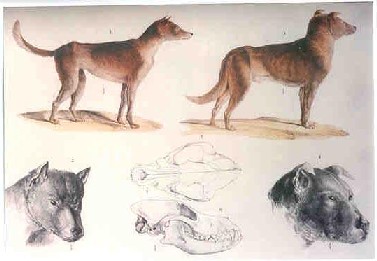
THE JAPANESE NATIVE DOG CIRCA 1829 by Carl Handy In the magazine "Akita World" there was an article about the Japanese dogs and their history. Mention was made of Franz von Seibold and the fact that he had sketched the native dog in the middle 1800's. His drawing was in the western anatomical style instead of the Japanese stylized artistic style. I decided since I live in suburban Washington, D. C. that I would try to find Siebold's drawings in the Library of Congress, or the libraries of the Smithsonian Institution. The Library of Congress could not find their copy. I struck pay dirt in the Smithsonian. I present the following dissertation not as a gospel of what the Japanese dog is today or that it should be used in writing a standard. It is however an interesting part of history and shows the type of native dog which was in Japan close to when the islands were opened to western influence. The Latin Title page of Fauna Japanica roughly translated states: "Japanese Fauna or a description of the animals which W. Fr. De Siebold collected with notes and observations and illustrated with sketches on a journey through Japan, on the orders and under the auspices of superiors who held the highest command in the Dutch East Indian government (Indonesia), undertaken in the years 1823-1830 in conjunction with the studies about vertebrates of C. J. Temminck and H. Schlegel and elaborated with W. De Haan concerning invertebrates. Edited under the auspices of the king "Lugdini of the Bataves (Dutch East India)". He sketched the native plants, Mammals, fish, birds and invertebrates. He also made notes about each species that he sketched. These sketches were deposited in the Netherlands National Museum in Amsterdam. In 1833 Dutch scholars took von Siebolds notes and sketches and published them in folio style in the same manner that John James Audubon's paintings were published in this country. Von Siebold differed from Audubon in that his sketches were compiled into eight volumes of Fauna Japonica, and eight volumes of Flora Japonica. The Japanese press has reprinted these volumes several times. The photograph which accompanies this article is a photostat of the dog plate in Fauna Japonica. the original size of the dogs from bottom of their paw to the withers is 3 inches. The notation is made that the sketch is scaled to one seventh size which makes the dog 21 inches high in life. The head sketches from tip of the ear to tip of the nose are 3 inches. The notation says that the heads are one third size so tip of ear to tip of nose would be 9 inches in life. The narrative which follows is a translation of the scientific French narrative in Fauna Japonica translated by William O'Leary. The photograph is courtesy of the Smithsonian Institution.
The Dogs 1
This family consists of a considerable number of species in the islands that
make up Japan. The people distinguish three races of domestic dogs; the dog
of the hunt, that of the streets, and the completely domesticated dog or that
of the house. I will give a short description of the three races borrowed
from the handwritten notes of Mr. Von Siebold. The dog of the hunt of the Japanese or their Kari-inu, also No-inu (dog of the field), Table X, fig. 1 and 2, is recognizable by his straight ears, his pointed muzzle, his lancelike stance and his vivacity along with his docility; 1 Fauna Japonica W. Fr. de Siebold, C. J. Temminck, and H. Schlegel Published J Mueller and Co. Amsterdam 1833. He is ordinarily covered with short and smooth hair, of a variety of colors, most often red or white, and marked with spots of clear brown or black. Their food along with all the other Japanese races consists of fish, this peculiarity in their manner of living is presumed to owe its origin to the dogs of Siberia who are essentially ichtyophage (fisheaters). The hunter uses this dog to flush the game and pursue it like our pointers. The dog of the street, their Bawa-inu (red dog) also called Kai-inu (coastal dog) see Table X, fig. 4 to 6. In the Japanese villages, where all the streets are closed by gates, each quarter has its dogs which are trained into a privileged family. These animals do not belong to individuals but they belong in common to the residents of the street where they take up their domicile. They are the guardians of their quarter and in defending access they engage in some crude combat with the dogs of the neighboring quarter. The dogs of the quarter devour the guts of the fish, vegetables and all the garbage; they contribute by maintaining cleanliness which renders them doubly useful. Their principal nourishment consists in fish; the dogs of the village eat nothing but fish, seen from the position near rivers of all the villages of the country, and given that the Japanese themselves are fisheaters; the guts of fish serve also as fertilizer in the country. It seems that the dogs of the streets were the bastard product of the dog of the hunt and numerous varieties imported successively into Japan by the people of China, India, and even Europe. The dog of the street is distinguished from that reserved for the (dog of) hunt in that their bones are thicker; their forms are less svelte; he has a heavier head, the muzzle more obtuse and a little turned up; his ears hang; his eyes are small. His tail somewhat curved is very furry; all the hair is longer than that of the dog of the hunt. He is found in every color, and among these varieties are some individuals of a red color, a poi seeming by its nature to that of our pele; these last carry the name of Muku-inu (red dogs). The dogs of the streets are not found to be fully domesticated, adopting independent ways. They often become untameable and go marauding. In this case they go in common (in a pack) for a serious hunt, the villages and the isolated suburbs and devastate the holding pens, they kill the pigs and the goats when they can stop them, and are the scourge of the farmers who hunt them. The completely domesticated dog or the dog of the house, Tsin of the Japanese, was introduced from China. It is from Macao that the first dogs were transported to Japan by the Portuguese. This dog perhaps is considered as the companion of all the homes, it is the faithful companion of the women of the country, and it is the object of the most assiduous care of the fair sex; it is both small and cute and it is esteemed and cherished by the mistress who has it with her, placed gently on a cushion covered with expensive fabric. The Makura dog (dog of the cushion) comes in a miniature size; this race of dwarf dogs are submitted from their birth to a particular treatment by means of which their nostrils are flattened and pushed up. A variety of Tsin is named Suiken tsin, which means dog of the water; its race resembles our lion dog. In China itself as well as Seghalie they raise and fatten dogs to eat them; In Japan the name of Sjok-ken, that is, dog for nourishment reminds us again of a custom similar to that followed by the older ancestors of that nation. When we summarize the history of the races of dogs, we see the dog of the hunt accompanying from north to south the people who hunt and fish and becoming their guest in the villages And cities where according to the times they have taken up their abode. The races is bastardized by the.crossing with races of strange origin. These bastard races are the product of one part of being a mixture of the dog of the cushion, the object of great care of the mistress; the other part the degenerated dog of the street, roaming ceaselessly along the banks of the rivers and the coasts of the sea where they scarcely obtain the necessaries to live. In this way they are poor and miserable. At evening the mendicants of Jedo are accustomed to join the dogs and they go out together in search of scraps for which they dispute in the streets. The Japanese also make mention in their writings of a savage dog which is named oakame (dog of the mountain); it is they say a species intermediate between the dog of the hunt and the wolf of Jamainu. This Oakame according to the Japanese naturalist Onolansan, is a grey brown animal, seen with a long grey tail with white flakes and whose cheeks are equally white. The feet have webbed toes and they swim perfectly and one sees him pursue his prey on water as well as land. The Oakame rarely leaves the high country; when the weather is cold on the mountain chains, he descends to the valleys and then becomes dangerous for the inhabitants of the hamlets. The museum has not obtained the pelt of this species.
|
|||||
|
|
|
|||||