|
|||||||

|
Shiba-Inu as Hunting Dog by Nobi Atsumi
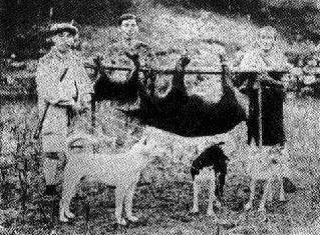
At a shiba party in January this year, I met Mr. Ichihara, a barber by profession and avid hunter during winter hunting season. Mr. Ichihara keeps several breeds of hunting dogs and swears that his shibas are better then German Short Haired Pointers for hunting copper pheasants. The discussion, I had with Mr. Ichihara, was so interesting that I wish to share with you some of his experiences and my thoughts on shiba-inu as hunting dog. It is a known fact that foundation stocks of shiba-inu as exists today are originally brought down from the mountains of Shinshu, San-In, Shikoku and other remote areas of Japan. There are numerous accounts of expeditions by the pioneers of Nippo in search of purest of the indigenous dogs in 1920’s and 1930’s. All such reports indicate that the best and the purest were found among Matagi hunters living in the mountainous regions of Japan. Matagis are professional hunters who make living by hunting bears, wild boars, deer, foxes, raccoons and other wild animals. The Matagis of different regions used different types of hunting dogs and Nippo established several breeds such as Shikokus and Kishus out of these indigenous dogs. In general, medium size dogs were used for hunting large animals while shibas are used mainly for small animals and birds.
Matagis with a Kishu in 1930’s
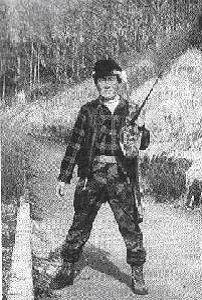
I do not hunt and know very little about hunting but I understand that hunters use different breeds of dog for different topographies and targets. Mr. Ichihara says that shibas are best suited for hunting copper pheasants in mountains. He does not recommend using shibas for flushing pheasants in an open field for safety reason. Shibas are best when used one to one with a hunter and they do not perform as well in a group. In 1994, Mr. Ichihara acquired 50 days old shiba pup. He named this red bitch “Koro”. Koro was not an easy pup to train and he could not call her back very well until she was full one year old. On several occasions he had to leave her in the mountain and retrieve her the next day. Otherwise, she had a very good quality to be an excellent hunting dog, easily maneuvering in and out of bushes and streams. By the time Koro was three years of age, she became a wonderful companion for Mr. Ichihara in the mountains of Tanzawa.
Mr. Ichihara with a catch
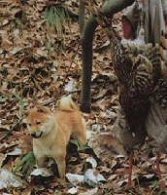
One typical winter day in the mountains of West Tanzawa, Mr. Ichihara let Koro out of the car at about 10 a.m. In ten minutes, they are at the mouth of a gorge leading to a mountain stream. Soon Koro began to take scent, keenly observing left upper side of the stream, quietly squeaking her nose. Mr. Ichihara readies his gun and keeps his eyes on Koro. Koro rushes into thick green bushes, rapidly climbing the mountainside. From a bush 20 to 30 meters ahead a male copper pheasant is flushed and Koro is barking in high-pitched shiba yelp. Koro always let Mr. Ichihara knows that a game is flushed by barking giving him a chance to take a shot even if Koro is not in sight. Koro stays within 30 to 50 meters of Mr. Ichihara and do not go very far letting him walk slowly enjoying the scenery and hunting at leisure. Some times when Koro goes over the ridge chasing a game, Mr. Ichihara would waits for her upstream and soon Koro will return tracing his scent. When she cannot find the scent, she would howl for Mr. Ichihara to call her name. When Koro takes the scent of a copper pheasant, she busily uses her nose and ears. If the pheasant moves even an inch, Koro stops with her ears pointing toward it and tail slightly dawn, dashing immediately towards the game, flushing it for a shooting chance. Because Koro dashes very quickly, the game is often surprised and some times forced to perch at a near by tree making it an easy pray. Mr. Ichihara and Koro reach top of a ridge by about 11 a.m. After a short rest, changing under-shirt and watering Koro, Mr. Ichihara noticed Koro pausing keenly with ears pitched forward and tail down a little, ready to dash toward a falling tree between a Japanese cedar and an oak. Mr. Ichikawa leveled his gun and gave Koro a verbal sign to flush. As soon as Koro flushes, a male copper pheasant fly to his right with a squeaking sound. The pheasant was put down with a single shot.
Shiba with Copper Pheasant
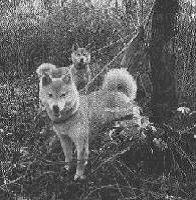
Koro uses her nose and ears very effectively and finds a game without wasteful movements. When she dashes towards a game it is flushed 100 percent of the time. Mr. Ichihara and Koro have learned to be a perfect hunting partner, enjoying a slow hike up the mountain streams, taking things easy, and cherishing a quiet companionship. Mr. Ichihara insists that shibas should be both good hunting dog and good looking. Koro was mated with a Nippo show winner Tengu no Ginryu and another fine hunting dog “Chibi” is produced. Mr. Ichihara is currently using both Koro and Chibi, some times mother and daughter in a pair. It is interesting to note that his friend in Wakayama is using Chibi’s littermate for hunting wild boars with a great success. Mr. Ichihara says that when breeding for both type and hunting instinct, at least dam should be a proven bitch to maintain the hunting instinct of off spring. He believes the advantages of shiba- inu over other breeds are excellent ability to take scent, good hearing, and nimble movement in the bushes of a steep mountain. He also mentioned that not all shibas are good hunting dog and a patient training is required to bring out the innate ability of a chosen few.
Chibi and Koro
I repeated time and again in my earlier articles that shibas are originally a hunting breed and it is important to maintain such qualities when breeding for true type of shibas. The Nippo standard clearly indicates this point and consider it an essential part of shiba-inu standard. Kan-I and Ryousei are significant aspects of hunting qualities. After seventy years of the establishment of Nippo (the Association for Preservation of Japanese Dogs), the original intention of preservation of once endangered breed can be announced as a sounding success. Now, shibas can be found anywhere in Japan and Kennel Clubs around the world recognize the breed. In spite of the amazing increase of shibas in Japan and other parts of the world, I wonder what the pioneers of Nippo would say about the quality of shibas today? I must confess that I have an uneasy feeling and remorse that shibas today are not the shiba-inu the early Nippo members intended to preserve. It is obvious to me that over the years, so-called modern shibas have lost many essential characteristics that make shiba-inu a good hunting dog. The fact that shiba-inu is originally a hunting breed should be clearly understood by all breeders of true shibas. I hope the breeders around the world would pause a little and consider a question, “ Do my shibas have the qualities to be a good hunting dog like their forefathers?” *** *** ***
P.S. Just a few days ago, my Fumi chased a crow into a bush in my yard and killed it right in front of my eyes. Fumi was excited and very happy to hunt down a bird. Perhaps the crow was stupid or did not think a shiba would attack but I was happy to see that Fumi had the instinct and ability to hunt. Fumi is normally a very gentle bitch. I must also mention that my other shiba, Beni, did not show same kind of interest in hunting as Fumi. I would be happy to hear from the readers, your experiences with shiba-inu hunting in the US or Europe. There are several books in Japanese on how to train shibas for hunting and I would be studying further on this interesting aspect of shibas and share the information with you in the future.
|
||||||
|
|
|
||||||