| Sheppard |
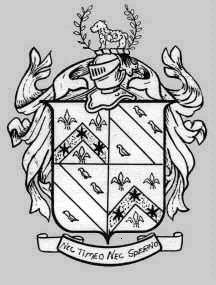
This Sheppard Coat of Arms illustration was drawn by an heraldic artist from information officially recorded in ancient heraldic archives. Documentation for the Sheppard Coat of Arms can be found in Burke's General Armory. Heraldic artist of old developed their own unique language to describe an individual Coat of Arms. In their language, the Arms (shield) is as follows:
| "Ec. :aux 1 et 4 d'azur au chev. d'or. ch. de trois etoiles de sa. |
| et acc. de trois fleur-de-lis d'arg; aux 2 et 3 d'arg. al la bande |
| de sa., acc. de trois tourt. du meme, 2 en chef et one en p." |
| Above the shield and helmet is the Crest which is described as: |
| "One un agneau pass. d'arg., embrasse par deux branches de laurier |
| de sin.; 2 un faucon ess. d'or, grillete de meme, pose sur un tertre |
| de sin." |
When translated the blazon also describes the original colors of the Sheppard Arms and Crest as it appeared centuries ago.
Family mottos are believe to have originated as battle cries in medieval times. "NEC TIMEO NEC SPERNO" was recorded with the Sheppard Coat of Arms. This is translated as "Nor Fear Nor Scorn".
The material above is quoted from research done for James Wesley Shepard by Halberts' of Bath, Ohio, in June 1971.
 |
he distinguished surname Shepard is one of the most notable Anglo/Saxon surnames, and its historical trail has emerged from the mists of time to become an influential surname of the middle ages and of the present day. |
|
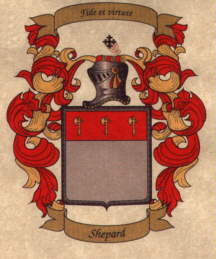
In an in-depth research of such ancient manuscripts as the Domesday Book compiled in 1086 A.D., by Duke William of Normandy, the Ragman rolls (1291-1296) collected by King Edward 1st of England, the Curia Regis Rolls, The Pipe Rolls, the Hearth Rolls, parish registers, baptismals, tax records and other ancient documents, researchers found the first record of the name Shepard in Dorset where they were seated from early times and their first records appeared on the early census rolls taken by the early Kings of Britain to determine the rate of taxation of their subject. Confusing to most, we found many different spellings in the archives researched. Although your name, Shepard, occurred in many manuscripts, from time to time the surname was also spelt Shepherd, Shephard, Sheppeard, Shepperd, and these changes in spelling frequently occurred, even between father and son. There is one record, a father and eight sons. In the graveyard where they are buried, all nine have different spellings of their surnames. Many reasons were revealed for these spelling variations but mainly church officials and scribes spelt the name as it was told to them. The family name Shepard is one of the most notable of the ancient Anglo/Saxon race. This founding race of England, a fair skinned people led by the Saxon General/Commanders Hengist and Horsa, settled in Kent from about the year 400 A.D. The Angles, on the other hand, occupied the eastern coast. The Anglo/Saxon five-century domination of English society was an uncertain time, and the nation divided into five separate kingdoms, a high king being elected as supreme ruler. By 1066, King Harold came to the throne of England which was enjoying reasonable peach and prosperity. However, the Norman invasion from France and their victory at the Battle of Hastings, found many of the vanquished Saxon land owners forfeiting their land to Duke William and his invading nobles. they became oppressed under Norman rule, and some moved northward to the midlands, Lancashire, and Yorkshire, even into Scotland. The family name Shepard emerged as a notable English family name in the county of Dorset where they were recorded as a family of great antiquity seated with manor and estates in that shire. The name was first found in Dorset before the tenth century. In examining the Coat of Arms invariably we find battle axes, and this is not surprising since the name has little or nothing to do with sheep, and the trade of a shepherd. The ancient trade of shepherd were of those who were employed to dig sod around the embattlements of a Saxon village, a means of defense, hence the shepherd's ring, and their tools were battle axes. The name was almost exclusively in the south of England and by the 13th century they had branched to Surrey, Suffolk, Sussex, Keyford House in Frome, Thornton Hollow in Buckingham, Kirbydon in Norfolk, and Derbyshire. Notable amongst the family at this time was Alexander Shepherd of Buckingham. For the next two or three centuries bearers of the surname Shepard flourished and played a significant role in the political development of England. During the 16th, 17th, and 18th centuries England was ravaged by religious and political conflict. Puritanism, Catholicism, royalist and parliamentary forces shed much blood. Many families were freely "encouraged" to migrate to Ireland, or to the "colonies". Some were rewarded with grants of lands, others were banished. In Ireland, settlers became known as the Adventurers seeking land in Ireland. Called "undertakers" they undertook to maintain the Protestant faith. In Ireland they settled in Dublin and county Kildare, and later in counties in Ulster. Meanwhile the New world beckoned and migration continued, some voluntarily from Ireland, but mostly directly from England or Scotland, their home territories. Some clans and families even moved to the European continent. Kinsmen of the family name Shepard were amongst the many who sailed aboard the armada of small sailing ships known as the "White Sails" which plied the stormy Atlantic. These overcrowded ships were pestilence ridden, sometimes 30% to 40% of the passenger list never reaching their destination, their numbers reduced by sickness or the elements. Principal amongst the settlers which could be considered a kinsman of the surname Shepard, or a variable spelling of that family name was Edward Shepard settled in Cambridge Mass. in 1630; Thomas Shepard settled in Boston in 1635, with Samuel, Margaret, John; Humphrey Shephard settled in Boston in 1635; Hester Shepheard settled in New England in 1660; Cathy Shepherd arrived in New York in 1822; Mathew, John, and Hannah Shepherd all settled in Barbados in 1660; Ould Sheppard settled in Virginia in 1623 with his son; Ralph Sheppard settled in New England with his wife, Thanks, and daughter Sarah in 1635; John Shepperd settled in Virginia in 1638; Robert Sheppeard settled in Virginia in 1624. The trek from the port of entry was also arduous and many joined the wagon trains to the prairies or the west coast. During the American War of Independence, many loyalists made their way north to Canada about 1790, and became known as the United Empire Loyalists. 20th century notables of this surname, Shepard, include many distinguished persons, Lord Shepherd of Spalding; Alan Shepard, Astronaut; John Shepherd, Physiologist; David Sheppard, Cricketer; Norman Sheppard, Scientist; Richard Sheppard, Architect. Research has determined the above Coat of Arms to be the most ancient recorded for the family surname Shepard. |