 |
|
|
|
|
|
|
|
|
|
|
|
|
|
|
|
|
|
|
|
|
|
|
|
|
|
|
|
|
|
|
|
|
|
|
|
|
|
|
|
|
|
|
|
|
|
|
Type M |
|
|
|
... for music |
|
|
|
Edited by Sheldon Robertson |
|
|
Vol. 1. No. 1 (Inaugral Issue) May 2007 |
|
|
|
|
|
|
Intro |
|
|
|
Why We Write |
|
|
|
Just what the Internet needs, another music news website, right? So why should you, the busy music fan stop to read the articles here over say, those in Rolling Stone and Q? Well, thankfully the music biz is big enough for all of us, so you can think of this as my humble attempt to shed some light on a few remote corners of the galaxy that the Imperial forces don't usually getto. So while I won't limit this site to coverage of Florida bands, I also won't waste a lot of bytes on stories being covered to death elsewhere -- unless I feel like it, of course, since I am master of my own domain, after all... |
|
|
|
Type M wasn't my first choice for a name -- this being the Internet, all the good addresses are taken -- but in retrospect it seems like the right one. Just as Type A personalities tends towards perfectionism, and Type T personalities are thrill-seekers, Type M is my self-coined label to describe my innate need to be involved in music on multiple levels. In other words, music is in my blood, and lately my my work in the service of other editors has done little to satisfy my cravings. So hopefully I can do a good enough job in my self-appointed new role to make you want to come back and check out future editions of this site. And since Time Magazine just named You 2006 Person of the Year for making the Web into a group effort, I look forward to getting your feedback on the articles you read here. Even if we disagree on matters of taste, I believe we can start with a mutual love of music and take things from there. So in the immortal words of Ric Ocasek, "let's go"... |
|
|
|
May, 2007 |
|
|
|
Lake Worth, Florida |
|
|
|
Review |
|
|
|
34 Degrees, 32 minutes |
|
|
|
Friction Farm |
|
|
|
 |
|
|
|
[ Full Disclosure: In the acknowledgement section of this CD, I'm thanked for my "many four-syllable words." This is a reference to my being asked by group lyricist Christine Stay for feedback while completing the lyrics for the song "Great Big Pie." None of my four-syllable suggestions for that song were actually used.] |
|
|
|
|
|
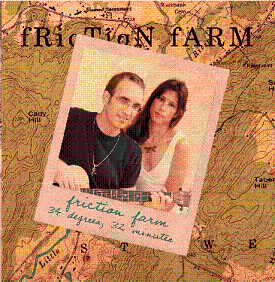
The title of the latest release from this acoustic-rock duo is composed of both geographic and temporal references: 34 degrees North, the approximate latitude of the group's new home in Alpharetta, Georgia; 32 minutes, the approximate running time of this nine-song album.Guitarist Aidan Quinn and lead-vocalist/bassist Christine Stay are veterans of the South Florida original music scene, and actually recorded this album at the Acoustic Music Productions studio in West Palm Beach just prior to leaving town. |
|
|
|
|
|
This album is the group's second studio release since they switched their sound from electric to acoustic, and right away it comes across as a more confident successor to 2004's Believe. The album opens with one of its best tracks, "Great Big Pie", a jaunty country-flavoured tune married to lyrical commentary on materialism. The follow-up track, "Walking in Pinewoods" is relatively darker but still manages a surprising amount of life, even with lyrics depicting a walk through a graveyard. |
|
|
|
In the spirit of Believe's acoustic remakes of previously-recorded material, this album offers up a guitar-and-mandolin-powered version of "Always The Moon." What was a powerful rocker on the group's second album Choose Red For The Sky is now a pensive ballad, putting the focus on the lyrics' pointed observations on inequities within a romantic relationship ("Your friends are polite but they don't listen when I speak/ The stories I try to tell they'll hear from you next week"). The group also sings an interesting melodic variation in the chorus, a nice treat for listeners already familiar with the electric version. |
|
|
|
A couple of tracks put the group on more topical ground than normal. "Reluctant Soldier" centers around an incident at a Broward County public school where a student wearing a t-shirt unflattering to President Bush was forced by his principal to turn it inside-out, leading subsequently to a legal battle waged on his behalf by the ACLU. The greater anti-war theme of the song is counterpointed nicely by the music feel of a patriotic ballad, complete with military snare-drum fills by former bandmember Bill Meredith. "Red Fish, Blue Fish" uses a Seuss theme to deliver an edgy critique of the electoral profiling currently in vogue with political news commentators. |
|
|
But the group also displays its softer side on this album. Following on the heels of "Reluctant Soldier", the pleasant ballad "When You Go" has a palate-cleaning quality, even with lyrics centered on the pre-emptive break-up of a relationship (the chorus wryly observes that "Doomsday prophets are never wrong/Waiting on the end just takes too long.") "Donner Pass" bypasses the usual themes of winter devastation and cannibalism associated with that historic incident to focus instead on the initial prospect of freedom that propelled the ultimately-doomed expedition. In "Graceful Bird", metaphor literally takes wing to depict a fellow folk musician carrying on in the face of the death of her musical and life partner. |
|
|
|
The album closes on a quirky note with "The Ballad of the Lone Sock." Another laundromat-inspired composition in the tradition of "Washing Machine" from the previous album, but done for fun this time around, with a number of clever lyrical footwear references. |
|
|
|
Guest musicians on this album are few in number but highly effective. The aforementioned Bill Meredith is joined in these sessions by his wife, violinist Ginny Meredith, who adds a spooky texture to "Walking In Pinewoods". Recording engineer Ron Litschauer plays a nice mandolin on several tracks, and is particularly effective in his solo on "Always The Moon." Dobro player Jerry Tillman reprises his Believe role of adding just the right amount of country to the right tracks. |
|
|
|
From a sonic point of view, this album might not measure up to its predecessors in some areas, particularly EQ, but it seems churlish to quibble about that, given that the project was completed under a certain amount of duress. 34 Degrees, 32 Minutes shows the group coming into their own as an acoustic duo, and hopefully any subsequent releases will build upon the solid foundation established by this work. |
|
|
|
The Lyricists' Corner |
|
|
|
Because without lyrics, every song would be an instrumental... |
|
|
|
I Hate To Say It, But Sting Was Probably Right |
|
|
|
For this inaugral discussion of the hardest part of songwriting, our focus turns to the former English teacher turned rock-superstar Gordon Mathew Sumner, better known as Sting. As frontman for the legendary New Wave group The Police, Sting has penned many a memorable lyric, but on a couple of occasions he managed to touch on themes that seem more relevant now than at the time of writing. |
|
|
|
The lyrics for "Too Much Information", from 1981's Ghost In The Machine, are somewhat simplistic but nonetheless effective: "Too much information/Running through my brain/Too much information/Driving me insane." This from an era where the only real media proliferation would have been in the area of magazines, since there have always been more glossy publications than anyone needs. With a modest number of television options at the time, and the Internet years away from changing our lives, Sting's complaining "Over kill, over thrill, over my dead body" seems almost wimpy in retrospect. Indeed, the lyrics seem more relevant to the music-downloading, video-streaming, TiVo-recording culture of today. |
|
|
|
But maybe the follow-up line provides a clue to what was really bothering the Police scribe: "Over you, over me, over everybody" This seems an like an echo of a complaint previously lodged in the song "Peanuts", a track from The Police's debut effort, Outlandos D'Amour. The song with the obscure title is a damning putdown of over-publicized celebrities and the papers that covers them: |
|
|
|
"Don't wanna read about the drugs you're taking |
|
|
|
Don't wanna read about the love you're making |
|
|
|
Don't wanna hear about the lives you're faking |
|
|
|
Don't wanna read about the muck they're raking" |
|
|
|
Given the ferocity of English tabloids in their pursuit of celebrity quarry, Sting's irritation seems justified. The term paparazzi might have been coined in Italy but its practise was perfected in the British popular press, as their coverage of their royal family amply demonstrates. |
|
|
|
In light of how much effort Sting has expended in his solo career to cultivate a thoughtful, articulate persona, it's ironic to think that a couple of songs harking back to his pseudo-punk days would have such thought-provoking lyrics. Ample proof that a powerful topic can make all the difference when it comes to penning memorable compositions. |
|
|
|
Quick Take |
|
|
|
Shine: The Best of the Early Years |
|
|
|
David Gray |
|
|
|
 |
|
|
|
Before he achieved his American breakthrough in 2000 with the White Ladder album, this singer-songwriter had been releasing recordings to critical acclaim in his native England for eight years. This album not only offers a second chance to check out those early releases, it also gives fans an opportunity to hear a less-adorned presentation of his work. This collection is certainly more acoustic-oriented than Gray's recent releases, with arrangements that are often spare to the point of being demo-like. Standout tracks: "Late Night Radio", a characteristically brash showcase for piano and guitar, "Everytime", a compelling midtemo groove, "Debauchery", a waltz-tempo Irish folk ballad, and "A Century Ends", the spirited title track of Gray's debut album. |
|
|
|
Ad-lib To Fade |
|
|
|
We give the final word to rock curmedgeon Frank Zappa, as quoted by the Chicago Tribune, 1978: |
|
|
|
"Most rock journalism is people who can't write, interviewing people who can't talk, for people who can't read." |
|
|
|
Copyright 2007 Sheldon Robertson |
|
|
Send feedback to: [email protected] |
|
|
|
|