|
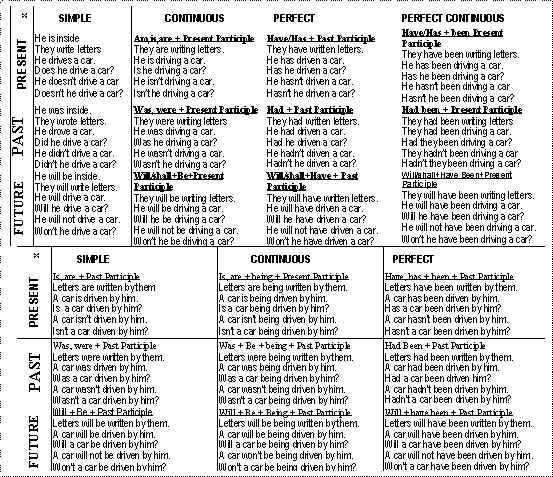
PRESENT TENSE
Present Simple
The chief uses of the present
simple tense are to indicate present action and actions which occur at all
time (the timeless present).
Present action or state of
being:
Momodu is absent.
Felix is ill.
Here comes Joseph.
We
are ready. John has my book.
Timeless events: The use of the present
simple in this case is very general. These include actions, which do not
only happen now, but repeatedly. Or it can even be used for events which
are true in general.
Isha likes the beach.
Musu does all the
housework.
They live in Banjul.
I see him every time I go to
school.
I wake up at 6 o'clock every morning.
A verb in the present
simple may not need an auxiliary. If there is any need, the auxiliary may
be constructed from the verb DO.
I know his house. I do know his
house.
I don't know his house.Do you know her cup?
She doesn't like
the idea. She likes the idea.
Present Continuous
The present
continuous deals with events, which are taking place now - at the time of
speaking.
He is going to church.
I am sweeping the
classroom.
They are writing a letter.
Note that the present
continuous is for events that are going on now, but the present simple is
for present events in general and those repeated over time.
Brima is
going to church.(present continuous)
Brima goes to church every Sunday.
(Present simple.)
The water is boiling. (Present continuous)
Water
boils at 100 degrees celsius. (Present simple.
Present
Perfect
This is used for an action that has just been completed. It is
used when we are thinking more of the present result than about the past
action.
Structure: Have/has + past participle
I have taken the
papers.
They have built a house.
She has chosen a new dress.
Has
she chosen a new dress?
I haven't taken the papers.
This tense
appears to indicate a past action, but the past action is not so important
here. What is important is the present result of the past action. If the
past action is more important, it is more appropriate to use the simple
past. Note the sentences below:
He has lost my cap. (He doesn't have it
now)
He lost my cap. (We can't tell now whether he has found it or
not.)
He has gone to Kabala. (He is there now.)
He has been to
Kabala.(He went and returned)
Present Perfect Continuous
It is
used to express an action that began in the past and is still
continuing.
Structure:
Have/has + been + present participle
It
has been raining for two weeks.
I've been working on it since
Sunday.
Has she been learning French for five years?
It hasn't been
raining for two weeks.
They have been sitting here since this
morning
PAST TENSE
Past Simple
This tense is used for actions
completed in the past. The past form of a verb appears in this
tense.
John was in the house.
She went into the classroom.
Note
that the past simple is used to pinpoint a specific time (i.e. day, week,
month or year)
If however a length of time is expressed in a sentence,
it is more appropriate to use the present perfect or the present perfect
continuous.
I met Alpha on Tuesday. (Specific time)
Alpha has been
to Koidu twice.(length of time)
Michael has been living in Hangha since
1960.
I have fallen twice since yesterday. (L.T.)
I fell down twice
yesterday. (Specific time)
Musa has been painting the house since this
morning. (i.e. from this morning to now) (L.T.)
Musa painted the house
this morning. (The painting started and ended this morning.)
Sidikie
graduated from college last year. (S.T.)
The following are used to
express length of time: for two years, three times, since Friday.
The
following are used to express specific time: last year, last week, in
June, in 1966,ago
Past Continuous Tense
This is used for past
actions that went on for some time. It is especially used when a certain
action in the past was interrupted by another
action. The first
action is written in the past
action. The first action is written in
the past
continuous tense, but the second action is written in the past
simple tense.
I was leaving the library when I met her.
While Musa
was going to the market he lost his money.
I was planning to visit you
when you came.
Past Perfect Tense
This tense is used to show
that, of two past actions, one took place before the other.
Structure:
Had + Past Participle
I had left before he arrived.
The fire had
gone out of control before we knew about it.
By the time we got to the
field, the game had started.
I had already locked the door before the
man pushed it.
The past perfect is the past form of the present
perfect. Look at the sentences below:
Who is this man? I haven't met
him before.
Who was that man? I hadn't met him before.
I am tired; I
have just painted the house.
I was tired; I had just painted the
house.
I think Aiah has gone to Koidu Town.
I thought Aiah had gone
to Koidu Town.
In writing narrative essays, it is better to use the
past perfect instead of the present perfect.
Amie was worried. She had
lost five hundred thousand leones in two days. In fact the week hadn't
been a good one for her. One disaster had followed another. At last mum
came to her rescue and all the problems were solved.
Past Perfect
Continuous Tense
This is used to show not only that one action took
place before another, but also that the first action was still going on
when the second started.
Structure: had been + Present Participle
I
had been trying to see him when he called.
FUTURE TENSE
Future
Simple
It contains will or shall and is used to express the
future.
I shall give you the bicycle.
He will make this radio
work.
They won't pay.
Future Continuous
It is used to
indicate that a certain action will be in progress at a particular time in
the future.
Structure: will/shall + be + Present Participle
At this
time tomorrow, I shall be travelling.
By this time tomorrow I will be
taking my exam
Musa will be flying to Bo next week.
Future
Perfect
Structure: will/shall + have + Past Participle
This is used
to indicate that a certain action in the future will have been completed
before a second action occurs in the future. The first action is written
in the future perfect, but the second action is written in the present
simple.
I will have gone by the time she arrives.
The shop will have
closed by the time the programme finishes.
We will have left the hut
before you get there.
The game will have started before we reach the
field.
Sometimes the second event is reduced to a mere phrase
indicating a time frame. In this case the future perfect is used to show
that an action will have been completed before a particular time in the
future.
I will have gone by this time tomorrow.
The shop will have
closed by five o'clock.
By this evening I will have finished my
work.
He will have spent all his allowances by the end of next
week.
He will not have gone by five o'clock.
He won't have gone by
five o'clock.
Won't he have gone by five o'clock?
Future Perfect
Continuous
This is used to express an action that has started in the
past and will still be continuing at a particular time in the
future.
Structure: Will/shall + have been + Present Participle
By
Christmas she will have been living in London for five
years.
����������������
Exercise 7
1. They�to go there next week,
but because of the floods they had to put of the visit.
A. have been
intending B. intend
C. had intended D. are intending
2. By the end
of this year, I ��in this school for five years.
A. would B. must have
been
C. may be D. shall have been
3. We��..English for five years
now.
A. studied B. are studying
C. have been studying D. have been
studied
4. Alice��.taking care of the baby since her mother
died.
A.has being B. has been C.as being D. can be
5.She��..before
he arrived.
A. has left B. have left
C. had left D. has been
gone
6. I couldn't take the test last week because I ����..a
cold.
A. have caught B. had caught
C. would catch D. might
catch
7. He suddenly came in while I��my dinner.
A. was having B.
have
C. had had D. would have
8. My mother left some food for me so
that when I returned from school I ���.
A. would eat B. will have eaten
C. will eat D. have eaten
9. When I went there the
stranger�questioned
A. was being B. has been
C. is being D. having
been
10.Since independence, smuggling�.illegal in this country.
A.
was B. is C. would be D. has been
11.Kofi said it��..raining before he
arrived.
A. had been B. is C. has been D. was
12.He��that he is
going to win the award.
A. was feeling B. is feeling C. feels D.
felt
13.The prices of commodities�since last year.
A. have gone up
B. has gone up
C. will have gone up D. went up
14.Before the bus
arrived passengers�..for a long time.
A. have been waiting B. had being
waiting
C. have waited D. had waited
15. Is it true that
Kofi��before the gates were closed last night?
A. had returned B. has
returned
C. should return D. will have returned
16.Inyang�absent
from school for two weeks.
A. has B. has been
C. will have been D.
have been
17. As we �.the thieves entered the house.
A. had slept B.
are sleeping
C. have slept D. were sleeping
18.At the end of this
month's meeting we�..held four meetings this year.
A. might have been
B. shall have been
C. might have D. shall have
19.Dike�..when the
thief broke into the house last night.
A. leaves B. had left C. has
left D. is leaving
20.The boss believed the clerk�French leave.
A.
to take B. has taken
C. have taken D. had taken
|