This is largely a hypothetical formula. I asked people to try it out and let me know how it works, but no one has. If anyone does try this, please send me an e-mail letting me know how it worked out.
Before we begin, we should discuss the plants we will be using:
Local Trees:
Moringa Olifera
Any Peace Corp who does not know
what this tree is should either learn quickly or publicly apologize and
be given an appropriate penance.
The antibacterial constituents can
be found in the seeds, shoots, leave, etc. and are both oil and water-soluble.
To get the most out of this plant, you should use the seed oil and strong
tea made from the leaves and seeds.
Neem
This is another well-known tree,
grows like a weed all over the Gambia.
This tree also has water and oil
soluble antibacterial parts.
An oil made from the seeds and a
tea from the leaves are used from this tree.
Cassia sieberianae
A.k.a. - African laburnam,
drumstick tree; Mandinka-guam gua; Fulas: malgahi, sama sinjang
You might need an Agfo and/or a
good tree book for this one.
You need to make a strong tea from
the inner root of this tree, so it may not be the best source for use.
However, it is a locally known herbal antibiotic.
Tylophora sylvatica
Use a tree ID book for this one.
The sap from this tree is used as
an antiseptic.
Other/non-local
herbs:
Chamomile
Use a strong tea.
Peppermint.
Use the oil and/or a strong tea.
This may cause a little numbing.
Tea tree oil.
This is good because it also acts
as a preservative. However, there may be some numbing
Thyme
Make a strong tea.
Extracting chemicals
from the herbs:
Strong Teas
What we are actually making for the purposes of this project is not a tea,
but as decoction. The main difference is is that in teas, herbs are added
after the water has been boiled and removed from heat, and in decoctions,
the herbs are boiled in the water.
Add a handful of fresh leaves for a pint of water, and boil for 10-20 minutes,
or until you have boiled off have of your liquid. Strain the herbs out
of the decoction. You don’t want to use a cloth to strain out the herbs,
though, as the cloth may absorb and remove some of the beneficial oils.
Seed Oil
Plant oil can be obtained one of
two ways:
The simplest way to get the oil at site is to boil plant seeds and skim
off the oils that form on top. Boil a large about of the seeds in the water.
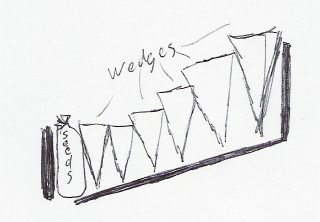
Another method to extract oils is to press the seeds. This is a little
more difficult to do, as oil presses are expensive and hard to come by.
A make-shift press can be made, however.
A bookshelf like structure is built with a space through which the oils
will be allowed to drip through.
The seeds are placed in a bag and placed at the end of the shelf with the
space. Wedges are slowly added over a period of a few days to crush and
press the seeds
And now for the recipes:
Hand Gel Recipe
#1:
½ cup herbal tea/decoction
¼ cup water
1 tbls lemon juice
1 tbls vinegar (preferably cider
vinegar, but use what you have)
1 Tbls glycerine
Dissolve gelatin in the ¼ cup of water. Gently heat the mixture until fully dissolved and mix in the remainder of the ingredients
Hand Gel Recipe #2:
½ cup un-petrolium jelly
(see below)
selected herbs (Moringa seeds and
leaves, Neem leaves, etc.)
Heat the jelly in a double boiler.
Stir in the selected herbs.
Simmer for an hour, stirring occasionally.
Strain with a non-metallic strainer.
Un-Petroleum Jelly:
1 cup vegetable oil (use as much
Moringa and Neem oil as possible to fill up this 1 cup measure)
¼ cup beeswax
Melt the wax and oil together.
I should be mentioned that this
jelly should not be considered latex friendly.