
I was born on April 12, 1861, in the Harbor of Charleston, South Carolina and the Constitution of the Confederate States of America is my Birth Certificate. The blood lines of the South run through my veins, for I offer freedom that each State should regulate her own affairs, according to its best interest. I am many things and many people.
I Am The South. I am millions of living souls, and ghosts of thousands who died for me. I am the Farmer-made soldier who did not turn his back during Pickett's Charge. I am the Rebel Yell that was heard across many of my rolling fields, protecting our homeland. I am Robert E. Lee and Thomas J. "Stonewall" Jackson: I stood at Fort Sumter and fired the shot heard through our young nation. I am Longstreet, Hood and Patrick R.Cleburne. I am General's Johnson, Beauregard and President Jefferson Davis. I remember how we fought in Gettysburg, Cold Harbor, Vicksburg, and Atlanta. When duty called I answered and stayed until it was over. I left my heroic dead in Chickamauga, in the fields of Shiloh, on the bloody hills of Mannassas and the mountains of Kennesaw.
I Am The South. I am the Mississippi River, and the cotton fields of Alabama and the piney woods of the Carolinas. I am the coal fields of Virginia and Kentucky, the Florida coast and the Louisiana bayou. I am Richmond, the Capitol of the Confederacy. I am the forest, field, mountain, and rivers. I am the quiet villages and the cities that never sleep. I am the Heritage that's been forgotten, the dying memory of a way of life that is being still. You see me in the twilight and hear me in Dixie, as the past continues to fade away each year.
Yes, I Am The South, and these are the things I represent. I was Conceived by force, and God willing, I'll spend the rest of my days remembering my birth. May I always possess the integrity and the courage, and the strength to keep my Heritage alive, to remain a Loyal Southerner and stand tall and proud to the rest of the world. Do not forget: who we are; what we are and where we came from ....This is my goal, my hope, my prayer.
(Written by 95 year old Louise Weeks of Hampton, Georgia, two weeks before her death.)
Major R.E.Wilson, 1st North Carolina Battalion of Sharpshooters
THE WAR FOR SOUTHERN INDEPENDENCE
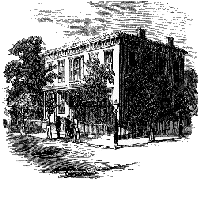
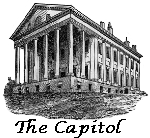
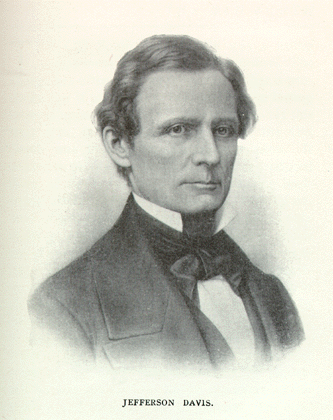
Jefferson Davis was born on June 3, 1808, in Christian (now Todd) Co., Ky., and educated at Transylvania University, Lexington, Ky., and at the U.S. Military Academy. After his graduation in 1828, he saw frontier service until ill health forced his resignation from the army in 1835. He was a planter in Mississippi from 1835 to 1845, when he was elected to the U.S. Congress. In 1846 he resigned his seat in order to serve in the Mexican War and fought at Monterrey and Buena Vista, where he was wounded. He was U.S. senator from Mississippi from 1847 to 1851, secretary of war in the cabinet of President Franklin Pierce from 1853 to 1857, and again U.S. senator from 1857 to 1861. As a senator he often stated his support of slavery and of states' rights, and as a cabinet member he influenced Pierce to sign the Kansas-Nebraska Act, which favored the South and increased the bitterness of the struggle over slavery. In his second term as senator he became the acknowledged spokesman for the Southern point of view. He opposed, however, the idea of secession from the Union as a means of maintaining the principles of the South. Even after the first steps toward secession had been taken, he tried to keep the Southern states in the Union, although not at the expense of their principles. When the state of Mississippi seceded, he withdrew from the Senate.
On Feb. 18, 1861, the provisional Congress of the Confederate States made him provisional president. He was elected to the office by popular vote the same year for a 6-year term and was inaugurated in Richmond, Va., the capital of the Confederacy, on Feb. 22, 1862. Davis was responsible for the raising of the formidable Confederate armies, the notable appointment of Gen. Robert E. Lee as commander of the Army of Northern Virginia, and the encouragement of industrial enterprise throughout the South. His zeal, energy, and faith in the cause of the South were a source of much of the tenacity with which the Confederacy fought the War of Northern Aggresion. Even in 1865 Davis still hoped the South would be able to achieve its independence. When he realized that Richmond must fall, he left the city with the intention of continuing the war from the Trans-Mississippi. On May 10, 1865, federal troops captured him at Irwinville, Ga. From 1865 to 1867 he was imprisoned at Fortress Monroe, Va. Davis was indicted for treason in 1866 but the next year was released on a bond of $100,000 signed by the American newspaper publisher Horace Greeley and other influential Northerners. In 1868 the federal government dropped the case against him. From 1870 to 1878 he engaged in a number of business enterprises; and from 1878 until his death in New Orleans, on Dec. 6, 1889, he lived near Biloxi, Miss.
Inaugurual Address
as Provisional President of the Confederacy
Montgomery, February 18, 1861
Montgomery, February 18, 1861
GENTLEMEN OF THE CONGRESS OF THE CONFEDERATE STATES OF AMERICA, FRIENDS AND FELLOW-CITIZENS:
Called to the difficult and responsible station of Chief Executive of the Provisional Government which you have instituted, I approach the discharge of the duties assigned to me with an humble distrust of my abilities, but with a sustaining confidence in the wisdom of those who are to guide and to aid me in the administration of public affairs, and an abiding faith in the virtue and patriotism of the people.
Looking forward to the speedy establishment of a permanent government to take the place of this, and which by its greater moral and physical power will be better able to combat with the many difficulties which arise from the conflicting interests of separate nations, I enter upon the duties of the office to which I have been chosen with the hope that the beginning of our career as a Confederacy may not be obstructed by hostile opposition to our enjoyment of the separate existence and independence which we have asserted, and, with the blessing of Providence, intend to maintain. Our present condition, achieved in a manner unprecedented in the history of nations, illustrates the American idea that governments rest upon the consent of the governed, and that it is the right of the people to alter or abolish governments whenever they become destructive of the ends for which they were established .
The declared purpose of the compact of Union from which we have withdrawn was "to establish justice, insure domestic tranquillity, provide for the common defense, promote the general welfare, and secure the blessings of liberty to ourselves and our posterity;" and when, in the judgment of the sovereign States now composing this Confederacy, it had been perverted from the purposes for which it was ordained, and had ceased to answer the ends for which it was established, a peaceful appeal to the ballot-box declared that so far as they were concerned, the government created by that compact should cease to exist. In this they merely asserted a right which the Declaration of Independence of 1776 had defined to be inalienable; of the time and occasion for its exercise, they, as sovereigns, were the final judges, each for itself. The impartial and enlightened verdict of mankind will vindicate the rectitude of our conduct, and He who knows the hearts of men will judge of the sincerity with which we labored to preserve the Government of our fathers in its spirit. The right solemnly proclaimed at the birth of the States, and which has been affirmed and reaffirmed in the bills of rights of States subsequently admitted into the Union of 1789, undeniably recognize in the people the power to resume the authority delegated for the purposes of government. Thus the sovereign States here represented proceeded to form this Confederacy, and it is by abuse of language that their act has been denominated a revolution. They formed a new alliance, but within each State its government has remained, the rights of person and property have not been disturbed. The agent through whom they communicated with foreign nations is changed, but this does not necessarily interrupt their international relations.
Sustained by the consciousness that the transition from the former Union to the present Confederacy has not proceeded from a disregard on our part of just obligations, or any failure to perform every constitutional duty, moved b! no interest or passion to invade the rights of others, anxious to cultivate peace and commerce with all nations, if we may not hope to avoid war, we may at least expect that posterity will acquit us of having needlessly engaged in it. Doubly justified by the absence of wrong on our part, and by wanton aggression on the part of others, there can be no cause to doubt that the courage and patriotism of the people of the Confederate States will be found equal to any measures of defense which honor and security may require.
An agricultural people, whose chief interest is the export of a commodity required in every manufacturing country, our true policy is peace, and the freest trade which our necessities will permit. It is alike our interest, and that of all those to whom we would sell and from whom we would buy, that there should be the fewest practicable restrictions upon the interchange of commodities. There can be but little rivalry between ours and any manufacturing or navigating community, such as the Northeastern States of the American Union. It must follow, therefore, that a mutual interest would invite good will and kind offices. If, however, passion or the lust of dominion should cloud the judgment or inflame the ambition of those States, we must prepare to meet the emergency and to maintain, by the final arbitrament of the sword, the position which we have assumed among the nations of the earth. We have entered upon the career of independence, and it must be inflexibly pursued. Through many years of controversy with our late associates, the Northern States, we have vainly endeavored to secure tranquillity, and to obtain respect for the rights to which we were entitled. As a necessity, not a choice, we have resorted to the remedy of separation; and henceforth our energies must he directed to the conduct of our own affairs, and the perpetuity of the Confederacy which we have formed. If a just perception of mutual interest shall permit us peaceably to pursue our separate political career, my most earnest desire will have been fulfilled. But, if this be denied to us, and the integrity of our territory and jurisdiction be assailed, it will but remain for us, with firm resolve, to appeal to arms and invoke the blessings of Providence on a just cause.
As a consequence of our new condition and with a view to meet anticipated wants, it will be necessary to provide for the speedy and efficient organization of branches of the executive department, having special charge of foreign intercourse, finance, military affairs, and the postal service.
For purposes of defense, the Confederate States may, under ordinary circumstances, rely mainly upon their militia, but it is deemed advisable, in the present condition of affairs, that there should be a well-instructed and disciplined army, more numerous than would usually be required on a peace establishment. I also suggest that for the protection of our harbors and commerce on the high seas a navy adapted to those objects will be required. These necessities have doubtless engaged the attention of Congress.
With a Constitution differing only from that of our fathers in so far as it is explanatory of their well-known intent, freed from the sectional conflicts which have interfered with the pursuit of the general welfare it is not unreasonable to expect that States from which we have recently parted may seek to unite their fortunes with ours under the government which we have instituted. For this your Constitution makes adequate provision; but beyond this, if I mistake not the judgment and will of the people, a reunion with the States from which we have separated is neither practicable nor desirable. To increase the power, develop the resources, and promote the happiness of a confederacy, it is requisite that there should be so much of homogeneity that the welfare of every portion shall be the aim of the whole. Where this does not exist, antagonisms are engendered which must and should result in separation.
Actuated solely by the desire to preserve our own rights and promote our own welfare, the separation of the Confederate States has been marked by no aggression upon others and followed by no domestic convulsion. Our industrial pursuits have received no check. The cultivation of our fields has progressed as heretofore, and even should we be involved in war there would be no considerable diminution in the production of the staples which have constituted our exports and in which the commercial world has an interest scarcely less than our own. This common interest of the producer and consumer can only be interrupted by an exterior force which should obstruct its transmission to foreign markets-a course of conduct which would be as unjust toward us as it would be detrimental to manufacturing and commercial interests abroad. Should reason guide the action of the Government from which we have separated, a policy so detrimental to the civilized world, the Northern States included, could not be dictated by even the strongest desire to inflict injury upon us; but otherwise a terrible responsibility will rest upon it, and the suffering of millions will bear testimony to the folly and wickedness of our aggressors. In the meantime there will remain to us, besides the ordinary means before suggested, the well-known resources for retaliation upon the commerce of an enemy.
Experience in public stations, of subordinate grade to this which your kindness has conferred, has taught me that care and toil and disappointment are the price of official elevation. You will see many errors to forgive, many deficiencies to tolerate, but you shall not find in me either a want of zeal or fidelity to the cause that is to me highest in hope and of most enduring affection. Your generosity has bestowed upon me an undeserved distinction, one which I neither sought nor desired. Upon the continuance of that sentiment and upon your wisdom and patriotism I rely to direct and support me in the performance of the duty required at my hands.
We have changed the constituent parts, but not the system of our Government. The Constitution formed by our fathers is that of these Confederate States, in their exposition of it, and in the judicial construction it has received, we have a light which reveals its true meaning.
Thus instructed as to the just interpretation of the instrument, and ever remembering that all offices are but trusts held for the people, and that delegated powers are to be strictly construed, I will hope, by due diligence in the performance of my duties, though I may disappoint your expectations, yet to retain, when retiring, something of the good will and confidence which welcome my entrance into office.
It is joyous, in the midst of perilous times, to look around upon a people united in heart, where one purpose of high resolve animates and actuates the whole-where the sacrifices to be made are not weighed in the balance against honor and right and liberty and equality. Obstacles may retard, they cannot long prevent the progress of a movement sanctified by its justice, and sustained by a virtuous people. Reverently let us invoke the God of our fathers to guide and protect us in our efforts to perpetuate the principles which, by his blessing, they were able to vindicate, establish and transmit to their posterity, and with a continuance of His favor, ever gratefully acknowledged, we may hopefully look forward to success, to peace, and to prosperity.
Source: CSA, Congressional Journal, 1:64-66, as reprinted in Lynda L. Crist and Mary S. Dix, eds., The Papers of Jefferson Davis (Baton Rouge, Louisana: LSU Press, 1992), 7:46-50.
Quote of President Jeff Davis:
We feel that our cause is just and holy; we protest solemnly in the face of mankind that we desire peace at any sacrifice save that of honour and independence; we ask no conquest, no aggrandizement, no concession of any kind from the States with which we were lately confederated; all we ask is to be let alone; that those who never held power over us shall not now attempt our subjugation by arms.
'President Jefferson Davis - 29 April 1861'
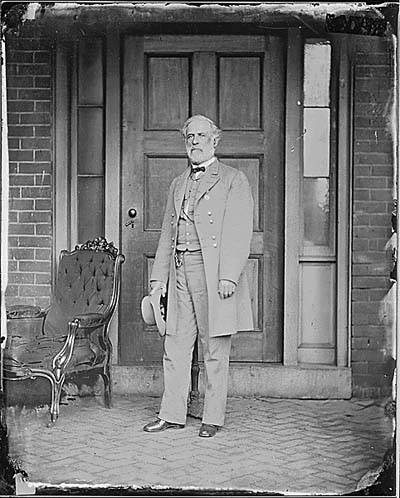
General Robert E. Lee was a US military leader, Confederate commander in the American Civil War, and military strategist. In 1859 he suppressed John Brown's raid on Harper's Ferry. Lee had freed his own slaves long before the war began, and he was opposed to secession, however his devotion to his native Virginia led him to join the Confederacy. At the outbreak of war he became military adviser to Jefferson Davis, president of the Confederacy, and in 1862 commander of the Army of Northern Virginia. Lee actually had been offered command of the Union armies, but he resigned his commission to return to Virginia. During 1862-63 he made several raids into Northern territory but after his defeat at Gettysburg was compelled to take the defensive; he surrendered 1865 at Appomattox.
Lee graduated from West Point and distinguished himself in the Mexican War 1846-48. In 1861 he joined the army of the Confederacy of Southern states; in 1862 he received the command of the Army of Northern Virginia and won the Seven Days' Battle defending Richmond, Virginia, the Confederate capital, against General McClellan's Union forces. In 1863 Lee won victories at Fredericksburg and Chancellorsville, both in Virginia, and in 1864 at Cold Harbor, Virginia, but was besieged in Petersburg, Virginia, June 1864-April 1865. He surrendered to General Grant on April 9, 1865, at Appomattox Courthouse. Following the war he was paroled and served as president of Washington College (now Washington and Lee University). His home had been seized by Union forces and now is part of Arlington National Cemetery.
Audio of Lee's Farewell
Lee's Farewell to the Army of Northern Virginia
by Robert E. Lee
After four years of arduous service, marked by unsurpassed courage and fortitude, the Army of Northern Virginia has been compelled to yield to overwhelming numbers and resources.
I need not tell the survivors of so many hard-fought battles who have remained steadfast to the last that I have consented to this result from no distrust of them; but feeling that valor and devotion could accomplish nothing that could compensate for the loss that would have attended the continuance of the contest, I determined to avoid the useless sacrifice of those whose past services have endeared them to their countrymen. By the terms of the agreement, officers and men can return to their homes and remain until exchanged.
You may take with you the satisfaction that proceeds from the consciousness of duty faithfully performed, and I earnestly pray that a merciful God will extend to you his blessing and protection.
With an unceasing admiration of your constancy and devotion to your country, and a grateful remembrance of your kind and generous consideration of myself, I bid you all an affectionate farewell.
NATIONAL ANTHEM OF THE SOUTH
�DIXIE�
BY: DANIEL DECATUR EMMETT
Oh, I wish I was in the land of Cotton--
Old times there are not forgotten
Look away! Look away! Look away! Dixie Land
In Dixie Land where I was born in early on one frosty mornin'
Look away! Look away! Look away! Dixie Land (Chorus)
Chorus:
Then I wish I was in Dixie. Hooray! Hooray!
In Dixie Land I'll take my stand: To live and die in Dixie!
Away! Away! Away down south in Dixie.
Away! Away! Away down south in Dixie.
Ole Missus marry "Will the weaver",
Willum was a gay deceiver.
Look away! Look away! Look away! Dixie Land
But when he put his arm around�er,
He smiled fierce as a forty pounder!
Look away! Look away! Look away! Dixie Land
(Chorus)
His face was sharp as a butcher's cleaver,
But that did not seem to grieve'er
Look away! Look away! Look away! Dixie Land
Ole Missus acted the foolish part,
And died for a man that broke her heart
Look away! Look away! Look away! Dixie Land
(Chorus)
Now here's a health to the next ole Missus,
An' all the gals that want to kiss us;
Look away! Look away! Look away! Dixie Land
But if you want to drive 'way sorrow,
Come and hear this song tomorrow
Look away! Look away! Look away! Dixie Land
(Chorus)
There's buckwheat cakes and Injun batter,
Makes you fat or a little fatter;
Look away! Look away! Look away! Dixie Land
Then hoe it down and scratch your gravel,
To Dixie's Land I'm bound to travel,
Look away! Look away! Look away! Dixie Land
(Chorus)
