| THE SOUTHERN SOLDIER |
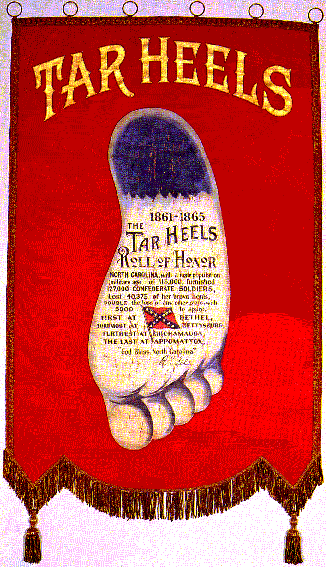
| WHO WAS I Who was I? I wasn�t any different than any man of my time. I had a family and friends. I had a home and enjoyed my way of live. But then one day someone decided that they needed our wealth in the South, they needed to control us and tell us what to do. With the election of Abe Lincoln we knew that �Our South� as we knew it was going to change. We were very rich in the South at this time. The north wanted our wealth to be controlled by them. They wanted to take our money; high tariffs were being imposed on us. They were telling us what to do with our property. Most of the money would stay �up north�. What were we to do? It would be just as if someone would come on to your property today and into your homes and demand of you what to do. Would you put up with this�.. absolutely not. So the call went out and we as our countrymen went to war. We went to war to fight for our �States Rights�, our �Constitutional Liberty�, we fought against a �TARRANTICAL GOVERNMENT�, but most of all we fought to protect and save our wonderful way of live in the South and to protect our homes from the illegal invasion of the yankees. We fought for four long years, we suffered, we starved, we froze, we bleed and we died. Those of us who did survive came home, some of suffered from the wounds we received till we died, we came home to ruins, our homes and families destroyed but worst of all we had to face reconstruction. Men were placed into government positions that could not even write their names. Carpetbaggers came into our towns and took over our churches, our schools and even lead some of the negroes to revolt against us. Our good names were slandered and flat out lied about. Our children were being taught by yankees and the true facts of the War of Northern Aggression were not being told. We faced all of this. We knew that sometime in the future that men and women would try to destroy all about us and totally wipe us and our history out. As we begun to grow older we had one prayer and that was that, the next generation and the generations after that would see to it that we weren�t forgotten, that what we fought, suffered, bleed and died for would not have been in vain. One of our Generals, Stephen D. Lee left a charge to the men who were sons of ours. The charge reads �To you, Sons of Confederate Veterans, we submit the vindication of the cause for which we fought; to your strength will be given the defense of the Confederate soldier�s good name, the guardianship of his history, the emulation of his virtues, the perpetuation of those principles he loved and which made him glorious and which you also cherish. Remember it is your duty to see that the true history of the South is presented to future generations.� These are some strong words that we leave to you. Will you stand up for us? You as descendants of us men and women are all that we have left to carry on the memory of us. You are all we have left to protect us, remember us and honor us for the true honorable men and women that we were. Please don�t let them dishonor us and destroy the memory of us. Please tell your children of us and let them be proud to be descendents of us. Tell them the truth about why we took up arms to protect what was so dear to us �Our South�. We as Confederate Veterans, when we meet you face to face when you pass over to the other side with us, with tears and open arms we will then be able to tell you how proud we are of you and how much we love you for standing up for us and making sure that each generation after us will never forget us. Who Was I Pvt. David H. Wyont, age 33, 11th NC Infantry, Co. I Enlisted March 23, 1863. Present and accounted for until wounded at Gettysburg, Pa. July 1-3, 1863. Present and accounted for until captured at or near Burgess� Mill, Virginia, October 27th, 1864. Taken to City Point, VA for transfer to Point Lookout MD. Confined at Point Lookout MD until released on June 22, 1865 after taking the oath of allegiance. Point Lookout MD Sgt. David H. �Hosea� Wyont, age 17, 72nd NC Infantry, Co E. Hosea ran away from home to fight in the WBTS. Enlisted May 21, 1864 in the NC JR. Reserves, 5th Regiment. He was captured at Fort Fisher on Dec. 25th 1864. Imprisoned at Ft. Monroe and transferred to Point Lookout MD. Paroled on June 21, 1865 Fort Fisher Sgt. Noah W. Wyont, age 48, 39th NC Infantry, Co I Enlisted March 25, 1862 in Macon County. Mustered in as Sergeant. Reported present during April, 1862. Died in the hospital at Bean�s Station, Tennessee, November 14, 1862 of disease. Capt. Daniel M. Wyont, Senior reserves, 89th NC, 22nd Brigade Enlisted Oct. 22, 1861 Pvt. John T. Wyont, age 21, 1st NC Cavalry (9th State Troops), Co. K Resident of Macon County, NC; 21 years old. Enlisted on July 14, 1861 at Macon County, NC as a 2nd Bugler. On July 14, 1861 he mustered into "K" Co. NC 1st Cavalry Pvt. Henry W. Hanks, age 25, 4th and 23rd Mississippi Infantry, Co E Resident of Panola County, Mississippi where he enlisted on August 24, 1861 at age 25 into the 4th Miss. which later became the 23rd Co E, �J.W. Thompson Invincibles� from old Carrolville, Tippah Co., Mississippi. He was mustered into State service at Iuka, Mississippi, September 15, 1861. Present or accounted for until captured at Big Black River, May 17,1862. POW Camp Douglas, Ill., August 1862. September 1862 sent to Vicksburg for exchange. Captured Champion Hill May 17, 1863. POW Fort Delaware, Delaware June 9, 1863, exchanged July 4, 1863. Wounded July 28, 1864 sent to hospital. Present and accounted for until captured December 18,1864, Franklin, Tenn. POW Louisville, Kentucky January 6, 1865. Transferred to Camp Chase, Ohio January 9, 1865 received at Camp Chase on January 11, 1865. Released June 13, 1865 after taking the Oath of Allegiance. 23rd Co E, �J.W. Thompson Invincibles 1st Lieut. Dabney Cosby Jr., age 26, 53rd VA Infantry, Co A Resided in Halifax VA as a lawyer when he enlisted at age 26 at Yorktown, VA on June 12, 1861 as a Private and was mustered into the 53rd VA Infantry, Co A. Promoted to 1st Lieut. of Artillery in Ordnance Department on April 2, 1863. Paroled April 28, 1865, placed not stated. Sgt. Elias G. Bost, age 23, 12th NC Infantry, Co A Enlisted April 27, promoted to Corporal on September 16, 1861, promoted to Sergeant on August 1, 1863. Present or accounted for until reported absent wounded. Reported wounded January 1864 through December 1864. Place and dated wounded not reported. Paroled at Appomattox Court House, Virginia, April 9th, 1865 Appomattox Court House, VA Pvt. William Robert David Bost, age 28, 23rd NC Infantry, Co. F Enlisted June 6, 1861. Present or accounted for until wounded at Seven Pines, Virginia, May 31, 1862. Died on or about June 9, 1862 of wounds. Place of death not reported. Pvt. Harvey Bost, age 26, 12th NC Infantry, Co A Resided in Catawba County as a carpenter prior to enlisting at age 26, October 16, 1861. Present or accounted for until wounded in the left arm at Chancellorsville, Va. May 1-3, 1863. Left arm amputated. Reported absent wounded until discharged on January 27, 1864, by reason of disability. Chancellorsville,VA Pvt. Noah A. Bost, age 22, 12th NC Infantry, Co A Resided in Catawba County as a laborer prior to enlisting at age 22 on April 27, 1861. Present or accounted for until killed at Malvern Hill, VA, July 1, 1862. Capt. Robert A. Bost, age 27, 12th NC Infantry, Co A Resided in Catawba County and was by occupation a farmer prior to enlisting at age 27 on April 27, 1861. Present or accounted for until transferred to Co K, 46th NC Troops on June 8, 1862. Wounded at the Wilderness, VA, May 5, 1864, returned July 30, 1864. Promotions: 1st Sgt. November 21, 1862, 2nd Lieut. August 28, 1864, Captain, November 30, 1864 He was Surrendered on April 9,1865 at Appomattox Court House, VA. Pvt. Jesse Holland, age 26, 49th NC Infantry, Co. H Born in Lincoln County and resided in Gaston County where he was by occupation a blacksmith prior to enlisting in Gaston County, March 22, 1862. Killed in the trenches near Petersburg, VA, August 18, 1864. Petersburg, VA, Pvt. Julius A. Holland, age 52, 49th NC Infantry, Co. H (father of Jesse) Resided in Gaston County and was by occupation a blacksmith. Enlisted subsequent to Aug. 31,1864. Captured at Five Forks, Virginia, April 1,1865. Confined at Point Lookout, MD, April 5, 1865. Released at PL on June 13,1865 after taking the oath of allegiance. Pvt. Franklin Holland, age 29, 49th NC Infantry, Co. H Residence Gaston County NC; a 29 year-old Farmer. Enlisted on 5/1/1862 at Gaston Co., NC as a Private. Mustered into "H" Co. 49th NC May 1, 1862 He was discharged for disability on 9/1/1862. He Reenlisted into "H" Co. 49th NC on March 14 1863 Franklin was Wounded May 15, 1864 at Drewry�s Bluff, VA ,returned July 15, 1864(place not stated) POW 4/1/1865 Point Lookout, MD, Confined 4/5/1865 Point Lookout, MD. Discharged Oath of Allegiance June 27, 1865 Point Lookout, MD Pvt. Robert Holland, 11th NC Infantry, Co. H Residence Mecklenburg County NC. Enlisted on Sept. 8,1864 at Camp Holmes as a Private. He mustered into "H" Co. 11th NC Sept. 8, 1864. He was Surrendered on April 9,1865 at Appomattox Court House, VA Assistant Surgeon, Ephraim B. Holland, General Hospital No. 8, Raleigh NC Pvt. John F. Holland, 49th NC Infantry, Co. E On 6/16/1864 he transferred into "E" Co. 49th NC Listed as a POW April 1,1865 Five Forks, VA. Confined April 5, 1865 Point Lookout, MD. Discharged after taking the Oath of Allegiance June 27,1865 Point Lookout, MD He also had service in: Co. �B� NC Mallet's Qtr. Master Sgt. James R. Holland, age 17, 49th NC Infantry, Co. H Resident of Gaston County NC; age 17, farmer. Enlisted on March 22, 1862 at Gaston Co., NC as a Private. He was mustered into "H" Co.49th NC March 22, 1862. He was surrendered on 4/9/1865 at Appomattox Court House, VA Promoted to Qtr Master Sgt. March 1,1863. Intra. Regimental Company Transfers: March 1,1863 from company H to Field & Staff Pvt. Wesley C. Stroup, age27, 52nd NC Infantry, Co. Residence Lincoln County, NC; a 27 year-old Farmer. Enlisted on 3/25/1862 at Lincoln County, NC as a Private. He mustered into "H" Co. 52nd NC on April 28, 1862. Hospitalized July 3, 1863 Gettysburg, PA POW July 3, 1863 Gettysburg, PA Wounded July 3, 1863 Gettysburg, PA Paroled Nov. 12, 1863 Baltimore, MD. Exchanged Nov. 11, 1863 City Point, VA He was transferred out on Nov. 8, 1864 On Nov 8, 1864 he transferred into Veteran Reserve Corps. Gettysburg, PA Pvt. Abel Brown Rhyne, Age 22, 49th NC Infantry, Co. H Resident of Gaston County. Enlisted on March 22, 1862. Mustered into Co H. April 21, 1862 Sergt. M.H. Rhyne, age 19, 49th NC Infantry, Co. H Resident of Gaston County, NC. A 19 year-old Farmer. He enlisted on March 22,1862 at Gaston Co., NC as a Private. He mustered into "H" Co. 49th NC on April 21, 1862. He was listed as POW April 3,1865 Appomattox River, VA, confined April 11,1865 Hart's Island, NY Harbor. Discharge by Oath of Allegiance June 19, 1865 Hart's Island, NY Harbor Sergt. Jacob E. Rhyne, age 19, 49th NC Infantry, Co H Resident of Gaston County NC; 19 years old. Enlisted on March 22,1862 at Gaston Co., NC as a Sergeant. Mustered into "H" Co.49th NC on April 21, 1862. He was listed as: wounded June 16, 1864 Petersburg, VA, returned July 1, 1864 (place not stated). Hospitalized March 25,1865 Richmond, VA, wounded 3/25/1865 Fort Stedman, VA. POW April 3, 1865 Richmond, VA (Hosp). Transferred May 2, 1865 Point Lookout, MD Discharged, Oath of Allegiance June 26, 1865 Point Lookout, MD Pvt. Iverson Rice Gwyn, age 31, 59th NC, 4th Cavalry, Co B Enlisted July 8, 1862 Caswell County. Pvt. Littleton A. Gwyn, age 19, 41st NC, 3rd Cavalry, Co C Enlisted in Caswell County, NC as a Private February 28, 1862. Paroled April 25, 1865 Pvt. John M. Winecoff, age 24, 7th NC Infantry, Co. B Enlisted in Cabarrus County March 22, 1862. Present and accounted for until reported missing in action on June 27, 1862. Rejoined the company prior to November 1, 1862, present or accounted for until killed at Chancellorsville, VA, May 3, 1863 Pvt. David H. Winecoff, age 21, 7th NC Infantry, Co. B Enlisted in Cabarrus County, August 17, 1861. Present or accounted for until wounded at or near Gaines Mill, Virginia, June 27, 1862. Captured prior to September7, 1862, when he was received fro exchange at Aiken�s Landing on September 21, 1862. Present or accounted for until wounded at Chancellorsville, VA, May 1863. Rejoined the Company in November- December 1863. Present or accounted for through Oct, 1864 Sgt. Levi A. Winecoff, age 30, 7th NC Infantry, Co. H Enlisted in Rowan County, July 30, 1861. Mustered in as a private. Captured at Roanoke Island on February 8, 1862 and paroled at Elizabeth City on February 21, 1862. Exchanged in August 1862. Promoted to Corporal on January 21, 1863, and promoted to Sergeant on March 19, 1863. Present or accounted for until killed in the trenches near Petersburg, VA, June 21, 1864. Pvt. David R. Winecoff, age 28, 7th NC Infantry, Co. H Enlisted in Cabarrus County, August 18th, 1861. Present or accounted for until captured at Gettysburg, Pa. July 2, 1863. Confined at Fort Delaware, Delaware, until transferred to Point Lookout, Md. October 15, 1863. Died in hospital at Point Lookout January 11, 1864 of � chronic diarrhea�. Buried in the mass grave at Point Lookout. Pvt. Joseph C. Winecoff, age 23, 20th NC Infantry, Co B Born in Cabarrus County where he resided as a farmer prior to enlisting at Fort Johnston at age 23, July 10, 1861. Present or accounted for until killed at Gettysburg, PA, July 1, 1863. Pvt. Martin Henderson Winecoff, age 21, 20th NC Infantry, Co B Resided in Cabarrus County where he enlisted at age 21, March 18, 1862 for the war. Present or accounted for until wounded at Gaines� Mill, VA, June 27, 1862. Returned to duty prior to November 1, 1862 and was present or accounted for until captured at or near Cedar Creek, VA on or about October 19, 1864. Confined at Point Lookout, MD, until released on June 22, 1865 after taking the Oath of Allegiance. Pvt. J.V. Winecoff, age 23, 1st NC, Miscellaneous Enlisted in Iredell County at age 23, August 18, 1862 for the war. Wounded in the leg at Fredericksburg, VA, December 13, 1862, and leg amputated. Died at Richmond, VA, January 15, 1863. Pvt. Marcus Winecoff, 7th NC Infantry, Co H Previously served in Hampton�s Legion, SC Volunteers. Transferred to this company in January-February 1863, present or accounted for until captured at Chancellorsville, VA, May 3, 1863. Paroled May 4, 1863. Rejoined the company in September-October 1863 and was killed at Kelley�s Ford, VA, November 8, 1863. Pvt. James B. Winecoff, age 21 7th NC Infantry, Co H Resided in Cabarrus County and enlisted in Wake County at age 21, August 20, 1862 for the war. Present or accounted for through October, 1864. Paroled at Greensboro NC on May 1, 1865 Pvt. Henry D. Winecoff, age 19, 7th NC Infantry, Co H Resided in Cabarrus County and enlisted at Hanover Court House, VA at age 19 on May 30, 1862 for the war. Wounded in the right ankle at Fredericksburg, VA, December 13, 1862, and right leg amputated. Died in hospital at Richmond, VA, February 14, 1863 of �hectic and pyemia.� Pvt. William H. Winecoff, age 22, 7th NC Infantry, Co H Born in Cabarrus County where he resided as a farmer prior to enlisting at age 22, August 5, 1861 for the war. Present or accounted for until he died in hospital at Staunton, VA, December 9, 1862 of �phthisis pulmonalis.� Pvt. George W. Winecoff, age 40, 30th NC Infantry, Co A Resided in Cabarrus County where he enlisted at the age of 40, September 12, 1863, for the war. Present or accounted for until Captured at Kelley�s Ford, VA, November 7, 1863. Confined at Point Lookout, MD, November 11, 1863. Paroled at Point Lookout on or about February 24, 1865 and transferred to Aiken�s Landing, James River, VA, where he was received February 25-March 3, 1865, for exchange. Pvt. Aaron Winecoff, age 35, 17 NC Infantry, Enlisted in Cabarrus County at age 35, April 6, 1863, for the war. Present or accounted for until captured in hospital at Richmond, VA April 3, 1865. Paroled on April 28, 1865. Corpl.. Pinckney Winecoff, age 35, 20th NC Infantry, Co A Born in Cabarrus County where he resided as a farmer prior to enlisting at age 35, April 19, 1861. Mustered in as a Private. Present or accounted for until discharged on July 30, 1862, under the provision of the conscription act. Reenlisted in the company subsequent to June 30, 1863 and was promoted to Corporal on February 14, 1864, Present or accounted for through December, 1864 Pvt. George W. Winecoff, age 20, 52nd NC Infantry, Co A and B Born in Cabarrus County where he resided as a farmer prior to enlisting in Cabarrus County at age 20, March 12, 1862. Killed at Goldsboro on December 17, 1862. Pvt. George Winecoff, age38, 52nd NC Infantry, Co A and B Born in Cabarrus County where he resided as a farmer prior to enlisting in Cabarrus County at age 38, March 12, 1863. Mustered in as Sergeant. Reduced to ranks on an unspecified date. Discharged on May 26, 1862 by reason of being overage. Pvt. John M. Winecoff, age 28, 52nd NC Infantry, Co A and B Resided in Cabarrus County and was by occupation a wagon and buggy maker prior to enlisting in Cabarrus County at age 28, June 26, 1863 for the war. Wounded at Bristoe Station, VA, October 14, 1863. Returned to duty in January-February 1864. Captured at or near Wilderness, VA, on or about May 6, 1864. Confined at Point Lookout, MD, May 17, 1864. Transferred to Elmira, NY, July 27, 1864. Paroled at Elmira on October 11, 1864. Received at Venus Point, Savannah River, Georgia, November 15, 1864 for exchange. Pvt. John A. Clark, age 41, 8th NC Infantry, Co K Previously served in Co. B, 42nd NC Troops. Transferred to this company on March 26, 1864. Present or accounted for until captured at Cold Harbor, VA, June 1, 1864. Confined at Point Lookout, MD. until transferred to Elimira, New York, July 12, 1864. Died at Elmira on April 19, 1865 or �chronic diarrhea� Elmira Prison Letter from the muster roll of John, Camp------------NC March 20th 1864 Sir, I have the honor to apply for a transfer from my company �B� 42nd NC Regt. To company �K� 8th NC regt. For the following reasons. I have a son and other relatives in the said co. �K� and none in the company to which I now belong. Very Respectfully Approved A. R. Cranford 1st Lieut. Your Obt. Sevt. Co. �B� 42nd NC Regt. John A. Clark Private Co. �B� 42nd NC Regt. Pvt. James W. Clark, age 18, 8th NC Infantry, Co K (son of John) Resided in Rowan County where he enlisted at age 18, December 20, 1862 for the war. Present or accounted for until captured at Cold Harbor, VA, May 31, 1864. Confined Point Lookout, MD. until transferred to Elmira, New York July 9, 1864. Released at Elmira, June 11-12 1865 after taking the Oath of Allegiance. Pvt. A.J. Best, age 28, 28th NC Infantry, Co B Resided in Gaston County as a farmer. Enlisted at age 28, March 29, 1862. Present or accounted for through February 1863. Discharged from service on March 28, 1864, by reason of �gunshot causing a loss of the left hand.� Pvt. James C. Ball, age 19, 26th NC Infantry, Co C Resided in Wilkes County where he enlisted at age 19, June 12, 1861.Present or accounted for until wounded at Gettysburg, Pa. July 1, 1863. Reported absent wounded through June 1864. Pvt. Solomon Hendren, age 18, 4th NC Infantry, Co C Sided in Iredell County where he enlisted at age 18, February 25, 1863, for the war. Company muster rolls indicate that he was captured at Chancellorsville, VA. May 3, 1863; however records of the Federal Provost Marshal do not substantiate that report. Killed at Spotsylvania Court House, VA, May 12, 1864. Pvt. Charles E. Transou, Musician, 26th NC Inf, Co F & S Resided in Forsyth County and enlisted at Orange Court House, VA., November 18, 1863, for the war. Mustered in as Musician. Present or accounted for until captured at Amelia Court House, VA. April 4, 1865. Confined at Point Lookout, Maryland, until released on June 20, 1865, after taking the Oath of Allegiance. 26th NC Pvt. Julius A Transou, Musician, 26th NC Inf, Co F and S Enlisted in Lenoir County on May 28, 1862 for the war. Mustered in as Musician. Present or accounted for through February 1865. Pvt. Rufus Transou, age 24, 26th NC Infantry, Co D Resided in Wilkes County NC enlisted at age 24 at Camp Holmes NC on September 22, 1862. Mustered into the 26th NC Co D on September 22, 1862. He was listed as wounded in the head July 1, 1863 at Gettysburg Pa. POW July 1, 1863, confined Point Lookout MD July 5, 1863. Transferred July 17, 1863 to David�s Island, NY Harbor. Paroled David�s Island, NY Harbor. Received at City Point VA, August 28, 1863 for exchange. Returned January 1, 1864 to duty, place not stated. Wounded May 5, 1864 at the Wilderness VA. in the right leg. Returned July 1,1864 place not stated. POW April 2, 1865 Petersburg, VA. Oath of Allegiance June 21, 1865 place not stated. Released June 21, 1865, place not stated. Pvt. Abraham L. DeMarcus, age 17, 7th NC Infantry, Co H Born in Cabarrus County and was by occupation a farmer prior to enlisting in Cabarrus County at age 17 on November 1, 1863, for the war. Present or accounted for until wounded in the left arm at Gravel Hill, VA, July 28, 1864. Reported absent wounded through October 1864. Retired to the Invalid Corps on December 9, 1864. Pvt. William B. DeMarcus, age 20, 7th NC Infantry, Co H Born in Cabarrus County where he resided as a farmer prior to enlisting at age 20 on August 5, 1861, for the war. Present or accounted for through October 1864, however, he was reported absent on detail as a teamster or as a cook during much of the war. Paroled at Appomattox Court House VA, April 9, 1865. Pvt. William A. DeMarcus, age 48, 52nd NC Infantry, Co A Resided in Cabarrus County NC as a Farmer prior to enlisting at age 48 as a Private on March 21, 1862. Mustered into the 52nd NC, Co A on April 28th, 1862, Cabarrus County, NC as a Private. He served as an ambulance driver much of the war. He was Surrendered on April 9, 1865 at Appomattox Court House, VA Pvt. Alexander Moore, age 31, 55th NC Infantry, Co B Resided in Wiles County where he enlisted at age 31, March 31, 1862. Reported absent with leave in June 1862. Reported absent without leave in April- October 1864. Returned October 1864 Pvt. James M. Moore, 55th NC Infantry, Co B Place and date of enlistment not reported. Captured at falling Waters, MD., July 14, 1863. Confined at Old Capitol Prison, Washington, D.C. Transferred to Point Lookout MD. where he arrived on July 31, 1863.Hospitalized at Point Lookout on October 9, 1863, with acute pneumonia. Paroled at Point Lookout on or about March 16, 1864. Transferred to City Point, VA where he was received on March 20, 1864 for exchange. Hospitalized at Richmond, VA March 24, 1864, Furloughed for thirty days on March 25, 1864. Pvt. Robert Moore, age 18, 55th NC Infantry, Co B Resided in Wilkes County NC, 18 years old, enlisted on July 25, 1862 as a Private. On Mustered into the NC 55th Infantry, Co B on May 30, 1862. He was listed as a POW September 6,1862 Washington, NC. Exchanged October 22, 1862 (place not stated) Hospitalized 10/24/1862 Richmond, Va. He died of disease on October 31,1862 at Richmond, VA (Died of "variola") Pvt. Levi Deal, 5th NC Infantry, Co K Resided as a farmer in Rowan County prior to enlisting in Iredell County on august 8, 1862. Wounded in the arm and back and captured at Gettysbury, Pa., July 1-5, 1863. Hospitalized at Gettysburg until transferred to hospital at David�s Island, NY Harbor, where he arrived July 17-24, 1863. Paroled at David�s Island and transferred to City Point, VA where he arrived September 27, 1863, for exchange. Exchanged prior to September 29, 1863, when he was hospitalized at Richmond, VA Reported absent wounded through December 1863. Reported absent without leave during January-October, 1864; however, medical records indicate that he was hospitalized during part of that period. Retired to the Invalid Corps on March 21, 1865. Paroled at Farmville, Virginia, April 11-21, 1865 and took the Oath of Allegiance at Salisbury on July 10, 1865. Private William A. Deal, age 30, 42nd NC Infantry, Co. G Resided in Rowan County where he enlisted at age 30, May 1, 1862, for the war. Present or accounted for through November 11, 1864 Pvt. Wilson A. Lingle, age 31, 57th NC Infantry, Co C Resided in Rowan County where he enlisted at age 31, July 4, 1862 for the war. Reported present through February 28, 1863. Captured at Chancellorsville, VA, on or about May 4,1863. Confined at Fort Delaware, Delaware, on or about May 7, 1863. Paroled and transferred to City Point, VA, where he was received on May 23, 1863, for exchange. Returned to duty on an unspecified date. Reported present accounted for until November 7, 1863, when he was captured at Rappahannock Station, VA. confined at Point Lookout, Maryland, November 11, 1864. Received at City Point on March 20, 1864, for exchange. Returned to duty prior to August 31, 1864. Wounded at Winchester, VA, September19, 1864. Survived the war. |
| THE CONFEDERATE SOLDIER IN THE CIVIL WAR by Major General Fitzhugh Lee An impartial study of the early history of the American Republic from the period a band of patriots, following the wave of Washington's sword, transferred power from king to people, will demonstrate that when Colonies were transformed into States, the latter delegated, in a written Constitution, the powers to be conferred on the United States, but all powers not so delegated were reserved to the States themselves, because they had never parted from them. Hence, sovereign power belonged to a State, while only derivative, and not primitive, power was possessed by the general Government. The States did not confer upon the Government they were then forming a right to coerce one of their number for any purpose, for it is not natural that the creator should create either executive, judicial or legislative authority anywhere which should be potent to destroy its life or diminish or alter the power it had reserved for its own purposes. A State speaks through its representative bodies, and the majority of delegates in a convention direct its course. The people of the original thirteen States believed in State sovereignty, and Pennsylvania and the New England States are upon record as primarily holding such opinions. The Southern people were educated in the belief that the allegiance of the citizen was first due to his State, and in any conflict between his Commonwealth and the United States, or other country, his place was at her side - at her feet he should kneel and at her foe his gun should be pointed. This is the only explanation of the great and enthusiastic response be the masses of the people to the action of their State Conventions, when they decided their States should no longer he members of the Federal Union, but, resuming their original independence, be free afterward to make such other alliances as they might deem best to protect their rights and promote their growth and glory. The Southern masses were the private soldiers of the armies they not have understood all the public questions involved, or the gravity of secession, or the importance of pending issues, as thoroughly as the statesman of the period, but they must have been thoroughly impressed in a conscious manner with the right of secession and with a fidelity and loyalty to the commands of their respective States. It has been said that man is under no circumstances so independent as he is when the next step is for life or death. The men who were to be enrolled as the soldiers of a new Confederacy of States, to battle for its existence, knew they were taking a step which might bring to them a hostile bullet and a soldier's grave. The existence of the slightest doubt as to the justice of the course of their States, or the presence of the smallest suspicion that their bayonets would glisten with treason, would have surely brought that independence of action spoken of, against which the pleading eloquence of their leaders would recoil as the waters are dashed back from a great rock. No earthly mandate can compel men to leave their firesides, families friends, and embrace death with rapture, unless their God-given consciences stamp with approval the motives which control their conduct. With a free, fair and honest ballot, undisturbed by extraneous influences, and untouched by the modern methods of bribery and corruption, the masses of the people, from which came unbroken ranks of gallant men, voted with practical unanimity to ratify the decision of their State Conventions. The movement to change the map of North America and make two republics grow only one grew before, was enthusiastically received by the great body of the Southern people. Men rushed to arms, companies were rapidly enrolled in every locality - grew into regiments, and regiments into brigades. Orders were joyfully received which carried local troops to the places where armies were forming, and the preparations for the impending battle were eagerly hailed by men whose previous footsteps had only fallen upon the paths of peace. The private soldier of the Confederacy had no hope of conspicuous honors, no opportunity to lay up riches, while meager rations and scant clothing banished any prospect he may have cherished for a reasonable amount of the pleasures of army life. The separation from his home, in many instances, marked the period when domestic sorrow replaced domestic happiness, and absolute want followed a fair competence. The producer was taken away, the consumers remained; while added to the infelicity of the wife, the grief of the mother, and the sister's sadness, was the ever tormenting thought that he, whose heart held the concentrated love of the household, might never again enter his doors alive, or even his dead body find a resting place in the little family burying ground, where loving hands could guard it from desecration. It was a terrible ordeal for those left behind, and it was a torturing thought for the soldier, that he might fall, bequeathing to those he cared most for a life of destitution and sorrow. To the usual hardships and dangers which accompany a soldier's career everywhere, must be added these peculiar conditions which surrounded the service of the Southerners in the late war, because so many of the rank and file had homes, and some property, and being for the most part from the rural districts, their absence in the army immeasurably increased the discomforts of their families, and was a source of never ceasing care and concern to them. It is true, however, that men of means, influence and position were also to be found in the ranks. At the outbreak of the war all wanted to fight, but all could not hold commissions. Out of 604 students at the University of Virginia when the war broke out, largely over one -half joined the Confederate army at the first trumpet sound of war, and more than 2,000 graduates of that University were in the Confederate service from 1861 to 1865, and more than 400 fell and were buried in soldiers' graves; while from Harvard, the great Northern University, but 1,040 men served in the armies and navies of the United States during the four years of war, and only 15; of these lost their lives. Beauregard, after the first battle of Manassas, in visiting one of his generals, whose tent was pitched not far from his headquarters, ordered one of his couriers, a private soldier, to accompany him. Upon dismounting he threw the bridle-rein to the soldier to hold his horse while he paid his visit, but seeing he was a neat, trim-looking cavalryman, remarked, suppose holding horses is a new business to you! " "Yes," said the soldier, who was a wealthy planter, "when I am in Mississippi I have a hundred negroes to hold my horse." General Lee's son was a private soldier in the artillery, and there were numerous similar instances, but the bulk of the fighting material of the South were men who could not well afford to leave their little farms or moderate business for any purpose, as the daily bread of so many others depended on their daily labor. Many were intelligent and thinking men, and in instruction and training were far above the average soldiers of the world. It has been well said that, "had the need arisen, as in the case of the Theban army in Thessaly, more than one Epaminondas might have been found serving as a private in the Confederate ranks." An army composed, large part, of brave, thoughtful, sensible soldiers, must write a grand record on the pages of history. With the component parts of a great engine working true, its work is most satisfactorily performed; so the more faithful, sensible and courageous the soldiers who make up the army, the more they can be wielded to the greatest advantage by a master of war. The difficulties and embarrassments which confronted the Confederate soldier were overcome; and when the numbers of those who opposed him, their munitions of War, the efficiency of their well-stored quartermaster, commissary and ordnance departments are contrasted with the great deficiency in the South of everything that mobilizes armies and contributes to their strength, the world wonders at what was accomplished. When " I See the battle-scarred soldiers and sailors of the Confederacy, with uncovered head and profoundest reverence I bow before those dauntless heroes, feeling that if the greatest suffering with the least hope of reward is worthy of the highest honor, these deserve to stand shoulder to shoulder with their greatest army commanders in the brotherhood of glory. When McDowell, at first Manassas, succeeded in turning Beauregard's left flank, and was driving the fragmentary forces which first encountered his huge turning column, it was the heroic stand taken by the soldiers, almost without command, on a line of battle perpendicular to the original line along Bull Run, which checked his impetuous onset, christened Thomas Jonathan Jackson "Stonewall," and gave to Johnston and Beauregard the victory ; and from that period to 1865 it was the restless charge of gallant troops in offensive battle, or their determined and courageous stand in defensive conflict, which so greatly contributed to promote the glory of their own deeds and the fame of their great generals. It was a wonderful exhibition of courage, constancy and suffering, which no disaster could diminish, no defeat darken. The soldiers went to battle from a sense of duty, and were not lured into the ranks by bounties or kept there by the hope of pension. The records show 600,000 Southern men were enlisted during the whole war, while 2,700,000 represent the total enlistments of their opponents during the same period. "It would be difficult to convince the world," General Lee would often say, "of the numerical superiority of our opponents." And yet for four years success trembled in the balance, and though fate denied the Confederate soldiers the final victory, it "clothed them with glorious immortality." It was a grand struggle on the part of the South, and illustrated in the highest degree the splendid fighting qualities of sons whose movements upon the field of battle were directed by the tactical genius of their leaders. There was no "passion-swept mob rising in mad rebellion against constituted authority," but armies whose ranks were filled by men whose convictions were honest, and whose loyalty to the Southern cause was without fear and without reproach - men who remained faithful to military duty in the conflict between fidelity to the Confederate banners or adherence to the trust assumed in the marriage vow, who resisted the pressure of letters from home, and whose heart-strings were breaking from the sad tale of starvation and despair in the family homestead. As the hostile invasion swept over more territory the more frequent the appeals came, marked by the pathos and power which agony inspires until at last the long silence told the soldier his home was within his enemies' lines, and the fate of his family was concealed from his view. Under such conditions the private soldier of the South promptly fell into line. If saved from the dangers of the contest, his reward was the commendation of his immediate commanding officers and the conscientiousness of duty faithfully performed. If drowned amid the hail of shot and shell, his hastily buried body filled a nameless grave, without military honors and without religious ceremonies. No pages of history recounted in lofty language his courage on the field or his devotion to his country, or described how, like a soldier, he fell in the fore-front of battle. His battle picture, ever near the flashing of the guns, should be framed in the memory of all who admire true heroism, whether found at the cannon's mouth, or in the blade of the cavalry, or along the blazing barrels of the infantry. There he stood, with the old, torn slouch hat, the bright eye, the cheek colored by exposure and painted by excitement, the face stained with powder, with jacket rent, trousers torn and the blanket in shreds, printing in the dust of battle the tracks of his shoeless feet. No monument can be built high enough to commemorate the memory of a typical representative private soldier of the South. |
 |
| HOME |
| THE SENTRY BY: JAMES DULIN BEYOND THE FRESHLY DUG EARTHWORKS FORWARD OF THE COMPFIRES LIGHT WALKS A YOUN CONFEDERATE SENTRY PRAYING FOR AN END TO THE NIGHT. HE CAN HEAR THE NEARBY RIVER ACROSS WHICH THE ENEMY SLEEPS WONDERING IF DAWN WILL BRING BATTLE AS HIS LONELY VIGIL HE KEEPS. RESTING HIS MUSKET AGAINST A TREE HE LOOKS UP AT A MIST COVERED MOON THINKING OF HOME IN CAROLINA HE HUMS A CHILDHOOD TUNE. HE VOLUNTEERED BACK IN �61 WHEN DUTY AND STATE HAD CALLED TO FIGHT THE YANKEE INVADER STANDING UP FOR KIN AND CAUSE. HE HAD NEVER BEEN AWAY FROM HOME NEVER TRAVELED THIS VAST LAND HIS MOTHER WEPT AT HIS LEAVING HIS FATHER JUST SHOOK HIS HAND. FROM THE SANDY TRENCHES OF NEW BERN THROUGH THE HELL OF GETTYSBURG SURVIVING THE HORRORS OF THE WAR NOW RUMORS OF AN END WERE HEARD. BUT JUST AS THE SUN WAS RISING HE THOUGHT HE HEARD A SOUND AND CAUGHT A SUDDEN FLASH OF LIGHT AS HE ROSE TO LOOK AROUND. THERE WAS NO GLORIOUS BATTLE THAT DAY NEAR THE RIVERSIDE NO CANNONADE OR CAVALRY CHARGE AS THE REBEL SOLDIER DIED. NO GRANITE MONUMENT LOOMS OH HIGH NO MARBLE GENERAL POINTS HIS WAY NOT EVEN A SIMPLE WOODEN CROSS MARKS THE GROUND WHERE HE LAYS. YET BEYOND THE FALLEN EARTHWORKS PAST FORGOTTEN CAMPFIRS SITES WALKS THE YOUNG CONFEDERATE SENTRY GUARDING HIS ETERNAL NIGHTS. |
 |

|
We feel that our cause is just and holy; we protest solemnly in the face of mankind that we desire peace at any sacrifice save that of honour and independence; we ask no conquest, no aggrandizement, no concession of any kind from the States with which we were lately confederated; all we ask is to be let alone; that those who never held power over us shall not now attempt our subjugation by arms. President Jefferson Davis - 29 April 1861 "If I ever disown, repudiate, or apologize for the cause for which Lee fought and Jackson died, let the lightnings of Haven rend me, and the scorn of all good men and true women be my portion. Sun, moon, and stars all fall on me when I cease to love the Confederacy. Tis the CAUSE, not the fate of the CAUSE that is golrious!" Major R.E. Wilson, 1st North Carolina Battalion of Sharpshooters |