By Vickie Carpenter
Founder of Southern Heritage of the Carolinas
May 19, 2002
It is always an honor for me to speak at a memorial service for our Confederate ancestors. We gather at these services to show the world that in this day and time of political correctness that we will not let them take away from us our God given right to show love, honor and respect for all of our Confederate men and women. Our Confederate ancestors have the same rights as anyone else does to be honored and remembered for the God fearing, courageous men and women that they were.
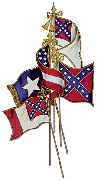
The politically correct society that we live in today says that you and I aren�t suppose to honor our Confederate dead nor are we suppose to display the symbols that these men carried into battle for 4 long and horrible years. These flags to these men meant to them love of their country, The Confederate States of America, love of their fathers, sons, brothers and friends who bled and suffered and the many who died fighting for what they believed in and knew was right. Above all these Southern men had courage, they had valor and honor. They were common everyday men who loved their way of life and who did not what to see it changed or taken from them. They had a passion and love of liberty and Freedom. These men were no different than the countless others that had echoed these same feelings all through history. Patrick Henry had this to say to the house on the 23rd of March 1775.
�It is in vain, sir, to extenuate the matter. Gentlemen may cry, Peace, Peace-- but there is no peace. The war is actually begun! The next gale that sweeps from the north will bring to our ears the clash of resounding arms! Our brethren are already in the field! Why stand we here idle? What is it that gentlemen wish? What would they have? Is life so dear, or peace so sweet, as to be purchased at the price of chains and slavery? Forbid it, Almighty God! I know not what course others may take; but as for me, give me liberty or give me death!�
That was the cry in 1775 that has been echoed over and over again through history. Why was it that our Confederate ancestors felt they must stand up and fight for what they knew was right? If we look at that war from a political point we must know and understand that our Southern people felt that there were certain constitutional guarantees given them as proclaimed in the Declaration of Independence by Thomas Jefferson and adopted by the American Constitutional Congress the 4th of July 1776 and embodied in the Constitution of the United States. We must remember that the Confederate Government was not a revolt against the Government of the United States; it was a protest against the abuse of that government which was established by the patriots of 1776. Then came the high tariffs. In the 1830�s South Carolina decided that the Federal government had not the right to pass high tariffs and the nullification crisis started. In the nullification debates we see that the agricultural South and West for the most part stood together against the North and East. Large increases in immigration from Europe began to pour into northern ports and to furnish much needed cheap labor for the Northern mills; the west needed many improvements that would be made at the expense of the Federal treasury. The improvements would call for large revenue and it added to the need for higher tariffs. Who were the higher tariffs going to be placed on? In the year of 1858 products of the north totaled around 45 million dollars and products of the South totaled some 193 million dollars. So we can see that the products of the South were more valuable than those of the north. The Kansas-Nebraska controversy also added to the causes of the war. The South was told to keep out of territories that they had helped to acquire right along beside the north. Along with all of this you had the abolitionist such as John Brown, Harriet Beecher Stowe and others who were causing concern to the Southern people. The Southern people had already seen what had happened in the slave uprisings in the Caribbean and Haiti. They were scared of the insurrection of the Negroes in the South. They knew that Lincoln would do nothing to stop this or give them any help. In a message given to congress the 19th of December 1859 this is what President Buchanan had to say. It ought never to be forgotten that however great may have been the political advantages resulting from the Union, these would all prove to be as nothing, should the time ever arrive when they cannot be enjoyed without serious danger to the personal safety of the people of fifteen members of the Confederacy. If the peace of the domestic fireside throughout these States should ever be invaded, if the mothers of families within this extensive region should not be able to retire to rest at night without suffering dreadful apprehensions of what may be their own fate and that of their children before the morning, it would be in vain to account to such a people the political benefits which result to them from the union.
Self preservation is the first law of nature, and therefore any state of society in which the sword is all the time suspended over the heads of the people must at last become intolerable.�
In his message on the 3rd of December 1860, President Buchanan said to Congress, and virtually to the people of the north. �The long continued and intemperate interference of the northern people with the question of slavery in the Southern States has at length produced its natural effects. I have long foreseen and often forewarned my countrymen of the new impending danger*** The immediate peril arises not so much from these causes as from the fact that the incessant and violent agitation of the slavery question throughout the north for the last quarter of a century has at length produced its malign influence on the slaves and inspired them with vague notions of freedom. Hence a sense of security no longer exists around the family altar. This feeling of peace at home has given place to apprehensions of servile insurrections.
Many a matron throughout the South retires at night in dread of what may befall herself and children before the morning. Self-preservation is the first law of nature and has been implanted in the heart of man by his Creator for the wisest purpose, but let us take warning in time and remove the cause of danger.�
The things I have told you are just a fraction of the reasons why our sister state of SC lead the way to secession. When the legislature of South Carolina met and passed the ordinance of Secession they then made �A declaration of the immediate causes which induce and justify the Secession of South Carolina from the Federal Union. Part of the Declaration said, �Thus were established the two great principles asserted by the Colonies, namely: The right of a State to govern itself, and the right of a people to abolish a government when it becomes destructive of the ends for which it was instituted. And concurrent with the establishment of these principles, was the fact that each Colony became and was recognized by the mother country as a Free, Sovereign and Independent State. On the 12th of April 1861 shots were fired on Fort Sumter. It has been estimated that over some 750,000 Southern men went to battle and an estimated 483,026 died for the cause for which they fought. North Carolina was one of the last states to secede from the Union but on April 15, 1861 two days after the surrender of Fort Sumter, Lincoln issued a mobilization order for the purpose of stopping as he described it a �Southern Insurrection� Governor Ellis of NC received a telegram from the secretary of war ordering him to furnish two regiments of state militia for active duty against the quote �rebels�. Governor Ellis saw this as unconstitutional and a �high-handed act of tyrannical outrage� against North Carolina�s Southern sisters. Governor Ellis�s reply vividly captures the essential reason why North Carolina joined on the Confederate side. This is what Governor Ellis had to say to Lincoln:
�Your dispatch is received, and if genuine, which its extraordinary character leads me to doubt, I have to say in reply that I regard the levy of troops made by the administration for the purpose of subjugating the states of the South, in violation of the Constitution and as a gross usurpation of power. I can be no party to this wicked violation of the laws of the country, and to this war upon the liberties of a free people. You can get no troops from North Carolinas.� Thus was the statement of Governor Ellis
On the 20th day of May 1861 an ordinance for secession was passed and North Carolina left the union. During those four years of the War for Southern Independence North Carolina furnished 125,000 men for the Confederacy and out of that some estimated 40, 305 died as a result of that war. Who were these 750,000 men who stood up against all odds for what they knew was right. The Confederate Soldiers have been placed in the front ranks of the world when it comes to soldiery. They have been described as men who fought more bravely than any men ever had. Their record shows beyond question that they were men of splendid courage who had unfaltering devotion to their South, they had unwavering loyalty to duty and dauntless courage in defense of what he knew was right. They were superb soldiers who endured hardships more patiently than any ever had. Most of the time they were poorly equipped, poorly clad, poorly fed and most of the time without pay. But they stood up against odds of 3 to one of well equipped, well fed, well clothed and well paid soldier of the north for 4 long horrible years and successfully resisted them. Northern Historians have been said to have admired them and their superior martial qualities and have used terms such as magnificent and incomparable to describe them. Today�s generation of the politically correct would have you believe that these Confederate Soldiers endured all the hunger, the pain, the suffering and the many lives lost simply because they were fighting to hold on to slavery in the South and the northern soldiers were fighting to free the slaves. Slavery as an issue of that war can be explained in many ways however, history tells us that there were fewer than an estimated 9% of the 750,000 Confederate soldiers who actually owned slaves. These men knew that their way of life was being threatened in everyway. Their feelings of being secure, their moral and God fearing way of life was going to be destroyed. They didn�t want to be ruled by a monster like Abraham Lincoln. They were not going to give up their wealth to the north, they wouldn�t have someone come into their country and tell them what to do. Over and over again the Confederate Veterans echoed that slavery was not the reason they took up arms. Col. C.B. Howard in June of 1867 had this to say about the reasons of that war. � The different generations had raised up on these different races of people, that the bloody war which had resulted had been brought on by the love of constitutional freedom on the part of the South, and a love for religion and law battling against a total disregard of all compacts on the part of the North, and an utter disregard of public morality, constitutional law and Bible religion on the part of the north. That while slavery may have embittered the contest it was not the cause, but only one of the incidents of the struggle. That constant and persevering invasions of our rights had proceeded from envy, hatred and malice.� Listen to the words written to the sister of my husband�s ancestor Dabney Cosby JR. who was a graduate of Washington University and who at the age of 25 found hisself a private in Company A of the Halifax Heavy Artillery of the 53rd VA Regiment. The letter was written on the 21st of Feb. 1862 from Fort Grafton near Yorktown Va. � I am glad to see that our defeat in Tennessee is naturally diminished by the telegrams in yesterdays papers. But it is bad enough at all event and we have not yet heard the truth of the catastrophe. But it does not dishearten us, but rather gives us a new inspiration of patriotic devotion. They may defeat us as we should have expected but they cannot conquer us. I feel as much as ever afraid of our independence. If a just God rules the nation, I do not, I cannot believe that he will yield us to the monsterous and inquistous desciption of the north.� In a letter to his mother he writes, � I would rather be fighting than sitting under the monsterous and evil rule of Abraham Lincoln.� While reading in my Confederate Veteran�s Magazine Book volume number 2 January 1894- December 1894 pg 210 the article is called � Gave Their Lives For Home and Country. This is the response that was given by Gen. S. G. French at a reunion of the Orange County Camp of UCV, at Orange County, Fla, on the 2nd of June 1894. For what more important purpose are we here than to honor the Confederate dead and to publicly proclaim that their memory is cherished in the hearts of our people? You state, Mr. Chairman that these men gave their lives for their homes and their country; if this be true, then there must have been some great principle or wrong involved in the issue, because men will not peril their lives and fortunes for an abstraction nor die for a metaphor.
We were a peaceful and quiet people, practicing the courtesies of an age that is past, and rose in arms only when our homes were threatened with invasion; and in doing so we did but exercise the first law of nature, an instinctive law that pervades all life. To have acted otherwise we would have lost self-respect, been untrue to ourselves, unworthy of our homes, false to our country, irreverent to God, who created man in his own image, conferring a nobility�a title above all created by the breath of man.
But I will pass on to the second part of the sentiment, which expresses the hope that �the memory of the Confederate dead may rest securely in the hearts of the Southern people�
I know of no better way to establish how deep-seated in the heart of the present generation is the respect for the Confederate dead than to illustrate it by some recent events: and before I do this I wish you to bear in mind that there is a tendency in men to condemn and to abandon their agents and leaders who have failed, and there by blasted the hopes of their supporters and followers whether in private enterprises or in military affairs not withstanding their labor and devotion to duty. The masses only look at results. If this test be applied to the Southern people, it will be found that they have ever been true to their leaders, alike in adversity as in prosperity; and his fidelity establishes their character as men, just as the field of battle has stamped their character as soldiers; and combined we have the highest known type of manhood. Do these statements from Confederate Soldiers not tell you who these Southern soldiers were and what they were fighting for? They knew what would happen if they didn�t stand up and fight for what they knew was right. So our ancestors took up arms, they left their homes and families and marched off to defend their Constitutional liberty. They wanted their God given rights of freedom and independence. They wanted what had been handed down to them by the Declaration of Independence and by the Constitution, their freedom and their independence. They were willing to fight even if it meant sure death to them.
It is my belief that recent generations of Southerners perhaps have lost the will and knowledge passed on to us by the Sons and Daughters of our Confederate Heroes to defend their history, and heritage which is not only our duty and concern but is even more important today considering how far we as a nation have strayed from the original principals of the Constitutional Republic as given to our Confederate Ancestors by the founding fathers. They tried to hand down to the next generations the will to fight and make sure that somehow the truth would be told. At the last United Confederate Veterans Reunion in New Orleans in the year of 1906 Gen. Stephen D. Lee in his address made it very clear about what he felt about the future. As you sit or stand here today I want you to close your eyes and open up your heart to the words as I read to you what Gen Stephen Dill Lee had to say.
�Comrades, there is one thing committed to our care as a peculiar trust----the memory of the Confederate soldier. So far as lies in our power, we have striven that history may not lack the evidence of his purity of motive, his fortitude, and his heroism. I, for one, do not fear that justice, however long delayed, will not ultimately be done to one of the grandest bodies of men who ever battled for independence or triumphing over defeat, bound up the bleeding wounds of their country.
There are three things peculiarly left for our concern. One of these is the erection of public monuments to our Confederate dead; not only to our leaders, but above all, to those private soldiers who made our leaders immortal. We must not over task posterity by expecting those who come after us to build monuments to heroes whom their own generation were unwilling to commemorate. The South has reached a position of material prosperity which justifies both state and private beneficence to honor the faithful dead.
In All human lot there has nothing been more found for man than to die for his country. If there be any virtue, if there be any praise, this fate is to be preferred above all others. We feel it is well with those who have thus fulfilled the highest of all trust, the duty of a citizen to his native land; and whatever may have been their private faults, their public service upon the field of battle has rightly given them a place with the immortals. Theirs was the martyr�s devotion without the martyr�s hope. Their generation and their country imposed upon them this high service. They fulfilled it with out flinching. They felt that the issue of battle was with God; the issue of their duty was with themselves.
I urge monuments to the Confederate soldier first for the sake of the dead, but most for the sake of the living that in this busy industrial age these stones to the Confederate soldier may stand like great interrogation marks to the soul of each beholder.
Let us pass the remainder of our days in such wise that nothing we shall do will bring shame and regret that we also were Confederate soldiers. As we shared with them the glory of their sufferings, the fame of their victories the tragedy of their overthrow, and that sympathy of their countrymen which covered the defeated as with a mantle of imperishable love, let us also share as best we may their simplicity of heart, their scorn of all ignoble actions, their dignity of soul, that our descendants may say of us with swelling hearts: He also followed Johnston; he also fought with Lee. To this day there stands carved upon the graves of English ancestors the symbol of the Crusaders. Their names are forgotten, but the cross remains. So let it be with the Confederate Soldier!
And is there any message we would give to the states we loved and on whose behalf we drew our swords more than a generation ago? As we have sorrowed over you devotion, we now rejoice in you prosperity. We chose for you the fortune of war rather than a shameful peace. We battled for you principle rather than yield them, not to conviction but to force. With breaking hearts we bowed beneath the stroke of fate. We chose the only course worthy of Americans. Better defeat than dishonor; better the long bitter story of reconstruction than tame surrender of the convictions we received from our fathers, the principles which we cherished as the basis of our liberties. We leave our motives to the judgment of posterity. In the choice we made we followed the dictates of conscience and the voice of honor. We sacrificed all that men hold dear for the land of our birth; and while we have no fear that history will record our deeds with shame, we do not regard even the verdict of posterity as the equivalent of a clear conscience; nor ought we to have been false to our convictions even to win the eternal praises of mankind. If our children shall praise us, it is well� if our own hearts tell us we have fulfilled our duty, it is better.
To you, mothers of the Memorial Association, will be given the service of commemorating the soldier�s virtues in the hearts of those who come after us by the story of the illustrious dead, of comforting the hearts of those who mourn our lost heroes with such ministrations as bespeak the sympathy of the patriot and the loving kindness of those who are familiar with the same sorrow.
To you, Son of Confederate Veterans, we will commit the vindication of the cause for which we fought. To your strength will be given the defense of the Confederate Soldiers good name, the guardianship of his history, the emulation of this virtues, the perpetuation of those principles which he loved and which you love also, and those ideals which made him glorious and which you also cherish. Are you also ready to die for your country? Is you life worthy to be remembered along with theirs? Do you choose for yourself this greatness of soul?
Not in the clamor of the crowded street,
Not in the shouts and plaudits of the throng,
But in ourselves are triumph and defeat.
To you, Daughters of the Confederacy will be given the loving service of remembering the Confederate dead and of ministering to the living who were dear to him and are in need of your help and tenderness. Worthy daughters you shall be of the immortal women, your mothers, who gave to womanhood a new perfection of heroism and a more divine expression of sacrifice and devotion.
To you, brave people of the South; to you true-hearted Americans everywhere; to you, world-conquering race from which we sprung- to all men everywhere who prize in man the manliest deeds, who love in man the love of country, who praise fidelity and courage, who honor self-sacrifice and noble devotion, will be given an incomparable inheritance, the memory of our prince of men, The Confederate Soldier.
You need to search your hearts and souls and ask yourself if you as descendants of these Confederate men and women are exemplifying them through what you are doing and saying. Are you standing up in defense of their good name, are you protecting their history and making sure that in this day and time of political correctness that the true history of our South and these men and women is being told correctly. Are you emulating the virtues of these men and women in everything that you do? Are you seeing to it that the principals that these men and women lived by will be carried on forever? Are you doing these things will all the love, honor and respect that they did? I can�t answer these questions for you but I know as a descendant of 81 Confederate soldiers I am and will do all that is in my power to show people that my Confederate ancestors were not about hate or animosity toward any one but that they were courageous men and women who loved who they were, loved their South, their independence and who believed in their rights set forth by the Constitution. It is my duty to protect them against anyone who is distorting or lying about them or the symbols they held dear whether it be from those opposed to all things Confederate or those of our own people who are saying, �yes remove the Confederate Flag and let that time in history go.� It is my duty to educate others about that time in history and it is my duty to see to it that we have our focus on the things we should have and that we do not sway from the course that was laid before us by our Confederate ancestors and their examples. It is my duty to see to it that their memory and the true history of the South is carried on for generations to come
What is your duty?
Deo Vindice