

"The Old North State"
The Old North State
Written by William Gaston
Composed by Mrs. E. E. Randolph
Carolina! Carolina! Heaven's blessings attend her!
While we live we will cherish, protect and defend her;
Tho' the scorner may sneer at and witlings defame her,
Still our hearts swell with gladness whenever we name her.
Hurrah! Hurrah! The Old North State forever!
Hurrah! Hurrah! The good Old North State!
Tho' she envies not others, their merited glory,
Say whose name stands the foremost, in Liberty's story,
Tho' too true to herself e'er to crouch to oppression,
Who can yield to just rule a more loyal submission?
Hurrah! Hurrah! The Old North State forever!
Hurrah! Hurrah! The good Old North State!
Plain and artless her sons, but whose doors open faster
At the knock of a stranger, or the tale of disaster.
How like the rudeness of the dear native mountains,
With rich ore in their bosoms and life in their fountains.
Hurrah! Hurrah! The Old North State forever!
Hurrah! Hurrah! The good Old North State!
And her daughters, the Queen or the forest resembling
So graceful, so constant, yet the gentlest breath trembling.
And true lightwood at heart, let the match be applied them,
How they kindle and flame! Oh! none know but who've tried them.
Hurrah! Hurrah! The Old North State forever!
Hurrah! Hurrah! The good Old North State!
Then let all those who love us, love the land that we live in,
As happy a region as on this side of heaven,
Where plenty and peace, love and joy smile before us,
Raise aloud, raise together the heart thrilling chorus.
Hurrah! Hurrah! The Old North State forever!
Hurrah! Hurrah! The good Old North State!
he song known as "The Old North State" was adopted as the official song of the State of North Carolina by the General Assembly of 1927. (Public Laws, 1927, c. 26; G.S. 149-1)

�Esse Quam Videri� **** �to be rather than to seem�
The General Assembly of 1893 (chapter 145) adopted the words "Esse Quam Videri" as the State's motto and said that these words with the date "20 May, 1775," be placed with our Coat of Arms upon the Great Seal of the State.
The words "Esse Quam Videri" means "to be rather than to seem." Nearly every State has adopted a motto, generally in Latin. The reason for mottoes being in Latin is that the Latin language is far more condensed and terse than the English. The three words, "Esse Quam Videri," require at least six English words to express the same idea.
The origin of our state motto is found in Cicero's essay on Friendship (Cicero de Amnicitia, Chapter 26).
Until 1893 the sovereign State of North Carolina had no motto since its declaration of independence. It was just a few states did not have a motto and it was the only one of the original thirteen without one.
The flag is an emblem of antiquity and has commanded respect and reverence from practically all nations from the earliest times. History traces it to divine origin, the early peoples of the earth attributing to it strange, mysterious, and supernatural powers. Indeed, our first recorded references to the standard and the banner, of which our present flag is but a modified form, are from sacred rather than from secular sources. We are told that it was around the banner that the prophets of old rallied their armies and under which the hosts of Israel were led to believing, as they did, that the flag carried with it divine favor and protection.
Since that time all nations and all peoples have had their flags and emblems, though the ancient superstition regarding their divine merits and supernatural powers has disappeared from among civilized peoples. The flag now, the world over, possesses the same meaning and has a uniform significance to all nations wherever found. It stands as the symbol of strength and unity, representing the national spirit and patriotism of the people over whom it floats. In both lord and subject, the ruler and the ruled, it commands respect, inspires patriotism, and instills loyalty both in peace and war. In this country we have a national flag which stands as the emblem of our strength and unity as a nation, a living representation of our national spirit and honor. In addition to our national flag, each of the states in the Union has a "state flag" which is symbolic of its own individuality and domestic ideals. The state flag also expresses some particular trait, or commemorates some historical event of the people over whom it floats. The flags of most of the states, however, consist of the coat of arms of that state upon a suitably colored field. It is said that the first state flag of North Carolina was built on this model but legislative records show that a "state flag" was not established or recognized until 1861. The constitutional convention of 1861, which passed the ordinance of secession, adopted a state flag. On May 20, 1861, the day the secession resolution was adopted, Col. John D. Whitford, a member of the convention from Craven County, introduced an ordinance, which was referred to a select committee of seven. The ordinance stated that "the flag of this State shall be a blue field with a white V thereon, and a star, encircling which shall be the words, Sirgit astrum, May 20, 1775."
Colonel Whitford was made chairman of the committee to which this ordinance was referred. The committee secured the aid and advice of William Jarl Browne, an artist of Raleigh. Browne prepared and submitted a model to this committee and this model was adopted by the convention of June 22, 1861. The Browne model was vastly different from the original design proposed by Colonel Whitford. The law as it appears in the ordinance and resolutions passed by the convention is as follows:
AN ORDINANCE IN RELATION TO A STATE FLAG
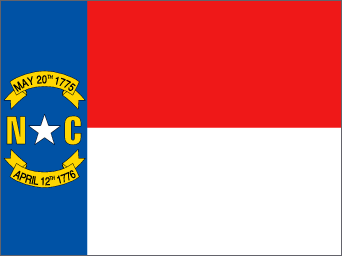
Be it ordained by this Convention, and it is hereby ordained by the authority of the same, That the Flag of North Carolina shall consist of a red field with a white star in the centre, and with the inscription, above the star, in a semi-circular form, of "May 20th, 1775," and below the star, in a semi-circular form, of "May 20th, 1861." That there shall be two bars of equal width, and the length of the field shall be equal to the bar, the width of the field being equal to both bars: the first bar shall be blue, and second shall be white: and the length of the flag shall be one-third more than its width. [Ratified the 22nd day of June, 1861.]
This state flag, adopted in 1861, is said to have been issued to North Carolina regiments of state troops during the summer of 1861 and borne by them throughout the war. It was the only flag, except the national and Confederate colors, used by North Carolina troops during the Civil War. This flag existed until 1885, when the Legislature adopted a new model.
The bill, which was introduced by General Johnstone Jones on February 5, 1885, passed its final reading one month later after little debate. This act reads as follows:
AN ACT TO ESTABLISH A STATE FLAG
The General Assembly of North Carolina do enact:
SEC. 1. That the flag of North Carolina shall consist of a blue union, containing in the centre thereof a white star with the letter N in gilt on the left and the letter C in gilt on the right of said star, the circle containing the same to be one-third the width of
the union.
SEC. 2. That the fly of the flag shall consist of two equally proportioned bars; the upper bar to be red, the lower bar to be white; that the length of the bars horizontally shall be equal to the perpendicular length of the union, and the total length of the
flag shall be one-third more than its width.
SEC. 3. That above the star in the centre of the union there shall be a gilt scroll in semi-circular form, containing in black letters this inscription "May 20th, 1775," and that below the star there shall be similar scroll containing in black letters the
inscription: "April 12th, 1776."
SEC. 4. That this act shall take effect from and after its ratification.
In the General Assembly read three times and ratified this 9th day of March, A.D. 1885.
It is interesting to examine the significance of the dates found on the flag. The first date, "May 20, 1775," refers to the Mecklenburg Declaration of Independence, although many speculate the authenticity of this particular document. The second date appearing on the state flag of 1861 is that of "May 20th, 1861." This date commemorated the secession of the State from the Union, but as the cause for secession was defeated, this date no longer represented anything after the Civil War. So when a new flag was adopted in 1885, this date was replaced with "April 12th, 1776." This date commemorates the Halifax Resolves, a document that places the Old North State in the very front rank, both in point of time and in spirit, among those that demanded unconditional freedom and absolute independence from any foreign power. This document stands out as one of the great landmarks in the annals of North Carolina history.
Since 1885 there has been no change in our state flag. For the most part, it has remained unknown and a stranger to the good people of our State. However, as we became more intelligent, and therefore, more patriotic and public spirited, the emblem of the Old North State assumed a station of greater prominence among our people. One hopeful sign of this increased interest was the act passed by the Legislature of 1907, requiring the state flag to be floated from all state institutions, public buildings, and courthouses. In addition to this, many public and private schools, fraternal orders, and other organizations now float the state flag. The people of the State should become acquainted with the emblem of that government to which they owe allegiance and from which they secure protection, and to ensure that they would, the legislature enacted the following:
AN ACT TO PROMOTE GREATER LOYALTY AND RESPECT FOR THE SOVEREIGNTY OF THE STATE
The General Assembly of North Carolina do enact:
SEC. 1. That for the purpose of promoting greater loyalty and respect to the state and inasmuch as a special act of the Legislature has adopted an emblem of our government known as the North Carolina State flag, that it is meet and proper that it shall be given greater prominence.
SEC. 2. That the board of trustees or managers of the several state institutions and public buildings shall provide a North Carolina flag, of such dimensions and materials as they deem best, and the same shall be displayed from a staff upon the top of each and every such building at all times except during inclement weather, and upon the death of any state officer or any prominent citizen the flag shall be put at half-mast until the burial of such person shall have taken place.
SEC.3. That the Board of County Commissioners of the several counties in this state shall likewise authorize the procuring of a North Carolina flag, to be displayed either on a staff upon the top, or draped behind the judge's stand, in each and every term of court held, and on such other public occasions as the Commissioners may deem proper.
SEC. 4. That no state flag shall be allowed in or over any building here mentioned that does not conform to section five thousand three hundred and twenty-one of the Revisal of one thousand nine hundred and five.
SEC. 5. That this act shall be in force from and after its ratification.
In the General Assembly read three times, and ratified this 9th day of March, A.D. 1907.
Many North Carolinians have questioned the legitimacy of having the date of the Mecklenburg Declaration, May 20th, 1776, on the flag. Historians have debated its authenticity because of the lack of any original documentation. The only evidence of the Declaration is a reproduction from memory many years later by one of the delegates attending the convention. Historians' main argument, other than the non-existence of the original document, is that the Mecklenburg Resolves, adopted just eleven days after the Mecklenburg Declaration, are comparatively weak in tone, almost to the point of being completely opposite. Many historians find it difficult to believe that the irreconcilable tone of the Declaration could have been the work of the same people who produced the Resolves. Efforts have been made to have the date taken off the flag and the seal, but so far these efforts have proved fruitless. Removal from the seal would be simple enough, for the date of the Halifax Resolves could easily be substituted without changing the basic intention of the date. The flag would prove to be more difficult, for there is no other date of significance which could be easily substituted.
Information taken from the State Library of North Carolina

I salute the North Carolina Flag and pledge to the
Old North State love, loyalty, and faith.
Richard Caswell, 1776 - 1780 (first of two terms)
Abner Nash, 1780 - 1781
Thomas Burke, 1781 - 1782
Alexander Martin, 1782 - 1785 (first of two terms)
Richard Caswell, 1784 - 1787 (second of two terms)
Samuel Johnston, 1787 - 1789
Alexander Martin, 1789 - 1792 (second of two terms)
Richard Dobbs Spaight, Sr., 1792 - 1795
Samuel Ashe, 1795 - 1798
William Richardson Davie, 1798 - 1799
Benjamin Williams, 1799 - 1802 (first of two terms)
James Turner, 1802 - 1805
Nathaniel Alexander, 1805 - 1807
Benjamin Williams, 1807 - 1808 (second of two terms)
David Stone, 1808 - 1810
Benjamin Smith, 1810 - 1811
William Hawkins, 1811 - 1814
William Miller, 1814 - 1817
John Branch, 1817 - 1820
Jesse Franklin, 1820 - 1821
Gabriel Holmes, 1821 - 1824
Hutchins Gordon Burton, 1824 - 1827
James Iredell, Jr., 1827 - 1828
John Owen, 1828 - 1830
Montford Stokes, 1830 - 1832
David Lowry Swain, 1832 - 1835
Richard Dobbs Spaight, Jr., 1835 - 1836
Edward Bishop Dudley, 1836 - 1841
John Motley Morehead, 1841 - 1845
William Alexander Graham, 1845 - 1849
Charles Manly, 1849 - 1850
David Steele Reid, 1851 - 1854
Warren Winslow, 1854 - 1855
John Willis Ellis, 1859 - 1861
Henry Toole Clark, 1861 - 1862
Zebulon Baird Vance, 1862 - 1865 (first of two terms)
William Woods Holden, 1865 (first of two terms)
Jonathan Worth, 1865 - 1868
William Woods Holden, 1868 - 1870
Tod Robinson Caldwell, 1870 - 1874
Curtis Hooks Brogden, 1874 - 1877
Zebulon Baird Vance, 1877 - 1879 (second of two terms)
Thomas Jordan Jarvis, 1879 - 1885
Alfred Moore Scales, 1885 - 1889
David Gould Fowle, 1889 - 1891
Thomas Michael Holt, 1891 - 1893
Elias Carr, 1893 - 1897
Daniel Lindsay Russell, 1897 - 1901
Charles Brantley Aycock, 1901 - 1905
Robert Broadnax Glenn, 1905 - 1909
William Walton Kitchin, 1909 - 1913
Locke Craig, 1913 - 1917
Thomas Walter Bickett, 1917 - 1921
Cameron Morrison, 1921 - 1925
Angus Wilton McLean, 1925 - 1929
Oliver Max Gardner, 1929 - 1933
John Christoph Blucher Ehringhaus, 1933 - 1937
Clyde Roark Hoey, 1937 - 1941
Joseph Melville Broughton, 1941 - 1945
Robert Gregg Cherry, 1945 - 1949
William Kerr Scott, 1949 - 1953
William Bradley Umstead, 1953 - 1954
Luther Hartwell Hodges, 1954 - 1961
Terry Sanford, 1961 - 1965
Dan Killian Moore, 1965 - 1969
Robert Walter Scott, 1969 - 1973
James Eubert Holshouser, Jr., 1973 - 1977
James Baxter Hunt, Jr., 1977 - 1985 (first of two terms)
James Grubbs Martin, 1985 - 1993
James Baxter Hunt, Jr., 1993 - 2001
Michael F. Easley, 2001 -
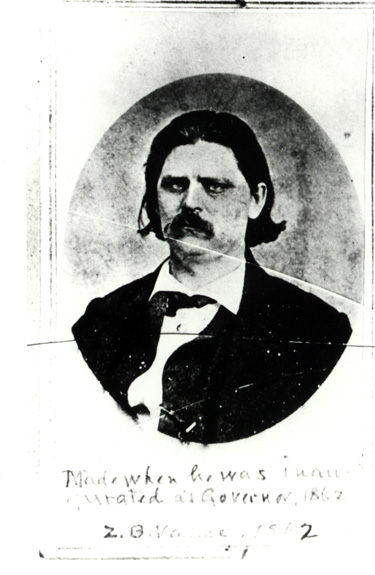
Governor of North Carolina
During The War Of Northern Aggression
Vance became the "soldier's candidate" for North Carolina governor and he easily won the post with a majority which included the vote of every man in his regiment. He took office in September 1862 and was re-elected in 1864. While the new governor was a Southerner, he was a North Carolinian first. During the War years, that priority put him in conflict several times with the confederate government in Richmond.
Governor Vance was a States' Righter and some of his independent actions did not find favor in Richmond. In particular, there was disagreement over his policy of exporting North Carolina cotton abroad by way of blockade runner ships and using the material received in exchange for the benefit of North Carolinians, both civilian and military. Because of this policy, North Carolina was the only Confederate state to equip and clothe its own regiments, but much of the blockade runner supplies were shared with the rest of the Confederacy. General Longstreet's Army for example received 12,000 uniforms from North Carolina after the Battle of Chickamauga.
Of all of Governor Vance's policies, the most remarkable was his insistence, in the midst of the devastation and confusion of war, upon the maintenance of the rule of law. North Carolina courts continued to function during the war, and North Carolina stands alone as the only state which never suspended the writ of habeas corpus.
With the fall of Fort Fisher in January of 1865, the last port open to the Confederacy was closed. In May General Joseph E. Johnston surrendered his Confederate troops to General William Tecumsah Sherman at the Bennett Place near Durham. Later that month Governor Vance was arrested and taken into custody by federal troops. He spent time as a prisoner in the Old Capital Prison in the District of Columbia.
After the War
At the end of 1865 Vance was paroled and sent home. He went to Charlotte and resumed practicing law. He also began a new career on the lecture circuit and used the monies earned to maintain his family and satisfy old debts.
In 1870 the governor won one of the North Carolina seats in the U.S. Senate, but still being under parole, was not allowed to serve. But six years later, by a majority of 13,000 votes, he defeated Thomas Settle and was voted into his third term as North Carolina's governor. During this third term the remaining federal troops left North Carolina. Also during this term, Governor Vance proposed plans to the legislature for increased educational facilities and teacher training throughout the state.
This third term was a short one, for in 1878 Governor Vance became U.S. Senator Vance, an office he held until his death on April 14, 1894.
Zebulon Vance was married twice. He was first married in 1853 to Miss Harriet Espy. Two years after his first wife's death in 1878, the Governor was married in 1880 to Mrs. Florence Steele Martin of the State of Kentucky. Governor Vance was the father of four sons by his first marriage.
In 1861, as war waged on and states continued to secede, North Carolina maintained its neutrality. However, when U.S. President Lincoln demanded troops for the Union armies from North Carolina, Gov. Ellis saw this as unconstitutional, and a "high-handed act of tyrannical outrage" against North Carolina's Southern sisters. Gov.Ellis responded to Lincoln in this manner, "You will receive no troops from North Carolina" and he issued a proclamation calling for a special session of the state legislature. The legislature backed Gov Ellis, and called a convention to declare secession. On May 20 1861, an ordinance for secession was passed, and North Carolina left the Union.
During the four years of that War for Southern Independence NC furnished 125,000 men for the Confederacy. NC had 14,452 killed, 5,151 died of wounds and 20,602 died of disease. That is a total of 40,305 men which is by the recorders more than any other state. It is said that NC furnished 1/5 of the men in the Confederacy. These Southern men of NC were among some of the finest men who fought. General A.P. Hill had this to say of our NC men. � Unquestionably North Carolinians�not that they are braver where all are brave, but brave as the bravest, they are the most obedient to command.� It was this marked trait which gave the troops from NC their pre-eminence. It was the same quality which gave to the Roman soldier his fame and to Rome the empire or the world. History shows no soldier since who more nearly resembles the legionaries of Caesar than the North Carolina Confederate private. He displayed, together with the same intrepidity, the same uncomplaining endurance of hardship and hunger, the same unquestioning obedience to orders, and wherever the bravest officer dared to lead, these the private soldier from the plains, the valleys and the mountains of NC swept on in his long unbroken lines. They but did as they were told to do and blushed to find it fame.
On August 29th 1864 General Lee wrote to Gov. Vance of NC about our men, � If the men who remain in NC show the spirit of those they have sent to the field, as I doubt not they do, her defense may be securely entrusted to their hands.� At Sailors Creek, when the jubilant Federals were driving the Confederate before them and Lee had sent his staff to rally his men, presently a column in good order came up and a smile of momentary joy lighted up the distressed features of the General. He called: � What troops are those/� � Cox�s NC Brigade.� Taking off his hat and bowing his head, he said: � God Bless gallant old North Carolina.� Our NC men of the Confederacy were known as �First at Bethel, Last at Appomattox� and �Farthest to the front at Gettysburg and at Chickamauga� President Davis had this to say about our NC troops in 1882, �Hence she was not among the first to pass an ordinance for secession; yet after having duly counted the cost, she boldly accepted the issue and staked life, fortune, and sacred honor on the maintenance of the principles for which her sons had fought, bled, and died in the war of 1776.
�How her sons bore themselves in the last ordeal your roster will partly tell. There will be shown the relative proportion of her troops to her population capable of bearing arms, and the long list of killed and wounded will prove that they were not the rear in attack or the front in retreat.�
�I have often expressed my high estimate of the conduct of North Carolinians during our war, but can eulogy enhance the fair fame with which their names will descend to posterity?? That their children and their children�s children may be worthy of their sires is the best wish and highest hope which I can offer them.�
DEO VINDICE
