

IT Strategy
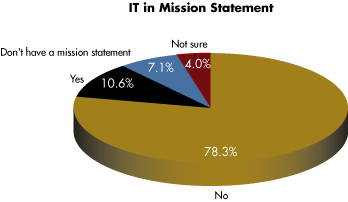
To optimize the value of IT to restaurant firms, it is essential that IT be integrated into strategic planning and management. Such integration is essential regardless of the type or size of the restaurant or the type of ownership—corporate or individual. To date, there has been only limited recognition of IT in the strategic thinking of most restaurateurs. When asked whether their firm’s mission statement had any reference to IT strategic planning; only 10.6% of this year’s survey respondents indicated that their mission statement included a reference to IT. This percentage is little changed from the 2003 percentage (9.0%). Thus, even though it seems that restaurateurs now have a more positive outlook toward the incorporate of IT into their operations, they have not yet considered IT to be part of their strategic planning. (See Figure 3.1)
The situation is a bit better in regard to the incorporation of IT into restaurant firms’ general business plans, though there is still much room for improvement. Only about one-fifth of the respondents (21.2%) indicated that technology strategy was highly integrated into their firms’ business plans. Another 60.6% indicated that IT was partially integrated into their firms’ business plans (a combined total of 81.8%.) (See Figure 3.2)
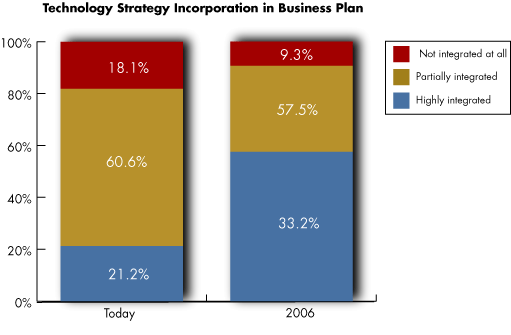
Just as was true in regard to these firms’ mission statements and IT, the situation is little changed from the 2003 survey results which indicated that about 17% of the respondents’ firms had technology strategy highly integrated into their general business plans and about 65% had IT partially integrated (a total of about 82%). The only change seems to be that a few of the firms that had IT partially integrated into their business plans last year now have IT more fully integrated into their plans. Unfortunately, though the remaining 18% of the respondents seem to have made no progress in regard to incorporating IT into their strategic thinking over the past year. There is a window of opportunity here for those restaurant firms who are thinking strategically about IT to gain a competitive edge over other firms that are not using IT strategically.
Although currently IT is not well integrated into restaurant firms’ business plans, the survey respondents were optimistic about the integration of IT into their firm’s strategic planning in the future. When asked to what extent they felt that technology strategy would be incorporated into their firms’ business plans in 2006, 57.5% indicated that they felt it would be highly integrated, and another 33.2% thought that it would be partially integrated (a total of 90.7% of all respondents). While about one-half of those firms who do not currently have any reference to IT in their business plans thought that their firms would have IT incorporated into their plans in at least some way in 3 years, the biggest change anticipated by 2006 is that firms will move from having IT partially integrated into their business plans to having it fully integrated.
Even if technology strategy is inco0rporated into a restaurant firm’s mission statement and/or its business plan, it is also important to consider how IT initiatives are developed, evaluated and implemented within the firm. As has been previously noted, “people issues” were the most frequently noted obstacle to the implementation of IT systems within restaurant firms. How IT initiatives are developed and handled within the firm can potentially have an important impact on “people issues”, or on how well the firm’s employees accept and support the incorporation of IT into their work environment.
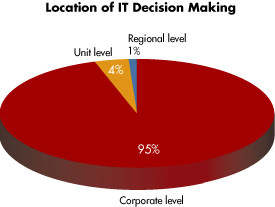
When asked where IT decisions were made within their firm, 95% indicated that these decisions were made at the corporate level. Thus, both management and employees at the regional and unit levels of the firms’ operations do not seem to be involved in the IT decision making process. (See Figure 3.3)
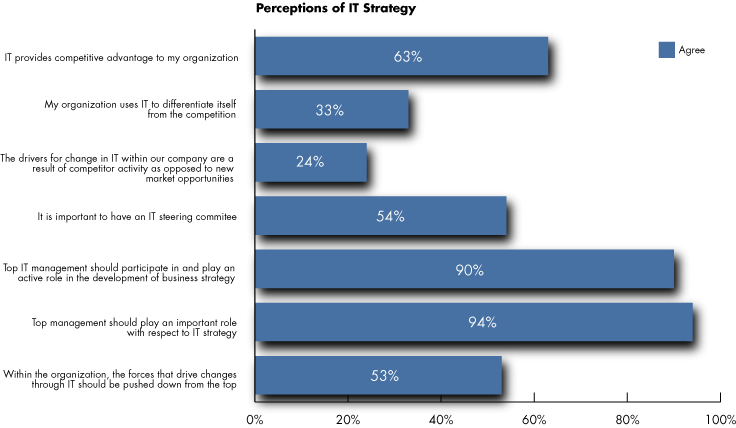
Corporate level IT management may well be the persons that are most knowledgeable about the capability of existing and potential IT systems, and they may be the people most able to suggest ways in which IT could be integrated into the overall business strategy. Indeed, 94.2% of the survey respondents indicated that top management should plan an important role with respect to IT strategy. (See Figure 3.4)
However, top management personnel are not the persons who will actually be “living with” the IT systems on a day to day basis. Even though corporate level personnel can see ways in which IT could enhance the possibility of meeting or exceeding the performance standards established through the strategic planning process, it takes the support and cooperation of personnel at the regional and unit levels in order to actually accomplish those standards. Thus, many restaurant firms have potential opportunities to improve their operational performance through the use of IT, not only by giving IT greater consideration in their mission statements and business plans, but also through the incorporation of regional and unit level personnel into the IT decision making process.
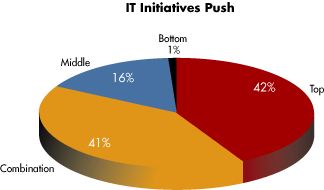
When asked where IT initiatives and IT-drive change are pushed from, the emphasis on the corporate level of management was further emphasized. Forty-two percent of the respondents indicated that, in their firms, IT initiatives were pushed down from the top of the firm. Only 1% indicated that IT initiatives were pushed from the unit level, with 16% indicating that IT initiatives were pushed by middle management or management at the regional level. On a more positive note, though, 41% indicated that IT initiatives were pushed by some combination of management levels; thus persons at the firms’ operational level seem to be more involved in the development and promoting of IT initiatives than they are in the actual decision making regarding IT implementation. (See Figure 3.5)
Interestingly, 53.1% of the survey respondents thought that within their organization, the forces that drive changes through IT should be pushed down from the top while 37.2% of the respondents disagreed with this perspective. Thus, there is definitely a feeling among this year’s respondents that managers, other than top level IT managers, should be involved in the IT planning and decision making process. As lower (unit) and middle (regional) management become more involved with the development of IT initiatives, the difficulties with “people issues” as implementation obstacles should decline.
One approach that firms might use to incorporate more persons throughout the different levels of management, as well as from different aspects of corporation operations, into the IT planning and implementation process would be to establish an IT steering committee within the firm. When asked if their firm had an IT steering committee, only 29.2% indicated that their firms had such a committee. (See figure 3.6)

Yet, 54.4% of the 2004 survey respondents and 60.4% of the 2003 survey respondents indicated that they thought that it was important for a restaurant firm to have a steering committee that was responsible for and/or involved with the establishment of the firm’s IT policy. Thus, it seems that although many feel that IT steering committees are important, only about half of those firms have actually implemented such a committee, and little progress has been made over the past year in regard to restaurant firms’ development of IT steering committees. Given the interest in such committees, the development of an IT steering committee is yet another opportunity for many restaurant firms that would like to effectively incorporate IT into their operations and mesh technology strategy with their business plans.
While IT has the potential to enhance a restaurant firm’s competitive edge, it is interesting to note that only 63.3% of the respondents indicated that IT provided a competitive advantage for their organization. However, this percentage represented a slight increase over the 58.2% of the previous year’s respondents who felt that IT gave their firms a competitive edge. One has to wonder why restaurateurs do not feel that the incorporation of IT into their operation can provide them with a competitive advantage. If IT systems will not enhance a restaurant firm’s competitive position, then what is the purpose of implementing such systems?
Further evidence that participants in this year’s survey did not see IT systems as a strategic tool which might give them a competitive advantage was the respondents’ lack of agreement with the statements that “my organization uses IT to differentiate itself from the competition” (only 33.2% agreed), and “the drivers for change in IT within our company are a result of competitor activity as opposed to new market opportunities” (only 24.3% agreed). The percentages of respondents who agreed with these statements are the same as the percentages that agreed with the statements last year. Thus, there has been no apparent change in restaurant firms’ perception of the potential of IT as a strategic tool which they might use to gain a competitive advantage in a highly competitive marketplace.
When considering IT strategy, it is important to know how restaurant firms are spending their IT dollars. Strategic planning for the future is very difficult without knowledge about the present baseline for IT incorporation in the firm’s business. Survey respondents were asked to indicate the percentage of their 2002 budget that was spent on each of 13 possible areas where IT might be utilized. They were also asked to indicate the percentage of their firms’ 2003 budget that was planned for each of these same areas. There was relatively little change in the allocation of these firms’ IT budget from 2002 to 2003. For both years, expenditures for the maintenance and support of existing IT and for hardware/software upgrades accounted for about 44% of the total IT budget. Expenditures for technology infrastructure and technology services, such as training, accounted for another 15% of the IT budget. Thus, a very large portion of restaurant firms’ IT budget is going toward maintaining and upgrading existing systems. (See Figure 3.7)
 Hosted by www.Geocities.ws