 (1.1)
(1.1)Fabrication of Optical Components for an 8” Newtonian Telescope
Shashikiran Ganesh
Department of Space Sciences
School of Sciences, Gujarat University
Ahmedabad
Project Report On Inplant Training Under Supervision
Of
Shri A.S.Kiran Kumar
Sensor Systems Division
Electro-Optics Sensor Development Group
Space Applications Centre (ISRO)
Ahmedabad
June-August 1995
Contents
1The Telescope 1
I.Introduction to the telescope system 1
II.The Principle of the Telescope 1
III.Some terminology associated with Telescopes 2
IV.Types of Telescopes 4
2Mirror Making 10
I.The Basic Principles of Optical Component Fabrication 10
II.Testing of Optical surfaces 14
3Making an 8” Newtonian 17
I.The Optical System 17
II.Calculations Of Parameters for the Newtonian System 17
III.The Telescope’s Mechanical Structure - a note 20
4Acknowledgements 21
5Bibliography 22
Of all the human senses, the eye is the most well developed, efficient and sensitive detector. Any instrument used to supplement this versatile detector would improve our perception of our environment. One such extremely useful instrument is the telescope. The credit for its invention goes to the Dutch Optician, Hans Lippershey for work in the year 1608.
Galileo Galilei was among the first (1609-1610) to use this invention to investigate the nature of the Universe by looking through his telescope at the Moon, the Planets and the Stars. Using this instrument he was convinced of the truth of the Copernican system. This was the first major success of the telescope as a scientific tool. Others were to follow soon after. Today we can hope that we have a fairly accurate description of the large scale structure of the Universe thanks to the telescope. One might say along with the poet Robert Frost1
“How stirring it is, the Sun and everything. Take a telescope and look as far as you will. How much of a universe was wasted just to produce puny us. It’s wonderful...,fine.”
The telescope, as its name indicates, is an instrument or optical aid to help the human eye to distinguish details in far off objects. In that sense, one might say that it brings the object of investigation closer to the observer. It does this by virtue of its resolving power & angular magnification. Telescopes generally produce an inverted image (except in the Galilean form), which, though not a problem for astronomical applications, is inconvenient for terrestrial viewing. Hence in telescopes used for terrestrial observing there is an additional lens or prism to make the final image an erect image.
As with any other branch of science, the Telescope too has its own descriptive parameters:
The lens or mirror to which light, from the object being viewed, comes first is known as the Objective lens (mirror) of the telescope.
The Eyepiece is the lens (usually a combination of lenses) closest to the eye.
The diametrical width of the objective lens (mirror) is known as the Aperture of the telescope. The focal-length is the optical path length from the objective to the focal plane of the objective. Some telescopes with secondary mirrors (i.e. with multiple elements) have what is known as an effective focal-length. F-ratio is the ratio of the aperture to the focal length of the system. Note that the f-ratio of the objective need not be the same as the f-ratio of the entire telescope system, since the effective focal length of the telescope may not be equal to the focal length of the objective. In general a large f-ratio implies larger angular magnification and a correspondingly smaller field of view.
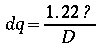
Resolution of a telescope is a measure of the smallest detail that can be distinguished in the object being studied. It is related to the wavelength at which the telescope is observing as well as to the aperture of the telescope. A larger aperture telescope has better resolution as also one that is operating at smaller wavelengths. The expression for the resolution is :
(1.1)
where,
 is the resolution in arc-seconds,
l is the wavelength of incident light,
D is the aperture of the telescope.
The resolving power is defined as the reciprocal of the resolution. Thus a telescope with small resolution is said to have high resolving power. For telescopes based on the surface of the earth the final limit on the resolution is due to the atmospheric turbulence also known as seeing conditions. Due to this the true resolution of a telescope may never be reached unless it is put into orbit beyond the atmosphere of the earth (as has been done with the Hubble Space Telescope).
The resolution of a telescope may also be calculated from the empirical relation known as the Dawes’ limit i.e. resolution in arcsec = 116/D where D is the aperture in millimetres. Thus for a telescope with aperture 200 mm the resolution would be 0.6 seconds of arc.
Magnification of a telescope is defined as the ratio of the focal length of the objective to the focal length of the eyepiece. i.e. :
 (1.2)
(1.2)
where
 is the magnification,
 is the focal length of the objective,
 is the focal length of the eyepiece.
The magnification of a telescope is a measure of the increase in the angular size of the image in comparison to the original object’s apparent angular width. Due to this reason this parameter is also known as angular magnification. Eqn.(1.2) shows that for the same objective, one may increase the magnification by using eyepieces of smaller focal length. One cannot go on magnifying beyond a certain extent as with increase in magnification the image brightness goes on reducing which also reduces contrast in lunar and planetary objects. However to resolve close double stars one may require high magnifying powers. In practice a range of magnifications is therefore used.
The largest angular size of an object i.e. the largest angle subtended is known as the field of view of the telescope. With increase in magnification the field of view decreases.
Telescopes can be classified according to the principle on which they are based:
The refractors are telescopes whose main imaging optical elements are lenses.
The Keplerian telescope, also known as the simple astronomical telescope, has two convex lenses - the objective and the eyepiece both are convex:
Figure 1 : The Keplerian Telescope
In the Galilean telescope, the objective is convex and the eyepiece is concave. The advantage of this system is that the final image is not inverted. This telescope is popularly known as the opera glass. The Galilean form of the refractor is not very widely used due to its low magnifying power.
Telescopes whose primary imaging elements are mirrors are known as reflectors. The mirrors are generally glass coated with a reflective layer of Aluminium or Silver. Aluminium is longer lasting than Silver but silver has better reflectance than aluminium.
The Gregorian telescope, described by James Gregory2, was the first form of the reflector (1663).
Figure 2 : The Gregorian Telescope
This system is no longer used due to its longer tube length in comparison to the other reflector systems.
This is the most widely used form of the reflector telescope and was invented (1668) by Sir Isaac Newton when his experiments with refraction and dispersion led him to believe that chromatic aberration was irremediable. The telescope uses two mirrors - a primary paraboloidal mirror and a secondary which is an optically plane mirror as shown:
Figure 3 : The Newtonian Telescope
Newton’s first working model of his telescope was presented by him to the Royal Society in 1671 and this telescope still exists. It has a mirror of about 2” aperture3 and is about 12” in length.
The Cassegrain, invented by M. Cassegrain in 1672, was the second successful reflector to be made. It has an optical path in which parallel rays of light from the object after being reflected from the concave primary mirror are incident on the convex secondary mirror which reflects the light back through a hole in the primary to a focal plane behind the primary mirror.
Figure 4 : The Cassegrain Telescope
The classical form of this instrument uses a primary which is concave paraboloidal and a secondary which is a hyperboloidal convex mirror.
The Cassegrain telescope has been modified and the most commonly used form of this instrument is due to Ritchey & Chretien (known as the Ritchey-Chretien Telescope) whose primary mirror is concave hyperboloidal and the secondary is convex elliptical. This form is free of spherical aberration and coma over a wide field. The other form of the Cassegrain is known as the Dall-Kirkham and this form has a primary mirror which is concave ellipsoidal and the secondary is a convex spherical mirror. The field of view of this telescope is only a third of that of a classical Cassegrain.
The Herschelian form of the telescope, known after its maker Sir William Herschel4, has a primary mirror and this mirror focuses the incident light to an off-axis focal point thus obviating the need for a secondary mirror:
Figure 5 : Sir William Herschel’s Telescope
This form is not very popular due to the large aberrations present in such an off-axis system.
These are systems where mirrors and “lenses” are both used. The mirrors are generally the main light gatherers and the “lenses” are there mainly to compensate for any aberrations that may be present.
This is a telescope, more correctly called a telescopic camera, with a very wide field of view - of the order of several degrees (a conventional telescope has a field of view of the order of several minutes of arc) - invented by an Estonian telescope maker named Bernhard Schmidt(1879-1935) at Hamburg Observatory in the year 1932. The Schmidt Telescope is primarily used photographically.
Figure 6 : The Schmidt Camera
The telescope has a primary spherical mirror with a very fast f-ratio say f0.4 to f3 with a field of view spanning over 12° to 15°. The large amount of spherical aberration in such a mirror is compensated for by a glass plate one of the surfaces of which has a precisely calculated curvature machined on it. The advantage of the Schmidt’s large field of view has been exploited in the Palomar Sky Survey photographic mission which used the 48” Schmidt5 on Mt. Palomar to map the entire Northern Hemisphere of the sky.
The Maksutov telescope/camera is a modification of the Schmidt design. It was independently discovered by D. D. Maksutov in Moscow and A.A. Bouwers in Holland in the early 1940s. They found that a thin negative meniscus lens, whose both surfaces where spherical, could also be used as a corrector. The advantage of this corrector is that it is slightly diverging in its action and hence can be kept closer to the primary.
Figure 7 The Maksutov Camera
This results in a smaller tube length, reducing the overall weight of the telescope. The second advantage is its ease of manufacture (spherical surfaces being more easier to make than aspherical). This has resulted in its emerging as a popular choice among telescope makers. The Maksutov is good for focal ratios upto about f1, below which the Schmidt is more superior. The Maksutov is also a photographic instrument but with the introduction of a secondary mirror it may be configured as a Newtonian or as a modified Cassegrainian when the second surface of the meniscus corrector has a central portion which is silvered.
This is a catadioptric system with a fast focal ratio primary mirror and a Schmidt Corrector plate. It is adapted for visual use by introducing a secondary convex reflector within the focal length of the primary.
Figure 8 : The Schmidt-Cassegrain Telescope
Thus it is a Cassegrain reflector which also has the wide field of view enjoyed by a Schmidt. It is becoming very popular among amateur astronomers with apertures ranging from 4” to 14”.

“In the reflecting telescope, the mirror is the thing.6”
We shall consider the basic principles of optical surface fabrication for mirrors in this chapter7.
Fabrication of the optical surface involves three basic steps :(1) grinding of the surface to obtain a curvature of a known amount, (2) polishing of this surface to required accuracy and finally, (3) figuring of the polished surface to precisely known curvature.
When any two glass disks are rubbed over each other with an abrasive substance between them, then their surfaces tend to change to spherical surfaces. The surface of the glass disk which is at the top becomes concave while the lower disk’s surface becomes convex spherical. The art of mirror making is based on this principle.
Initially a coarse abrasive such as carborundum grit is used which hollows out the mirror surface quickly to a rough approximate to the required curvature. The curvature can be calculated by measuring the sagitta using a spherometer using the formula :

where R is the radius of curvature,
D is the aperture of the mirror,
s is the sagitta of the surface.
Finer and finer grades of carborundum or emery are then used progressively. A particular grade of abrasive is used as long as the pits left by the previous abrasive are present.
The strokes that are used are generally moving center of mirror over center of tool with the length of the stroke being half the diameter of the mirror. One forward and backward motion of mirror on tool counts as one stroke. The mirror must be rotated simultaneously with the stroke such that it completes one revolution in about 20 to 30 strokes. After every ten or twenty strokes the tool is rotated in the opposite direction to the direction of the mirror’s rotation. This is the stroke which is used for making the surface spherical. To increase the radius of curvature a stroke which is not center over center may be used i.e. an off centered stroke. The same may also be achieved by inverting the positions of the mirror and tool and continuing with the center over center stroke. In the entire process no care need be taken for following the length / direction recommendations rigidly since random nature of the small variations in the stroke should enable the mirror’s surface to be truely spherical. The strokes are continued as long as the cutting action of the abrasives is felt. Once the cutting action is not felt, the strokes tend to become more mushy due to the addition of the glass particles that have been removed from the surfaces, the surfaces may be washed or additional “charge” of abrasive may be added.
Different workers specify variations of these techniques for the griding process based on their experience. In the mechanised or semi-automated process used, the tool is fixed to a spindle which rotates at a constant rate and only the mirror need be rotated by hand. It is possible in such a case to vary the speed of rotation of the tool. Fast rotation speed is not generally used as the chances of slipping of the mirror and possible damage are high. Care must be taken to ensure that the charge of abrasives is wet and water may be added at intervals to compensate for the evaporation and spill over.
After the grinding has been completed one has to polish the mirror using a pitch lap with a “charge” of cerium oxide. Melted pitch is usually poured over the tool the edges of which have been surrounded by paper. While the pitch is still not hard, the tool is kept on top of the mirror with water and liquid soap between them to prevent the two from binding. This is done so as to ensure that the pitch lap has the proper curvature on the surface. When the polishing is done manually the pitch lap may be provided with square facets using a sharp knife after which it should be cold pressed over the mirror for one or two hours. In the case of the semi-automated process it is also possible to use concentric ring shaped facets on the surface of the pitch lap which can be made with the help of the edge of a knife with the tool rotating at speed. Along with the rings, it is also possible to provide minute facets using a coarse meshed cloth kept between the mirror and the tool while the pitch is still not completely hard. The facets need to be re-carved periodically as pitch has a tendency of flowing and with polishing the facets tend to fill up.
The strokes used in polishing are similar to the ones used for grinding except that the polishing of the mirror must be done with its own weight and no extra pressure must be exerted on it.
After about four to six hours of polishing it should be possible to focus the filament of a lamp on a screen. At this stage testing of the mirror’s surface can be started using the Foucault knife edge test. Thereafter, the process of figuring starts and this stage of mirror making is the one where more testing is done and little of actual work on the mirror. Only with experience can the interpretation and follow-up (in terms of figuring strokes) of the Foucault test be done successfully.
The making of an optical flat follows the making of the spherical surface discussed above but for some changes. When a reference flat is available, it is possible to use a flat metal tool which is rotating at slow speed for the grinding of the flat surface. The pitch lap for a flat is made on another metal tool with the first flat tool serving in the place of the mirror in the procedure discussed above. The flat is then polished on this tool. Later with the help of the reference flat and the Newton’s rings interference test the flat may be figured to a perfectly matching flat.
The Foucault Knife Edge test is an extremely delicate test and in the hands of experienced workers it is a very versatile tool. The test itself is simple : A point source of light is kept at the center of curvature of the mirror being tested. Adjacent to the source is a “knife edge” fixed to micrometer screws which can move it in two dimensions towards and away from the plane of the image and also across the image. When the source and the knife edge are both at the center of curvature of the spherical mirror it should be possible to see the entire mirror as a bright disk. Moving the knife edge across the image should show a shadow moving across the disk and in the case of a perfect spherical mirror the shadow must be uniform and the whole mirror must become dark within a rotation of the micrometer screw. This means that the size of the image of the pinhole is the same as the size of the actual pinhole source. However, in practice it is never possible to get this perfect test in the very first time the surface is tested. The imperfections in the shadow imply that the radius of curvature of the surface is not uniform but different parts of the surface have a different radius of curvature. Note that in the case of a paraboloidal surface a smooth variation in the radius of curvature is present and zonal testing is done in such a case to achieve a paraboloidal surface. We shall leave further discussions of the knife edge test - both qualitative and quantitative, alongwith the illustrations of mirrors with different kinds of surfaces, to the masterly treatises mentioned in the bibliography.
The Newton’s rings test is based on the principle of interference from a thin film in monochromatic light. The advantage of this test is that once a reference master is made it is possible to make a matching negative surface using this test.

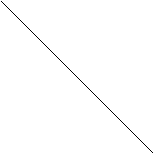

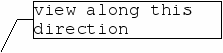




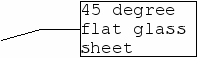
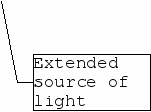



Figure 9 : Interference test setup
When a concave surface is required one uses a reference surface which has a convex surface of the required radius of curvature. For a flat surface of course a flat reference is used.
This chapter contains the calculations for the parameters of an 8” Newtonian telescope.
The optical configuration decided upon was a Newtonian system due to the advantage of having to make only one curved surface; the other being flat. The 8” aperture mirror was made from an available plate glass blank using a semi-automated process involving a rotating tool. It was figured using the Foucault knife edge test to a spherical surface tending towards a paraboloid. However, zonal testing necessary for figuring an accurate paraboloidal surface was not carried out due to lack of time. The flat diagonal secondary was made from fused silica scrap material. The glass was given an elliptical shape using a grinding disk attached to an electric drill. The flat surface was figured with the interference test method described earlier.
We now take a look at the resolution, magnification, wavefront errors due to shape approximations, the sagitta required for a 200mm aperture f8 spherical primary mirror and the size of the diagonal mirror.
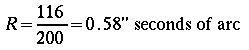
For a primary mirror of aperture 200mm (8”), the resolution using the Dawes’ criterion is :
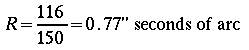
If however, the aperture is stopped down to 150mm (6”), the resolution, using the same criterion reduces to :
The wavefront error that would arise due to the surface of the primary mirror being left with a spherical surface rather than a paraboloid is a measure of the spherical aberration of the mirror. This figure can be calculated from the formula :
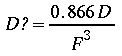
where D is the aperture of the mirror in mm and F is its focal ratio.
For our 200mm f8 mirror, the wavefront error is :
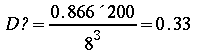 i.e. an error of nearly l/3
However, stopping down the 200mm aperture to 150 mm increases the focal ratio to f10.7 for which the wavefront error is :
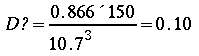
thus the spherical surface of 150mm aperture with f10.7 is within a tenth of a wavelength approximation to a paraboloidal surface. Thus for planetary observations where the definition of the image is critical it may be advisable to stop down the mirror to a smaller size than its 200mm aperture. The entire aperture may however be used for locating faint objects such as galaxies where the superior light gathering power of the 200mm (in comparison to say 150mm) would be more useful.
The range of magnifications obtainable with this telescope’s focal length of 1600 mm are as follows :
|
Focal length of Eyepiece in mm |
Angular Magnification obtained |
|
37 |
43 |
|
25 |
64 |
|
18 |
89 |
|
16 |
100 |
|
14 |
114 |
|
12 |
133 |
|
9 |
178 |
|
6 |
267 |
In each case, the magnification may be multiplied by 2, 3 or 4 times with the help of an additional Barlow lens.
The primary mirror being 200mm in aperture and focal length being 1600mm the sagitta required is found as shown:
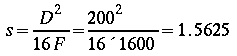 mm
mm
Thus the centre of the mirror must be deeper than the edge by a depth of 1.5625mm.
The size of the minor axis of the elliptical shaped diagonal secondary mirror is given by the formula:
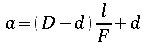
where D = aperture of the primary mirror,
d = the image scale = 0.009F
l = distance of final image plane from axis
F = focal length
Thus, the minor axis size for the secondary mirror works out to a = 32.96mm for l = 160mm, d = 14.4mm, F = 1600mm and D = 200mm.
Hence a minor axis size of over 35mm is sufficient for the diagonal secondary mirror.
The mounting decided upon is an alt-azimuth Dobsonian type. The optical tube is made from a PVC pipe of 9” OD which is 1/8” thick. The primary is supported using a three point support cell with a wooden base mounted on spring loaded bolts. The secondary mirror support is also three point spring loaded bolt supported and is fixed to the PVC tube using a three legged “spider” made from junior hacksaw blades.
I would like to thank Dr. V.S.Iyengar, Group Director, EOSDG, for his encouraging and inspiring advice. I would also like to thank Shri A. S. Kiran Kumar, for not only allowing me to make use of the facilities of the Optics Lab of the SSD/EOSDG at SAC but also sparing his valuable time to sort out the problems that cropped up from time to time.
I also wish to thank Dr.K.K.Gupta for his support. But for the constant help and guidance of the Optics Lab technicians - Shri A.S.Dighe, Shri Darshan Singh and Shri J.D.Patel - the mirrors would not have been brought to the accuracy of surface finish which they ultimately reached. I owe my grateful thanks to them for their help beyond the call of normal duty. I cannot forget the help and encouragement given to me by Dr. V.K.Dadhwal, Shri R.M.Pandya, Shri N. Ravi and other scientists of SAC from time to time. Thanks also go to the ODTC staff, the SAC Library staff, and the CISF for their help and cooperation.
At PRL, I wish to thank Prof. G. S. Agrawal, Director, for granting permission to use the Thin Films Lab facilities for Aluminium coating of the mirrors. I also wish to thank Prof. J. N. Desai for his encouragement. Shri S. D. Rawat must also be thanked for his support. Thanks must also go to Shri C.S.Panchal of the Thin Films lab for his help.
My thanks also to Prof. V.B.Gohel, Head of the Dept. of Physics, Dr. K.P.Singhal, incharge of Space Sciences, Dr. A.D.Vyas, and Dr. M.E.James for their guidance and support.
Amateur Telescope Making (in three volumes). Ed. Albert G. Ingalls, Scientific American. This is the cornerstone set of books in the library of a telescope maker. The three volumes contain articles that are loosely interrelated and have been written by the Great Masters in the field such as George Ritchey etc. There are many interesting details to be found in these volumes about various kinds of telescopes.
How to make a Telescope, (translated from the original French)., Jean Texereau., Willman-Bell. This book contains more information on construction of Cassegrain systems.
The Amateur Scientist, Ed. C. L. Stong, Compilation of articles from The Amateur Scientist Column of The Scientific American.
Making your own Telescope, Allyn J. Thompson. Sky Publishing Corporation. This is a collection of a series of articles that appeared in the Sky & Telescope Magazine.
Telescopes, Vol. 1 of Stars & Stellar Systems, Gerard P. Kuiper and Barbara M. Middlehurst. University of Chicago Press.
How to build a telescope, by P. N. Shankar, Karnataka Rajya Vijnana Parishat. This booklet on telescope making is written from the viewpoint of telescope making in Indian conditions.
All about telescopes, by Sam Brown, Edmund Scientific Co. This is a “cook book” of recipes for various sizes of Newtonian Reflectors, with step by step instructions and illustrations.
Visual Astronomy of the Deep Sky, by Roger N. Clark, Cambridge University Press & Sky Publishing Corporation. This book concentrates on visual observations of galaxies and other deep sky objects. The first two chapters are on the eye and the telescope.
Advanced Amateur Astronomy, by Gerald North. This book covers various advanced techniques in astronomy.
Norton’s 2000.0, Star Atlas & Reference Handbook, Ed. Ian Ridpath, This is the star atlas, which is the starting point in an amateur astronomers’ voyage through the Universe.
The Astronomy Encyclopaedia, Gen. Ed. Patrick Moore.,
Guide to Amateur Astronomy, Jack Newton & Philip Teece.
Sky & Telescope, Articles appearing in this monthly from Sky Publishing Corporation, contain very useful and informative ideas about various aspects of constructing, using and maintaining telescopes.
1 Robert Frost was also an accomplished amateur astronomer - see Sky & Telescope article on him in June, 1992 issue (pp 692-93).
2 James Gregory (1638-75) was a Scottish Mathematician and did not attempt to make the telescope himself.
3 Apertures of telescopes are usually specified in inches and this practice is maintained here too in describing telescopes. In the later sections where design and construction is discussed the more useful millimetre scale convention is used in the calculations.
4 Sir William discovered Uranus using a telescope of his own making. He was an accomplished telescope maker, and knowing no test for the surface accuracy of the mirror he used to test the state of accuracy of the mirror’s surface by actual observations on a star.
5 The size of the corrector is the size of such a telescope - the mirror being much larger in size
6 Russell W. Porter in Amateur Telescope Making, Book One.
7 This chapter is only an outline of the art of mirror making and hence should not be used as a substitute for the books mentioned in the bibliography which have been written by authors with years of experience.