|

|
"The Man in
the Panther’s Skin" consists of a prologue, sixty-one chapters
and an epilogue. The story is mainly about the adventures of three
heroes Nestan-Darejan, Tariel and Avtandil, which takes place in India,
Arabia, Mulghazanzar and Gulansharo – in non-Christian countries.
However, the book expresses the ideas of Georgian absolute monarchy and
Christian ideology.
In the prologue of the poem the author gives ideas about God and the
universe, presents a eulogy of Queen Tamar and her consort, David
Soslani, praises the main hero Tariel, speaks about his theoretical
views on poetics "shairoba" and love. The prologue is an
important part of the poem: what is said there is later perfectly
generalized in the poem itself. The very first
stanza is a hymn to glorify God and it is an expression of a theological
concept based on Christian doctrine and Georgian hymnography. This kind
of relationship between Christian ideology and Georgian religious
literature of previous centuries is found throughout the whole book. |
 |
Then the poem
describes the accession to the throne of Tinatin, the only daughter of
Rostevan, king of Arabia. (We cannot fail but see here an analogy to the
accession to the throne of Queen Tamar, who was made "king" by
her father in his lifetime). All Arabia celebrates the event. But the
sudden appearance and then disappearance of an unknown knight riding a
black horse, puzzles Rostevan and his daughter. That unknown man kills
the slaves who have been sent to capture him and vanishes. People are
sent to all four parts of the country, but in vain; nobody knows
anything about him. Then Tinatin sends her beloved Avtandil, who is
"spaspet" (general of the troops) in quest of the unknown
knight. Avtandil searches hard from three long years and finally finds
Tariel, the knight in the Panther’s skin who appears to be a ward of
the king of India, Pharsadan, and a Crown prince. He is
"amirbar" (Commander of the troops and Admiral of the seas).
Avtandil learns from Tariel of his misfortune – how he has lost his
sweetheart. On learning this knight and shares his sufferings ever
after. |
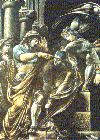 |
Tariel’s story
is truly a sad one: he has fallen in love with the only daughter of
Pharsadan, beautiful Nestan-Darejan. The two promise each other
everlasting love. But king Pharsadan, who does not know about that love,
gives word to marry his daughter to the Khvarazmian Prince. The lovers
are in despair. After discussion with his sweetheart, Tariel kills the
bridegroom. Pharsadan is furious and wants to sentence Davar (his
sister, who brought Nestan-Darejan up) to death. The frightened aunt
hands her over niece to two slaves, telling them, "Lose her in the
middle of the great seas", while she herself commits suicide.
Tariel in his quest for his sweetheart "roams mad in
the fields". All his men die, except Asmath, Nestan-Darejan’s
devoted servant, who shares his misfortunes. During his wanderings
Tariel becomes friendly with another knight Pridon. But they cannot find
Nestan-Darejan. |
 |
On learning this,
Avtandil decides to share the sufferings of Tariel and help him to find
his sweetheart. He goes back to Arabia but then secretly flees from the
country. Avtandil leaves a remarkable testament for king Rostevan. It
reveals to us Avtandil’s great education, deep knowledge of the
psychology of man, his complete perception of the universe, and his
extraordinary human qualities. He is thus a real Renaissance man. |
 |
Avtandil finds
Tariel unconscious between a lion and a panther he has killed. That
passage is rather difficult to understand. But one thing is clear: that
Tariel’s emotional power reaches here its highest point. It seems that
his passion has run out and he is in despair and hopeless. Avtandil
brings him to, and threes to persuade him to do something rather than
simply give up, while he himself goes off in quest of Nestan-Darejan. |
 |
After many
adventures Avtandil finds out where she is. The wicked Kaji magicians
have captured her. With the help of Phatman, Nestan-Darejan’s great
sympathizer, it becomes possible to send a messenger to her. In her
replay from the Kajeti Castle she asks her lover not to attempt to
rescue her, because although Kajis |are men fleshly like us", it is
impossible to defeat them as they are "men skilled in
sorcery". This letter is a fine manifestation of the greatness of
her personality and the power of self-sacrifice; here love ever comes
death. The beautiful and delicate lady at the edge of life and death
thinks of others: of her homeland, lover, and father. She is prepared
even to commit suicide to keep her innocence and stay faithful to her
lover. |
 |
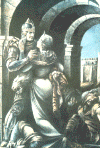
As soon as they
know where Nestan-Darejan is, the three friends, the three knights
Tariel, Avtandil, and Pridon are ready to sacrifice themselves to free
her. Of course Tariel wants to be first in this risky but honorable act.
He suggests the plan and the three friends simultaneously, on three
sides, attack the Kajeti Castle; slay all the guards and set
Nestan-Darejan free. |
 |
Friendship and
love, bravery and selflessness, perseverance during misfortune and good
deeds gain victory over the nest of evil and wicked – Kajeti. Nestan-Darejan
and Tariel marry. So do Tinatin and Avtandil. In India, where King
Pharsadan has died, Tariel and Nestan-Darejan reign; India regains its
strength and greatness. All the three friends, now
kings, rule with wisdom. They love each other and their countries become
places of love and mutual consent where "wolf and goat would graze
together". |
|