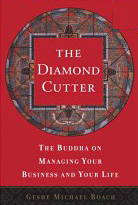
The Diamond (Vajra) Cutter Sutra
Arya Vajracchedika Nama Prajñaparamita Mahayana Sutra [Indian]
Phags pa shes rab kyi pha rol tu phyin pa rdo rje gcod pa zhes bya ba theg pa chen po'i mdo [Tibetan]
The Diamond Cutter Sutra
Teachings
of the
Buddha
The Diamond Cutter Sutra (or Vajra Cutter Sutra) is one of the texts within the Prajnaparamita, or Perfection of Wisdom sutras. The Prajnaparamita is the body of sutras and commentaries representing the essence of the Mahayana Buddhism, particularly those related to the realization of the illusory nature of all phenomena. This wisdom which realizes the true nature of all phenomena is like a diamond, which cuts through our wrong conceptions and brings liberation.
He said that and the venerable Subhuti replied to the Bhagavan, "Bhagavan, that dharma that was manifestly and completely realized by the Tathagatha from the Tathagatha Dipankara, unsurpassed perfect and complete enlightenment, does not exist whatsoever."
He said that and the Bhagavan replied to the venerable Subhuti, "Subhuti, it is so. It is so, that dharma that was manifestly and completely realized by the Tathagatha from the Tathagatha Dipankara, unsurpassed perfect and complete enlightenment, does not exist whatsoever. Subhuti, if that dharma that was manifestly and completely realized by the Tathagatha were to exist at all, the Tathagatha Dipankara would not have made the prediction to me, saying, 'Young brahmin, in a future period you will become the Tathagatha Arhat Perfectly Completed Buddha called Shakyamuni.' Subhuti, thus, since that dharma that was manifestly and completely realized by the Tathagatha, unsurpassed perfect and complete enlightenment, does not exist whatsoever, therefore, the Tathagatha Dipankara made the prediction to me, saying, 'Young brahmin, in a future period you will become the Tathagatha Arhat Perfectly Completed Buddha called Shakyamuni.' Why is that? Because, Subhuti, 'Tathagatha' is an epithet of the suchness of reality. "Subhuti, if someone were to say, 'The Tathagatha Arhat Perfectly Completed Buddha manifestly and completely realized unsurpassed perfect and complete enlightenment,' they would speak wrongly. Why is that? Subhuti, because that dharma that was manifestly and completely realized by the Tathagatha, unsurpassed perfect and complete enlightenment, does not exist whatsoever. Subhuti, that dharma that was manifestly and completely realized by the Tathagatha has neither truth nor falsity. Therefore, 'all dharmas are buddha dharmas' was taught by the Tathagatha. Subhuti, 'all dharmas', all those are non-dharmas. Therefore, it is said that 'all dharmas are buddha dharmas.' Subhuti, it is like this, for example: like a human endowed with a body and the body became large."
The venerable Subhuti replied, "Bhagavan, that taught by the Tathagatha, 'a human endowed with a body and a large body,' is taught by the Tathagatha as not being a body. Therefore, 'endowed with a body and a large body' is said." The Bhagavan said, "Subhuti, it is so; if some bodhisattva were to say, 'I shall cause sentient beings to completely pass beyond sorrow,' he should not be called 'bodhisattva.' Why is that? Subhuti, does the dharma that is called 'bodhisattva' exist whatsoever?"
Subhuti replied, "Bhagavan, it does not."
The Bhagavan said, "Subhuti, therefore, it was taught by the Tathagatha that 'all dharmas are without a sentient being, without a living being, without a person.' "Subhuti, if some bodhisattva were to say, 'I shall actualize arranged fields,' he too should be expressed similarly. Why is that? Subhuti, because the arranged fields called 'arranged fields' are those taught by the Tathagatha as non-arranged. Therefore, they are called 'arranged fields.' Subhuti, whatever bodhisattva appreciates that dharmas are selfless, saying 'dharmas are selfless,' he is expressed by the Tathagatha Arhat Perfectly Completed Buddha as a bodhisattva called a 'bodhisattva.' "Subhuti, What do you think about this? Does the Tathagatha possess the flesh eye?"
Subhuti replied, "Bhagavan, it is so; the Tathagatha possesses the flesh eye." The Bhagavan said, "Subhuti, what do you think about this? Does the Tathagatha possess the divine eye?" Subhuti replied, "Bhagavan, it is so; the Tathagatha possesses the divine eye." The Bhagavan said, "Subhuti, what do you think about this? Does the Tathagatha possess the wisdom eye?" Subhuti replied, "Bhagavan, it is so; the Tathagatha possesses the wisdom eye." The Tathagatha said, "Subhuti, what do you think about this? Does the Tathagatha possess the dharma eye?" Subhuti replied, "Bhagavan, it is so; the Tathagatha possesses the dharma eye." The Tathagatha said, "Subhuti, what do you think about this? Does the Tathagatha possess the buddha eye?" Subhuti replied, "Bhagavan, it is so; the Tathagatha possesses the buddha eye."
The Bhagavan said, "Subhuti, what do you think about this? If, there being also just as many Ganges Rivers as there are grains of sand in the river Ganges, there were just as many world systems as there are grains of sand of those, would those world systems be many?"
Subhuti replied, "Bhagavan, it is so; those world systems would be many."
The Bhagavan said, "Subhuti, as many sentient beings as exist in those world systems, I totally know their continua of consciousness of different thoughts. Why is that? Subhuti, because a so-called 'continuum of consciousness' is that taught by the Tathagatha as a non-continuum. Therefore, it is called a 'continuum of consciousness.' Why is that? Subhuti, because past consciousness does not exist as an observable, nor does future consciousness exist as an observable, nor does present consciousness exist as an observable. "Subhuti, what do you think about this? If someone, completely filling this billion fold world system with the seven types of precious things, were to give gifts, do you think that son of the lineage or daughter of the lineage would produce an enormous heap of merit on that basis?"
Subhuti replied, "Bhagavan, enormous. Sugata, enormous."
The Bhagavan said, "Subhuti, it is so. It is so; that son of the lineage or daughter of the lineage would produce an enormous heap of merit on that basis. Subhuti, if a heap of merit were a heap of merit, the Tathagatha would not have taught a heap of merit called a 'heap of merit.' "Subhuti, what do you think about this? Should one be viewed as the Tathagatha due to total achievement of the form body?"
Subhuti replied, "Bhagavan, it is not so; one should not be viewed as the Tathagatha due to total achievement of the form body. Why is that? Bhagavan, because 'total achievement of the form body' is that taught by the Tathagatha as not being total achievement; therefore, it is called 'total achievement of the form body.'"
The Bhagavan said, "Subhuti, what do you think about this? Is one to be viewed as the Tathagatha due to perfect marks?"
Subhuti replied, "Bhagavan, it is not so; one is not to be viewed as the Tathagatha due to perfect marks. Why is that? Because that which was taught by the Tathagatha as perfect marks was taught by the Tathagatha as not being perfect marks; therefore, they are called 'perfect marks.'"
The Bhagavan said, "Subhuti, what do you think about this? If it is thought that the Tathagatha considers, 'the dharma is demonstrated by me,' Subhuti, do not view it like that, because the dharma that is demonstrated by the Tathagatha does not exist whatsoever. Subhuti, if someone were to say 'the dharma is demonstrated by the Tathagatha,' Subhuti, he would deprecate me since nonexistent and wrongly seized. Why is that? Subhuti, because that demonstrated dharma called 'demonstrated dharma,' which is referred to saying 'demonstrated dharma,' does not exist whatsoever."
Then, the venerable Subhuti said to the Bhagavan, "Bhagavan, in the future period, will there be any sentient beings who, having heard this demonstration of such a dharma as this, will clearly believe?"
The Bhagavan said, "Subhuti, they are not sentient beings nor non-sentient beings. Why is that? Subhuti, so-called 'sentient beings,' because they were taught by the Tathagatha as non- sentient beings, therefore are called 'sentient beings.' "Subhuti, what do you think about this? Does that dharma that was manifestly and completely realized by the Tathagatha, unsurpassed perfect and complete enlightenment, exist whatsoever?"
The venerable Subhuti replied, "Bhagavan, that dharma that was manifestly and completely realized by the Tathagatha, unsurpassed perfect and complete enlightenment, does not exist whatsoever."
The Bhagavan said, "Subhuti, it is so; it is so. For it, even the least dharma does not exist and is not observed; therefore, it is called 'unsurpassed perfect and complete enlightenment.' "Further, Subhuti, that dharma is equivalent since, for it, inequivalence does not exist whatsoever; therefore, it is called 'unsurpassed perfect and complete enlightenment.' That unsurpassed perfect and complete enlightenment - equivalent as selfless, without sentient being, without living being, without person - is manifestly and completely realized through all virtuous dharmas. Subhuti, virtuous dharmas called 'virtuous dharmas,' they, taught by the Tathagatha as just non-dharmas, are therefore called 'virtuous dharmas.'

"Further, Subhuti, compared to any son of the lineage or daughter of the lineage collecting a heap of the seven types of precious things about equaling whatever Sumeru, king of mountains, exist in a billion world systems, and giving gifts, if someone, having taken up even as little as a stanza of four lines from this wisdom gone beyond, were to teach it to others, Subhuti, compared to this heap of merit, the former heap of merit having not approached even a hundredth part, does not withstand comparison. "Subhuti, what do you think about this? If it is thought that the Tathagatha considers, 'Sentient beings are liberated by me,' Subhuti, do not view it like that. Why is that? Subhuti, because those sentient beings who are liberated by the Tathagatha do not exist whatsoever. Subhuti, if some sentient being were to be liberated by the Tathagatha, that itself would be, of the Tathagatha, grasping a self, grasping a sentient being, grasping a living being, grasping a person. Subhuti, so-called 'grasping a self,' that is taught by the Tathagatha as non-grasping, yet that is grasped by childish ordinary beings. Subhuti, so-called 'childish ordinary beings,' they were taught by the Tathagatha as just non-beings; therefore, they are called 'childish ordinary beings.' "Subhuti, what do you think about this? Is one to be viewed as the Tathagatha due to perfect marks?"
Subhuti replied, "Bhagavan, it is not so; one is not viewed as the Tathagatha due to perfect marks." The Bhagavan said, "Subhuti, it is so; it is so. One is not viewed as the Tathagatha due to perfect marks. Subhuti, if one were viewed as the Tathagatha due to perfect marks, even a chakravartin king would be the Tathagatha; therefore, one is not viewed as the Tathagatha due to perfect marks."
Then, the venerable Subhuti said to the Bhagavan, "Bhagavan, as I understand the meaning of what the Bhagavan has said, one is not viewed as the Tathagatha due to perfect marks."
Then, these verses were spoken by the Bhagavan at that time: Whoever sees me as form, whoever knows me as sound, has wrongly engaged by abandoning, those beings do not see me. The buddhas are dharmata viewed; the guides are the dharmakäya. Since dharmata is not to be known, it is unable to be known. "Subhuti, what do you think about this? If one grasps that 'the Tathagatha Arhat Perfectly Completed Buddha is due to perfect marks,' Subhuti, you should not view so for, Subhuti, the Tathagatha Arhat Perfectly Completed Buddha does not manifestly and completely realize unsurpassed perfect and complete enlightenment due to perfect marks.
"Subhuti, if one grasps that 'some dharma has been designated as destroyed or annihilated by those who have correctly entered the bodhisattva's vehicle,' Subhuti, it should not be viewed so; those who have correctly entered the bodhisattva's vehicle have not designated any dharma whatsoever as destroyed or annihilated.
"Further, Subhuti, compared to any son of the lineage or daughter of the lineage who, completely filling with the seven kinds of precious things as many world systems as there are grains of sand of the rivers Ganges, were to give gifts, if any bodhisattva attained forbearance that dharmas are selfless and unproduced, on that basis the heap of merit they themselves would produce would be much greater. Further, Subhuti, a heap of merit should not be acquired by the bodhisattva."
The venerable Subhuti replied, "Bhagavan, should not a heap of merit be acquired by the bodhisattva?"
The Bhagavan said, "Subhuti, acquire, not wrongly grasp; therefore, it is called 'acquire.' "Subhuti, if someone says, 'The Tathagatha goes or comes or stands or sits or lies down,' he does not understand the meaning explained by me. Why is that? Subhuti, because 'the Tathagatha' ('the One Gone Thus') does not go anywhere nor has come from anywhere; therefore, one says, 'the Tathagatha Arhat Perfectly Completed Buddha.'
"Further, Subhuti, if some son of the lineage or daughter of the lineage were to render as many atoms of earth as exist in a billion fold world system, like this for example, into powder like a collection of subtlest atoms, Subhuti, what do you think about this? Would that collection of subtlest atoms be many?" Subhuti replied, "Bhagavan, it is so. That collection of subtlest atoms would be many. Why is that? Bhagavan, because if there were a collection, the Bhagavan would not have said 'collection of subtlest atoms.' Why is that? Because that 'collection of subtlest atoms' that was taught by the Bhagavan was taught by the Tathagatha as no collection; therefore, one says 'collection of subtlest atoms.' That 'billion fold world system' that was taught by the Tathagatha was taught by the Tathagatha as no system; therefore, one says 'billion fold world system.' Why is that? Bhagavan, because if there were to be a world system, that itself would be grasping a solid thing. That taught by the Tathagatha as grasping a solid thing was taught by the Tathagatha as no grasping; therefore, one says 'grasping a solid thing.'"
The Bhagavan said, "Subhuti, grasping a solid thing is itself a convention; that dharma does not exist as expressed, yet it is grasped by ordinary childish beings. Subhuti, if someone were to say, 'Viewing as a self was taught by the Tathagatha and viewing as a sentient being, viewing as a living being, viewing as a person was taught by the Tathagatha,' Subhuti, would that be spoken by right speech?"
Subhuti replied, "Bhagavan, it would not. Sugata, it would not. Why is that? Bhagavan, because that which was taught by the Tathagatha as viewing as a self, was taught by the Tathagatha as no viewing; therefore, one says, 'viewing as a self.'"
The Bhagavan said, "Subhuti, those who have correctly entered the bodhisattva's vehicle should know, should view, should appreciate all dharmas like this; they should appreciate like this, not abiding whatsoever in any discrimination as a dharma. Why is that? Subhuti, because discrimination as a dharma, called 'discrimination as a dharma,' is taught by the Tathagatha as nondiscrimination; therefore, one says 'discrimination as a dharma.' "Further, Subhuti, compared to any bodhisattva mahasattva who, completely filling unfathomable and incalculable world systems with the seven kinds of precious things, were to give gifts, if any son of the lineage or daughter of the lineage who, having taken as little as a stanza of four lines from this perfection of wisdom, were to memorize or read or understand or correctly and thoroughly teach it to others in detail, on that basis the merit he himself could produce would be more, incalculable, unfathomable.
"How should one correctly and thoroughly teach? Just vow one would not correctly and thoroughly teach; therefore, one says, 'correctly and thoroughly teach.' "
As a star, a visual aberration, a lamp, an illusion, dew, a bubble, a dream, lightning, and a cloud – view the compounded like that."
That having been said by the Bhagavan, the elder Subhuti, those bodhisattvas, the fourfold disciples bhikshus, bhikshunis, upasakas and upasikas – and the world with devas, humans, asuras, and gandharvas, overjoyed, highly praised that taught by the Bhagavan.
The Exalted Mahayana Sutra on the Wisdom Gone Beyond called 'The Vajra Cutter' is concluded.
Colophon to the Lhasa Zhol text: compiled, revising the translation of the Indian abbot Silendra Bodhi and Yeshe sDe with the new language standard. Colophon to the English translation: This translation of the Vajra Cutter Sutra is based on the Tibetan Lhasa Zhol text, having compared it with various other Tibetan printings as well as with Sanskrit versions, and having viewed several excellent earlier English translations. It was completed on 22 March 2002 at the Chandrakirti Tibetan Buddhist Meditation Centre, near Nelson, New Zealand, by Gelong Thubten Tsultrim (the American Buddhist monk George Churinoff).
This translation was based on the Tibetan Lhasa Zhol printing, and translated into English by Gelong Thubten Tsultrim (American Buddhist monk George Churinoff), © George Churinoff, 2002. It has been made available in a variety of languages in pdf format by the FPMT Education Department.