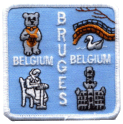
 BRUGES, BELGIUM WALKING PATCH
Send $12.50 per patch to:
SHAPE
Neighborhood Girl Scouts
Patch Program
Coordinator
CMR 451, Box 147
APO AE 09708
Send $2.50 per patch.
Welcome to Bruges, the Queen of
Flanders, the Venice of the North, say the Belgians. Like Rothenburg on the
Tauber, Germany, time seems to have stopped for several centuries in this
beautiful medieval city. Lovely canals meander through this old Flemish town
and narrow cobbled streets lead past quaint buildings little changed in
hundreds of years.
Settled between the years 600 and
899 on the banks of the Zwin, the first inhabitants called the village Bryggia.
With its harbor, the town grew quickly around the Burg (fortress) into an
important port city of the Middle Ages. Defense of the town was easily
maintained with the use of dikes. By releasing water from the canals to flood
the flat countryside, Bruges became an island which no enemy could invade.
During the years 1200-1499,
merchants traveled to Bruges from all parts of the world, sailing up the Zwin
River with rich cargos, wool from Britain, silk from Asia and exotic spices
from the Middle East. With the sea trade and the manufacture of woolen cloth,
prosperity flourished in Bruges. I impressive government houses, monuments,
churches and homes were built, and at the same time, Flemish artists were
encouraged and handsomely supported. Today, the Flemish school of painting and
its students are famous throughout the world. Original paintings done by Jan
Van Eyck, Petrus Christus, Hans Memling, Pieler Pourbus and many more from this
time can be seen today in the museums of Bruges. From the year 1300, tapestry
weavings and lace making evolved. Since the Middle Ages, the laces have become
world famous.
Unfortunately, in the 1500’s, the
Zwin River began to FILL WITH silt, and within 20 years, ships could no longer
reach the city. As trade declined, the sea trade, merchants, and bankers
eventually moved from Bruges to Antwerp, the second largest port in Belgium.
Bruges then fell into a deep sleep remaining unchanged for two hundred years.
In 1900, the novel, Bruges der
Tote (Bruges the Dead), written by George Rodebach, a Belgian, was published.
The vividly described beauty of Bruges captivated readers. As the years
passed, these readers became tourists. A new pathway to the sea, the Zeebrugge
canal, was constructed in 1907 and in the 1970's a port for ocean shipping
opened, awakening the sleepy city of Bruges to the 1900's.
So, come explore Bruges and its
secrets. Our walking tour is easily completed in a day. Remember to wear
sturdy, comfortable shoes as the cobbled streets, pathways and stone steps can
tire your feel quickly. Be careful as some streets are very busy and the
sidewalks narrow considerably at times.
We have enclosed a map to help you
discover Bruges. All points of interest that we felt were necessary to complete
the patch worksheet and gain a solid feeling of Bruges are lettered. There are
many other points with historical value in this city and if you have time
explore these, too. This is a day tour beginning at 9am and ending late
afternoon. It is written on a point to point basis, A-N, with historical
information and important tips such as bathroom facilities, hours, fees (which may
vary) and open areas for resting. The patch can be shortened to 9 areas
of interest if there is a time constraint.
We have enclosed a map to help you discover Bruges. All points of interest that we felt were necessary to complete the patch worksheet and gain a solid feeling of Bruges are lettered. There are many other points with historical value in this city if you have time explore these, too. This is a day tour beginning at 9am and ending late afternoon. It is written on a point to point basis, A-N, with historical information and important tips such as bathroom facilities, hours, fees (which may vary) and open areas for resting. The patch can be shortened to 9 areas of interest if there is a time constraint.
DIRECTIONS: From Mons (Bergen) to Bruges (approx 80 miles) at Nimy take E19 toward Paris then E42 toward Tournai. Exit 34, pick up N50 toward Courtrai (Kortrijk). Stay on N50. Bruges is straight ahead. Pick up green autoroute sign for Bruges in Courtrai. Make a left at light Colmer Restaurant is on corner. Follow green autoroute signs and markings for A17 which becomes N31 then N397.
Upon entering Bruges, pick up R30 toward Gent. Take this ring road and when you see N9 to Gent, get in the left hand turn lane to cross the canal into the city of Bruges. As soon as you cross the canal, bear right toward the windmills (Kruisvest). Follow the road to second windmill. Take immediate left on ROLWEG, a narrow street but with plenty of parking.
A.
SINT-JANSHUYMOLEN-ST. JOHN'S WINDMILL
OPEN MAY 2-SEPT 30
HRS 9:30-12:00, 2-6:00, ALL WEEK
FEE ADULTS 20 BF OR 10 BF FOR CHILDREN UNDER 10 OR GROUPS OF 20+
Summer-If windy the vanes turn at full speed. Three windmills are still standing on KRUISVEST. Originally there were 27 mills encircling Bruges.
St. John's is a stilt windmill built in the year________________________________________________
B. FOLKLORE MUSEUM AND THE ZWART CAT MUSEUM PUB, 340 ROLWEG
The museum is a reconstruction of the interiors of typical village buildings of Bruges during the 1800's and 1900's (Excellent for children).
30-45 MINUTE VISIT (no booklets available in English)
OPEN APR 1-SEPT 30
HRS 9:30-12:00, 2-6:00, ALL WEEK
OPEN OCT 1-MAR 31
HRS 9:30-12:00, 2-5:00 CLOSED TUES.
CLOSED JAN 1-FEB 1, AND ASCENSION DAY (AFTERNOON)
**BAKERY DEMO 2-5:00 THUR.
FEE ADULT 60 BF, STUDENTS 30 BF, FAMILY 120 BF, 30 BF FOR GROUPS 20+
* "NOTE THERE ARE 2 WC'S IN MUSEUM
ROOM # 1: KITCHEN OF AN OLD BRUGES HOME. Look around. Notice the items that were part of the old kitchen. Identify an item that is still in use today but has changed in style:____________________________________________________________________________
ROOM # 2: BAKERY. Demonstrations are on Thursday 2-5:00pm.
ROOM # 3: DISPLAY OF CHOCOLATE AND MARZIPAN MOLDS. Many pastry decorations are the same in Belgian bakeries today. The painting on the back wall show a view of the baker in 1911.
ROOM # 4: PHARMACY. What is the Flemish word for pharmacy?_____________________________
ROOM # 5: SPIRAL STAIRCASE (room not worth visiting). At this point go back to the entrance hall for rooms 6-14. Rooms 15-16 are a working pub, the Zwart Kat (Black Cat)
***WC is located on the right. Queen of Heart's card is ladies room.
ROOM # 6: CLOTHING AND SAMPLERS of the 1800's and the 1900's.
ROOM # 7: SCHOOL. The painting on the left shows a school of 1864. Find and name a play item used
at recess.________________________________________________________________________
ROOM #8: SHOEMAKER
ROOM # 9: HATMAKER
ROOM 10: GENERAL STORE. How were the foods weighed for pricing?________________________
ROOM # 11: RELIGIOUS ITEMS
ROOM # 12: BARREL MAKER (COOPER). Can you name one item in English that the
Cooper made on display?_____________________________________________________________
ROOM # 13: TOBACCO PIPE EXHIBIT
ROOM #14:
TOBACCO JARS AND CANES. What is the Flemish name for walking stick?___________________________________________________________________________
*** WC is on the left as you enter #14. The
door has a Queen of Clubs and King of Hearts card on it, indicating combined
ladies' and men’s' room. Knock first.
Directly outside there is a courtyard with benches for resting. Before you leave the courtyard to exit the Museum, look up at the roof. Here is the earliest symbol of Bruges.
What is the symbol?_________________________________________________________________________
Leaving the museum turn right at the corner. This is Baisiraat. It is a one way street. At the end to your left is C. JERUSALEM CHURCH and D. KANTCENTRUM (MUSEUM AND SCHOOL.)
C. JERUSALEM CHUCH-PEPERSTRAAT was built in the 1400's and is a copy of the Holy Sepulcher Church in Jerusalem, Israel. It was founded by Mr. and Mrs. Adorne, who are buried here.
10 MIN VISIT
OPEN ALL YEAR
HRS 10-12:00,2-5:00 MON-SAT
CLOSED SUN AND HOLIDAYS
FEE: FREE, BUT MONIES PLACED IN TITHE BOX ARE APPRECIATED FOR UPKEEP.
D. KANTCENTRUM (LACE CENTER AND SCHOOL), #3 PEPERSTRAAT
30-45 MIN VISIT
OPEN ALL YEAR
HRS 10-12:00,2-6:00 MON-FRI
10-12:00,2-5:00 SAT
CLOSED SUN AND HOLIDAYS
FEE ADULTS 40 BF, STUDENTS 25 BF, 25 BF FOR GROUPS OF 20+
During the school year, on Wednesday and Saturday, you can view the actual school in session. On Monday, Tuesday, and Thursday, adults demonstrate the art and skills of lace making. The lace workshops are located in the houses of the Adorne's family.
At this point, return to your cars parked on Rolweg or the side street. You will depart for E. SMEDENPOORT GATE and the underground parking lot t’Zand.
ROUTE:
Follow ROLWEG to end of the street making a left on JERUZALEMSTRAAT. At the end
of JERUZALEMSTRAAT there is an intersection of five streets. Proceed into
intersection to "V". Take the left of the "V" (STUN
STREUVELSTRAAT). At the end of the street take right on KRUISVEST. You must
cross over bridge on your left to R30-RING Road of Bruges (BUITEN K.RUISVEST). Continue
on R30 until you see a CENTRUM sign with a big blue box with P for parking.
Bear right as entering tunnel. This will take you directly into the underground
parking lot, "t ZAND".
FOR BUSES: Drop off is allowed on 't ZAND. A bus lot is located west oft ZAND at BEURSPLEIN. There is a fee charged and no parking is allowed before 2:00 pm on Saturday.
TAKE your parking ticket with you.
After parking, follow wheelchair signs, elevator is located there.
PARKING CENTRUM 't ZAND
HRS: 6:45am-12:45am
FEE:
1 -2 HOURS, 25 BF per hr
3-6 HOURS, 20 BF per hr
AFTERWARD, 10 BF per hr
Depending on which level you park, there are 3 buildings at street level. The middle building has a machine for payment: it takes 100 BF bills. There is a ticket window but it is not manned at all times. The other two buildings have machines that DO NOT take 100 BF bills. Take change.
***WC facilities (closes at 6:00 pm but hours may vary) are here on street level outside at far end of the 'tZAND. See map. 7 BF per person. They are neat and clean.
Proceed to E. - SMEDENPOORT TOWN GATE. This is a 5 minute walk from the 't ZAND heading SW.
E. THE SMEDENPOORT TOWN GATE
The SMEDENPOORT GATE was built in 1367-68. It is one of the 4 remaining gates in the encircling walls of Bruges. Above the gate there is a small bell used to announce the closing time of the gate.
*There is a park with benches for resting and lunching on either side of the gate along the canal.
What bronze object do you see on the gate wall?___________________________________________
This is a reminder to all who leave Bruges of a Gent citizen who in 1688 tried to betray the city by opening the gate for the French invaders under Emperor Louis XIV.
If needed, follow the map back to the 't ZAND for any emergency WC stops before you head to F. THE CHUCH OF OUR. LADY (about 5 minutes). Point F is a quick stop as your goal is to reach G. THE FISH MARKET before 1 pm.
ROUTE: SMEDENSTRAAT 't ZAND.. H. GEESTRAAT GOEZEPUTSTRAAT.
Turn right at end of street. About 35 feet down GEESTRAAAT there is a crosswalk that takes you directly to the side door of the church where the entrance is located.
F. CHURCH OF OUR LADY began in 1290 and was completed in 1549.
OPEN ALL YEAR
HRS 10-11:30, 2:30-5 MON-FRI.
10-11:30, 2:30-4:30 SAT. (* might close on SAT.)
2:30-5:00 SUN (no visits during church service)
You will be viewing the white marble statue. Madonna with Child, by Italian sculptor Michelangelo. This is one of the few pieces by him located outside of Florence. Italy. It was ordered and purchased by Bruges merchant J. Moscroven. in 1506, then donated to the church.
ROUTE TO FISH MARKET: At corner of church make a right GRUUTHUSESTRAAT, DIJVER ROZENHOEDKAAL. At corner of BRAAMBERGSTRAAT is the FISH MARKET on your left.
G. THE FISH MARKET was established in 1821. At one time early in the 1800's, every marble table was covered with fresh fish caught in the North Sea. Today at 6am about 1/3-1/2 of the tables are used. Most is sold by l0 am but there are always at least 2 merchants there until l pm. Watch how easily the fish are filleted. Listen to the merchants as they call out the prices. There are numerous fish and shellfish for sale everyday.
What is the Flemish word for fish?______________________________________________________
ROUTE: ULINDE EZELSTRAAT - BLIND DONKEY - (narrow street) to the BURG. The BURG area is where the original fortress stood. Today, 900 years of architecture can be admired. As you enter the BURG area, to your left is the **CITY HALL. It is a GOTHIC building, 1376-1420. On your RIGHT is the ***OLD RECORDER'S HOUSE, 1534-37, a RENAISSANCE style building. The INFO OFFICE is located on the BURG, in the ****OLD COUNTRY HOUSE built in 1520 (now the city administration building). ***WC's (close at 6pm but hours may vary) are located directly across from the INFO OFFICE 10 BF per person. Wednesday is Market Day at the BURG (sometimes congested).
H. THE DOUBLE BASILICA OF THE HOLY BLOOD, located in the far left corner of the BURG. The lower chapel, in ROMANESQUE style, was constructed in 1139-1149. The interior takes one back to the CRUSADES when one's life was dominated by the Christian faith. It was built to contain the relics of St. Basil. Notice the wayside stone altar located above the entrance. It depicts the Baptism of St. Basil in the Jordan River. It is the most ancient carving that survives in Bruges. In the 1100's the upper chapel was built. Twice destroyed in the 1500's and almost entirely destroyed during the French Revolution of 1795, it was rebuilt in 1934. You must use the stairs outside to get to the upper chapel. The stairway is from 1529-1533. 15-20 minute visit.
What shape is the unusual wooden pulpit as you enter the chapel?______________________________
It is BAROQUE in style and was carved of oak in 1728 by Pulincx, a Bruges craftsman. The upper side chapel contains a tiny fragment of cloth soaked in the blood of Christ and brought back to Bruges in 1150 after the Second Crusade. It is on view in the gold and silver box on the canopied throne altar only on Fridays for public viewing. There are usually large crowds, allow ample time to visit.
What sleeping animal can you see on the alter opposite the throne?_____________________________
One the first Monday after May 2nd, the HOLY BLOOD is taken on a procession through Bruges. (Not advisable to come at this time due to large crowds and day long procession).
ROUTE: BREIDELSTRAAT to view I. MARKT AREA and J. BELFRY
I. MARKT AREA. The BELFRY tower is on your left as you enter the MARKT AREA. There are numerous lace and tourist shops along BREIDELSTRAAT. This is a good place to purchase your gifts. On WOLLESTRAAT are 2 chocolate shops. Also on the MARKT are cafés, a frites stand and a QUICK Burger. If you decide to stop, listen to the carillon located in the BELFRY.
J. BELFRY TOWER The First tower was built of wood in 1240 and destroyed by fire in 1280. In 1300, a replacement tower of stone was completed. There are 47 bells in the carillon. They operate from 7am-10pm daily on the hour and every 15 minutes.
***WC (Closes at 6pm but hours vary) located in the courtyard (10 BF).
The BELFRY can be visited 9:30-12:00noon and 1:30-5pm. It's a museum! It has 366 steps to climb! If time permits.
PROCEED to K. BURGHERS LODGE
ROUTE: (5 minute walk) VLAMINGSTRAAT, right on ACADEMIESTRAAT.
K. BURGHERS LODGE is an original building dating back from the 1400's. This was a meeting place for important citizens and merchants of Bruges when it was a world famous port city. The city honored the most well known of these citizens with a statue placed on the building. Can you find it?
What animal is this statue?____________________________________________________________
It is the oldest inhabitant of Bruges. More important, this animal is in the coat of arms of the city of Bruges.
PROCEED to L. GROENINGE MUSEUM a ten minute walk.
ROUTE: ACADEMIESTRAAT. VLAMINGSTRAAT to
WOLLESTRAAT to DIJVER (all busy streets).
The museum is on the opposite side of the street about 2 blocks down.
Cross carefully.
L. GROENINGE MUSEUM, 12 DIJVER
OPEN APR-SEP 30
HRS 9:30-6:00 SUN-SAT
OPEN OCT-MAR 31
HRS 9:30-12:00noon, 2-5pm. closed TUES.
CLOSED Jan 1 and Ascension Day
ROUTES:
1. At this point you can follow the path you entered on to go to a canal boat ride (located on the opposite side of the street on the corner.) Tour lasts 35 minutes. Adults 130 BF and children -1-12 with adults 65 Bf.
2. Or you can follow the path to your left.
Cross the small street GROENINGE. There is a small garden and a lovely old
cobbled bridge. Watch your step. Nice picture spot.
3. After crossing the bridge, turning left takes you to the side entrance of the Church of Our Lady or cross the street at the crosswalk to M. ST. JAN'S HOSPITAL MUSEUM and HANS MAASTRICHT #38 (KATELIJNESTRAAT).
4. Or go to your right after the bridge, this takes you to N. GRUUTHUSE MUSEUM, ST. JOHN'S HOSPITAL-APOTHECARY and HANS HEMLING MUSEUM
20 MIN VISIT FOLLOWING ITINERARY
OPEN APR -SEP 30 HRS 9:30-12:00,2-6:00
OPEN OCT-MAR31 HRS 9-.30-12 NOON, 2-5:00
CLOSED: WEDNESDAYS AND JANUARY I
FEE: ADULTS 100 BF. CHILDREN 50 BF
GROUPS OF 20 OR MORE. 70 BF
FAMILY TICKET 200BF
To date there are no English translations of any of the exhibits. However, it is a wonderful way to learn about hospitals during the 18 century. There is a book (595 BF) that explains many of the items on view.
Entrance to the St. John's (Jans) Hospital is on the left after you go through the archway with the cobbled path.
***WC is located further into the courtyard to the right.
On entering the museum, you are located in the original ward of the hospital. Find the painting by Jan Beerblock of Bruges, 1778. This painting depicts the hospital as it was when directed by the nuns.
How was the food served?____________________________________________________________
On the right. What item was used to take away soiled bandages?_______________________________
How were patients taken to the hospital?_________________________________________________
Notice photo (12"x20") on the left wall. It is of St. Jans Hospital in 1918. Continue down the ward. Here you see actual or reproductions of hospital pieces taken from the painting.
Find the bed with rope above it, notice the wild boar relief on the plaque of amulet.
The straw body on the wooden bench is shown in the painting directly on the wall. Apparently the dead were wrapped in straw for burial in the 1700's.
On the far wall is a cabinet containing old document boxes. Locate these.
The second room of the hospital contains paintings, furniture and relics of saints used in the convent and the chapel area of the hospital.
M. HANS MEMLING MUSEUM
Hans Memling is the favorite son of Bruges. He developed new oil painting techniques, which gave his paintings a unique brightness and beauty. Six of his masterpieces are located here.
Entrance is located in the ward room of the hospital. On entering, you will see where St. Ursula's bones are kept.
What shape is the box?______________________________________________________________
Note the large 3 part altar painting.
In the right section of the painting, what is Heaven surrounded by?_______________________________
The second room of the MEMLING MUSEUM contains 3 of his paintings.
*On leaving the MEMLING MUSEUM visit the old pharmacy (Apoteek).
**Show your ticket**
After entering the building the pharmacy door is to your right. Medicines were made by weight.
What can you find that measure the weights?______________________________________________
(There are 4 of these).
Look to the left wall by the ceiling. The painting shows the nuns at work in the pharmacy where you are now standing. On the counter are 2 boxes with medicines that were ground for patient use.
PROCEED TO N. THE GRUUTHUSE MUSEUM.
ROUTE: (2 minutes walk) use the crosswalk and proceed LEFT around the Church of Our Lady to GRUUTHUSESTRAAT (DIJVER). Watch for the sign pointing the way. The museum is located on the right, down a path after you pass the church.
N. GRUUTHUSE MUSEUM is the former palace of the lords of Gruuthuse from the 15th century (1400's). The best known member of this Bruges patrician, bourgeoisie family was Lodewijk van Gruuthusc, "Knight of the Golden Fleece." In 1692 the mansion was a pawnbroker's shop. After restoration work between 1883-1898, it became the home of the Bruges Antique Society. Since 1955 it has been the Bruges Museum of Antiques and Fine Arts. Its 22 rooms are filled with tapestries, works of art and examples of the luxurious life in early Bruges.
45-60 MINUTE VISIT FOLLOWING ITINERARY
OPEN APR -SEP 30 HRS 9:30-12 NOON. 2-6:00 all week
OPEN OCT-MAR 31 HRS 9:30-12 NOON, 2-5:00 closed Tuesday
CLOSED JAN 1 and ASCENSION DAY (afternoon)
FEE ADULT 100 BF, CHILDREN 50BF FAMILY 200 BF
GROUPS 20+ 70BF
To date there are no English translation of any of the exhibits here. However there is a book for 595 BF that translates into 3 languages many of the objects you will be viewing.
ROOM # 1.: DINING ROOM
next go to:
ROOM #3: MEDIVAL KITCHEN
What
shapes do you see in the wrought iron (black) cooking utensils hanging on the
wall?_____________________________________________________________________________
***WC is
located here on the right comer, far wall, two cubicles. No charge. To re-enter
the kitchen use the same door (handle is the ring). Slide it to the left to
open door.
ROOM # 4: BEDROOM
ROOMS # 5, 6. 7: MEDIVAL WOOD CARVINGS
** Spiral stone stairs. Watch your step.
next go to:
ROOM # 9: TAPESTRIES
** Spiral stairs. Watch your step.
ROOM # 10.
Name 2 of the Constellations on the 1774 drawing.
ROOM # 11: MUSICAL INSTRUMENTS
To your right upon entering, is a wall size music box. You can use a 5BF coin to play it as you view the room. To the right in front of the window is a SCHELLENBOOM.
How many jingle bells does it have?_____________________________________________________
To visit rooms #12-16, go down the spiral staircase.
ROOM # 12: FURNISHINGS
ROOM ¹ 13: Find the long wall tapestry 3'x 12'. What is its title?________________________________
Name 2 animals you recognize on the tapestry.____________________________________________
ROOM # 14: Look out the window for a pretty view of the canal and buildings. You might even hear a flute being played in the garden below as was done in the Middle Ages.
ROOM # 15: EUROPEAN CERAMICS AND SILVER from the 1.500-1800's (including Delft from the Netherlands).
ROOM # 16: TAPESTRIES AND WOODEN STATUES
Find the tapestry at the other end of the room. What do you see in the oceans on the globe in the tapestry?_________________________________________________________________________
ROOM # 17. Private view for the Gruutihuse family of the chapel built in 1472 which is part of the Church of Our Lady.
ROOMS #18-20: LACE EXHIBITS
Note: Optional viewing. Similar pieces of lace have been seen or can be seen at the KANTCENTRUM by the FOLKLORE MUSEUM.
Note: Dangerous spiral stairs for children. Take the regular stairs down, a portion of the handrail is missing.
ROOM #22: WEAPONS located on the ground floor. There are knight's helmets of the 1600's, a guillotine of the 1700's and many crossbows.
Count the number of crossbows in the room._______________________________________________
When you exit the GRUUTHUSE MUSEUM look for the moon in the courtyard (a relic of the Middle Ages). The courtyard is a good rest area where you can view the canal on the right.
CONGRATULATIONS! You have now completed the Bruges Walking Patch. If time permits, you might take the canal ride.
Canal Tour: 35 Minute ride
Fee: Adults 130 BF, Children Accompanied by responsible adult 65 BF
Departure for the canal is the same as when you entered the museum. Right on GRUUTHUSESTRAAT (DIJVER), There is a canal dock located on the corner opposite side of the street.
OPTIONAL TOUR: If you have time, try to visit the MINNEWATE (Lake of Love), a 10 minute walk heading south from M. ST. JOHN'S HOSPITAL. For a small price you can purchase buns to feed the swans and ducks from a shop directly opposite the bridge located there.
Also, located on the other side of the bridge through the tall arched gate is the BEGUINAGE (BEGIJHOF) founded in 1245. It was a home for the widows and spinsters who led a life of prayer behind the walls. They were known to wash the wool for weavers in the canal waters along side their home. Later in 1930, the nuns of the Benedictine Order set up a community here adopting the Beguines' style of dress.
BEGUINAGE (BDGIJHOF):
A Beguine's house is open for viewing. The home gives one a good idea of what was like in the BEGUINAGE, a 10 minute walk from the Church of Our Lady heading SW.
10-15 MINUTE VISIT
OPEN APR -SEP 30
HRS 9:30-12,1:45-5:30 MON- SAT
HRS 10:45-12, 1:45-6:00 SUN AND HOLIDAYS
CLOSED FRIDAY MORNINGS AND SUNDAY 4:20-5:05
OPEN OCT-MAR 31
HRS 10:30-12:00, 1:45-5:00 MON-TUE
CLOSED FRI MORNINGS
CLOSED SUNDAY 4:20-5:05
*CLOSED FRIDAY MORNINGS AND SUNDAYS 4:20-5:05
DEC-FEB, WED, THU, SAT, SUN 2:45-4:25
FEE ADULTS 50 BF, CHILDREN 25BF
GROUPS of 10 -30BF
Upon paying fee, obtain card in English describing each room. Lace can be purchased here. Prices vary. Much is handmade.