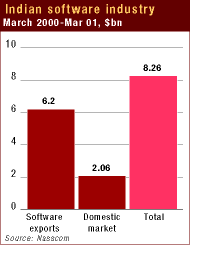
 Software exports: down 30%
Source: CII and trade estimates
Terror’s toll
The
terrorist attacks in the
Several
IT industry conferences across the
The
growth rate for the value of software exports, which used to stand at 50%
annually, is likely to slip to 20% in 2001-02, a leading trade analyst
predicts.
The
Indian software and services industry currently accounts for almost 2% of the
country’s gross domestic product.
US
US
The
attacks on the
The
number of new jobless claims rose by 58,000 to 450,000 for the week ending 22
September, well above analysts’ expectations, with 11,000 new claims
coming in
Meanwhile,
an index measuring the number of jobs being advertised across the
The
data is expected to reinforce analysts’ fears that
the
Jobless claims
Increases
in unemployment were reported in states around the
Since
the attacks, the aviation industry alone has laid off over 100,000 workers.
The
data is a further sign that the world’s biggest
economy is struggling, after the number of unemployed on benefits rose by
68,000 to 3,298,000 for the week that ended on 15 September.
Help wanted
The
business group Conference Board also released its Help Wanted Advertising Index
which fell to 53 in August from 58 in July, a eight and a half year low, with a
further fall expected for September.
“The
souring of consumer attitudes in September seems certain to result in a drop in
consumer spending - beyond the obvious categories of travel and recreation,”
said Ken Goldstein, an economist at the Conference Board.
“That
drop in economic demand will most likely translate into further layoffs...
Under present circumstances, continued deterioration in the labour market is
very likely over the next few months.”
The
Conference Board surveys 51 major newspapers across the country about their
patterns of help-wanted ads every month
Job losses to hit 24 million
|
|
The
overall picture would mean very little improvement in the global employment
situation
The ILO said an Asian revival is needed
Twenty-four
million job opportunites - more than the population of

The projection comes from the International Labour Organistation (ILO), which
said its figure for the losses included actual and prospective positions that
would have been eliminated worldwide.
Economic
growth has to be revived in
Separately,
the Geneva-based body said the airline industry, in particular, will take years
to recover after more 200,000 of its 4 million global employees lost their jobs
after the attacks.
“The
overall picture would mean very little improvement in the global employment
situation,” it said.
Poor outlook
The
ILO report warned the 1.7% average annual growth of the world’s
workforce over the past decade had outstripped the 1.4% annual rise in global
employment.
“In
recent years the global economy has created about 40 million jobs a year for
the 48 million annual new entrants to the labour force,” it said.
Over
97% of new job seekers in the next decade will come from developing countries,
with 65% of them in
For
the industrialised world, the ILO forecast the labour force would shrink, with
population growth expected only in the
Globally
unemployment rates are expected to remain stable but the number of working poor
will rise, the ILO said.
More
than one billion people live on less than one dollar a day, according to UN
estimates.
The
reports were released ahead of the ILO’s Global
Employment Forum in
2001:
Historical turning point?
The
importance of the flag is evident everywhere
Devastation
at Ground Zero has become an enduring image
The assertion has been made many times since 11
September - the attacks on
The sight of the twin towers of the
Watching those images in disbelief, millions must
have had the same thoughts. What does this mean for the world, for my country,
and for my family?
In the space of a few minutes we seemed to have
entered a new age of uncertainty. We instinctively knew things were different,
even if we were not sure why or where we were heading.
The extent to which the world really has changed
depends on where you are in the world and your perspective on global politics.
Knock-on effects
The
impact of this gradual but painful economic slowdown is now being felt at the
most personal level, as urban Indians lose their jobs and recruitment dries up.
Every
sector has been affected, from banking to steelmaking, with millions facing
voluntary retirement schemes.
And
fewer new recruits are needed, even in fast-growing industries.
“Due
to the slowdown, software recruitment has been affected by around 30% to 50%”,
said Dr. Raj Sharma, Director of the Cistems Institute of Information
Technology.
“The
demand for software professionals has dropped considerably, and we are not
getting any fresh inquiries from software companies. The job market has never
been so bad for freshers as it is today,” says Ravi
Chaudhary, who runs a placement agency.
“The
job market will shrink by up to 25% this year.”
Overall,
the recent terrorist attacks on the
Predictions
that
Phiroz
Vandrevala does not play golf but he likes golf tales, such as the one about a
“CEOs
talking about
In
the weeks ahead, the IT lobbying organisation will spread the word in the
US-India’s biggest market-and later set its
sights on what for most Indian IT companies is virgin territory-Europe.
Nasscom
will argue that in weakening economies, outsourcing helps businesses live
within tighter budgets yet retain an edge over rivals.
Indian
companies hold 1.5-2 per cent of the global software services and maintenance
pie, the part of the overall IT menu in which they have earned a global
reputation built on low costs and advanced processing skills. About 16 per cent
of the workforce in this narrow sliver of services are Indian, according to
industry data.
Yet
after last month’s terrorists’ attack in
the
Nasscom
has revised downwards its growth to 30-35 per cent for the year to March 2002,
corresponding to exports of $8.2bn. This rate of expansion is impressive but
still falls short of the 55 per cent growth achieved in 2000-01.
Big
companies such as Infosys Technologies and Wipro have slashed their sales
growth forecasts, the former by more than two thirds from 100 per cent-plus in
2000-01. Small companies trapped at the less rewarding end of the value chain
are dangerously exposed. Across the board, recruitment has slowed, wage
inflation has been pricked and attrition tamed. More software engineers are
jobless than ever before in
“There’s
a lot of fog on the windscreen,” says Narayana Murthy, chairman of
Nasdaq-quoted Infosys. Yet few can honestly claim to know what lies ahead as
First,
Indian companies are grappling with the fall out from the
The
immediate impact is a freeze on deals and visits to sites in
Though
Infosys and Wipro’s results for the quarter to September
topped expectations, the real impact of the September 11 attack is unlikely to
feed through fully until the next two quarters.
The
slowdown has already forced US technology companies to aggressively slash IT
budgets. Reduced budgets mean a change in the mix of work, which imposes
pressures on Indian companies with a disproportionate exposure to niche areas
The
prime casualty is work on developing new applications, such as internet-based
portals. Typically, this lucrative “non-mission
critical work” accounts for 60 per cent of a client’s
IT budget and its diminution has hit companies such as Bombay-based MphasiS.
The
rest of an IT budget goes on systems maintenance, which is low value work but
one that offers a secure revenue stream during difficult times. The big
companies earn about 40 per cent of their revenues from this source.
The
smaller amount of work available has given rise to the second key trend at
work, a shift in the mix of clients. Indian companies may be looking for a
deeper partnership with Fortune 500 companies by encouraging them to outsource
more work such as mechanisms to manage customer relations.
But
a parallel hope is to tap a new generation of customers from the Fortune
1000-2000 universe. These companies are less global in their outlook,
unfamiliar with the offshore model and lack sophisticated internal IT
structures.
Capturing
them poses marketing challenges. Indian companies must, for example, persuade
an audience worried about the political impact of cutting jobs in a recession
to switch to a service provider in an unfamiliar country.
Indian
IT companies have never had to do this before because their clients have been
global in outlook and have regarded outsourced IT as a “strategic
differentiator,” says Gautam Kumra, principal at
McKinsey, the management consultant in
The
scope is huge. The bulk of the 180-plus Fortune 500 companies that outsource to
The search for new customers is also turning Indian eyes
towards
The
third broad trend is a virtuous cycle that is making the biggest Indian
companies even bigger as they hog the portfolio of reference accounts. The
scale and brand quality of the aristocrats of Indian IT-TCS, Wipro, Infosys,
and Satyam-is crowding out mid-sized rivals.
This
means new and existing customers tend to focus on service providers that are
well capitalised, possess a global brand, and an end-to-end capability from
consultancy to implementation. “These are uncertain times and clients
want companies that are going to be around in the long term,” says
Nandan Nilekani, managing director of Infosys. “There is a
lower desire for risk,” he says.
Similarly,
clients under budget pressures want to rationalise the number of vendors. They
are increasingly concentrating on a single service provider of scale and
record. One consequence is that dominant Indian players are forced to expand
beyond their traditionally narrow range of specialisations to cater for a wider
range of demands.
Wipro
is investing $10m-$15m in IT-enabled services; TCS and the
“The
question is how fast and to what extent
The
implication of this trend on mid-sized companies could be disastrous, as they
become general purpose companies lacking scale, pricing power or niche
specialities.
These
broad themes run alongside other changes whose impact is becoming more
apparent. The primary one is labour market weakness after several years of
buoyancy - typified by golden handshakes, generous share options and wage
inflation in excess of 30 per cent and more for specialists, especially
duringthe dotcom boom. Nasscom says about 3,000-4,000 software engineers lost
their jobs last year, though this is probably a conservative figure given that
the shedding at small companies is often unrecorded on a national level.
Satish
Doshi, managing director of Sampoorna Computer People, a recruitment agency in
One
sign of the softer labour market is lower utilisation rates. This is a measure
of how many expensively trained software engineers are working on projects and
generating an income, rather than sitting idle on the bench. The rate is about
60 per cent, or less at smaller companies, from a peak of 75 per cent two years
ago.
The
lower utilisation level is sufficient to cope with existing work. But, combined
with the general job freeze and, in some instances, job cuts, software
companies are exposed in the event of a sudden rush of orders.
Many
companies have learned to respond quickly to a new orders in effect, becoming
nimble “just-in-time employers”.
Like
New Year’s Eve revellers, many technology
users began 2001 with a thumping hangover. Computer departments in companies
had overdosed on investments in software, personal computers, handhelds and
internet strategising. And the cure for many companies in the
The
technology bubble had burst and
The
chip industry was trapped in the worst downturn in its history. Gartner, a
technology research group, predicted that semiconductor markets would not pick
up until the second quarter of 2002.
One
by one,
Summer
came, but failed to provide any relief. The so-called silly season, when news
is light, instead focused on the worrying threat of digital attack. Warnings of
an internet meltdown, caused by the Code Red worm, scared hundreds of thousands
of website operators to install anti-virus software patches.
Even
mergers failed to lift the black mood. On Labor Day, the official end of the
But
the capital markets expressed their disapproval by sending HP’s
shares down almost 19 per cent a day after the merger was announced, wiping out
the notional premium that the all-stock deal would have handed to Compaq
shareholders. The dissenters were later joined by the heirs of the Hewlett and
Packard families.
A
week after the HP/Compaq deal announcement, on September 11, the world was
shaken by a distinctly low tech attack in
The
internet was one technology that proved its reliability as people across the
world surfed the web for news of the
The
technology industry remained in the doldrums for the rest of the year, with a
marked decline in attendance at Comdex, the annual
Microsoft
and the Justice Department announced that they had reached a final settlement
to end the three-year antitrust battle. The deal, which amounted to little more
than a slap on the wrist, split the opinions of the
2001 was a year that many in the computer industry
would rather forget. The hope is that 2002 can only be better.
lot of websites .......... simply to tell -the whole web wld !!!