





Critical Theory
 
The Frankfurt School is a school of neo-Marxist critical theory, social research, and philosophy. The grouping emerged at the Institute for Social Research (Institut für Sozialforschung) of the University of Frankfurt am Main in Germany when Max Horkheimer became the Institute's director in 1930. The term "Frankfurt School" is an informal term used to designate the thinkers affiliated with the Institute for Social Research or influenced by them. It is not the title of any institution, and the main thinkers of the Frankfurt School did not use the term to describe themselves. http://en.wikipedia.org/w/index.php?title=Frankfurt_School&printable=yes

Max Horkheimer (February 14, 1895 – July 7, 1973) was a German philosopher and sociologist, a founder and guiding thinker of the Frankfurt School/critical theory.
http://en.wikipedia.org/w/index.php?title=Max_Horkheimer&printable=yes

Jürgen Habermas (born June 18, 1929) is a German philosopher and sociologist in the tradition of critical theory and American pragmatism. He is best known for his work on the concept of the public sphere, which he has based in his theory of communicative action. His work has focused on the foundations of social theory and epistemology, the analysis of advanced capitalistic societies and democracy, the rule of law in a critical social-evolutionary context, and contemporary politics -- particularly German politics. Habermas's theoretical system is devoted to revealing the possibility of reason, emancipation and rational-critical communication latent in modern institutions and in the human capacity to deliberate and pursue rational interests.
http://en.wikipedia.org/w/index.php?title=J%C3%BCrgen_Habermas&printable=yes

Theodor W. Adorno (September 11, 1903 – August 6, 1969) was a German sociologist, philosopher, pianist, musicologist, and composer. He was a member of the Frankfurt School along with Max Horkheimer, Walter Benjamin, Herbert Marcuse, Jürgen Habermas, and others. He was also the Music Director of the Radio Project.
    Already as a young music critic and amateur sociologist, Theodor W. Adorno was primarily a philosophical thinker. The label social philosopher emphasizes the socially critical aspect of his philosophical thinking, which from 1945 onwards took an intellectually prominent position in the critical theory of the Frankfurt School.
http://en.wikipedia.org/w/index.php?title=Theodor_W._Adorno&printable=yes

Paul Lazarsfeld (1901-1976) was one of the major figures in 20th century American Sociology. The founder of Columbia University's Bureau for Applied Social Research, he exerted a tremendous influence over the techniques and the organization of research. "It is not so much that he was an American sociologist," one colleague said of him after his death, "as it was that he determined what American sociology would be." He had a son called Robert Lazarsfeld, and a daughter.
http://en.wikipedia.org/w/index.php?title=Paul_Lazarsfeld&printable=yeshttp://www.google.com/ig?hl=enhttp://www.google.com/ig?hl=enhttp://www.google.com/ig?hl=enhttp://www.google.com/ig?hl=enhttp://www.google.com/ig?hl=enshapeimage_1_link_0shapeimage_1_link_1shapeimage_1_link_2shapeimage_1_link_3shapeimage_1_link_4
The Links
Friday, November 9, 2007
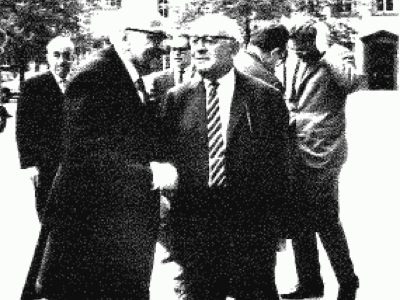
Max Horkheimer (front left), Theodor Adorno (front right), and Jürgen Habermas in the background, right, in 1965 at Heidelberg

Hosted by www.Geocities.ws

1