|
|
|
|
|
|
|
|
|
|
|
|
|
The protestant's ancestors had planted or colonised native lands so as to make Ireland a safer place for Britain the idea being to make invasion of Protestant England by Catholic France or Spain via Ireland that much more difficult. The Protestant's lived in constant fear of retrubution from the substantial minority of Irish catholics whose land they had taken. They viewed the Catholics with a mixture of fear, ignorance, and hatred. The catholics trapped in a state not of their creation were bitter and resentful having been abondoned by the south after 1921, confronted by arrogant, superior-seeming rulers and subjected to interrmittent salvos of pogram-like violence, they knew they could only look to themselves for protection, and trust only their own. Each community feared and distrusted each other. Anti-Catholism was built into the state ideology and promoted by its leaders. In the one-party state that was N.I., Catholics routinely found themselves the victims of economic and social discrimation. There was little or no room in the new Northern Ireland state for Catholics. The message was reinforced by occasional sectarian violence. Riots, burning, shootings, and bombings-carried out by mostly Protestant mobs-had been a regular feature of political life in the north of Ireland since the mid-nineteenth century, when Irish nationalists first began to agitate for Home Rule and a degree of separation from Britain. The Protestants with the support of British Consertive leaders in London, organised a private army the Ulster Volunteer Force (UVF) the first Irish paramilitary group, armed with thousands of rifles smuggled into Ulster from Germany, to oppose Home Rule.
The Provisional Irish Republican Army's (PIRA) campaign against Northern Ireland being a part of the United Kingdom had begun in the two years prior to Bloody Sunday, but perceptions of the day boosted the status of and recruitment into the organisation. Bloody Sunday remains among the most significant events in the recent troubles of Northern Ireland, arguably because it was carried out by the army and not paramilitaries, and in full public and press view. Thirteen people were shot and killed, with another man later dying of his wounds. The official army position, backed by the British Home Secretary the next day in the House of Commons, was that the Paratroopers had reacted to the threat of gunmen and nail-bombs from suspected IRA members. However, all eye-witnesses (apart from the soldiers), including marchers, local residents, and British and Irish journalists present, maintain that soldiers fired into an unarmed crowd, or were aiming at fleeing people and those tending the wounded, whereas the soldiers themselves were not fired upon. No British soldier was wounded by gunfire or reported any injuries, nor were any bullets or nail-bombs recovered to back up their claims. In the rage that followed, irate crowds burned down the British embassy in Dublin. Anglo-Irish relations hit one of their lowest ebbs, with Irish Minister for Foreign Affairs, Patrick Hillery, going specially to the United Nations in New York to demand UN involvement in the Northern Ireland "Troubles". When it arrived in Northern Ireland, the British Army was welcomed by Roman Catholics as a neutral force there to protect them from Protestant mobs, the Royal Ulster Constabulary (RUC) and the B-Specials. After Bloody Sunday many Catholics turned on the British army, seeing it no longer as their protector but as their enemy. Young nationalists became increasingly attracted to violent republican groups. With the Official IRA and Official Sinn F�in having moved away from mainstream Irish nationalism/republicanism towards Marxism, the Provisional IRA began to win the support of newly radicalised, disaffected young people. |
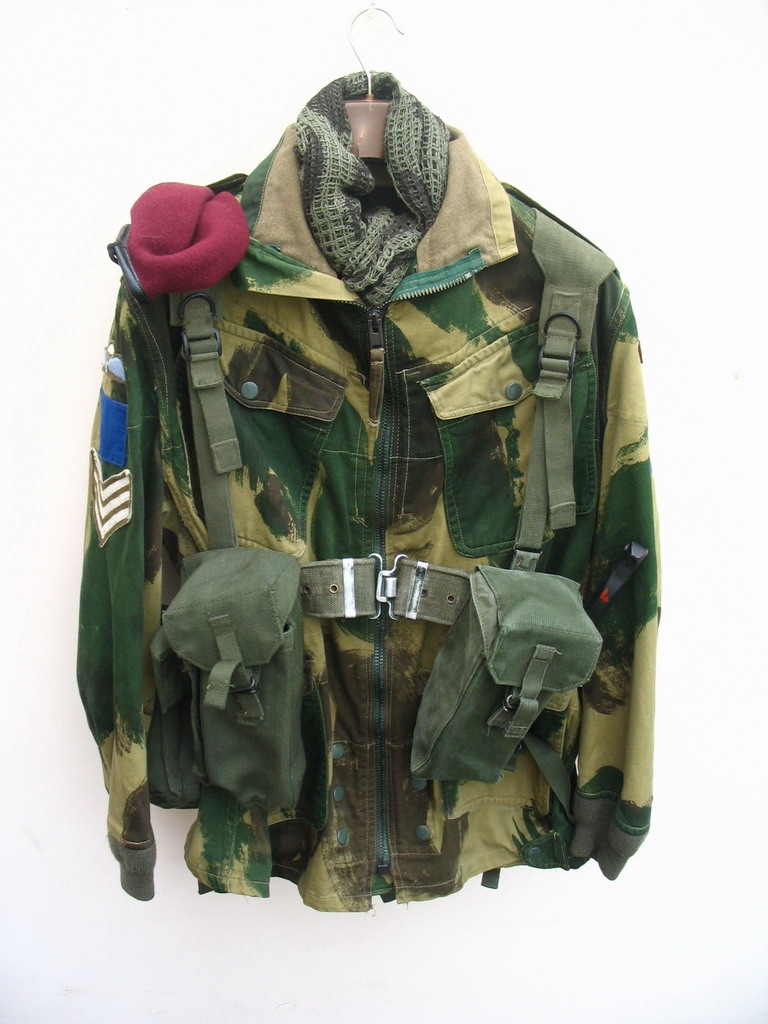

British Army Soldier 2000 Jacket
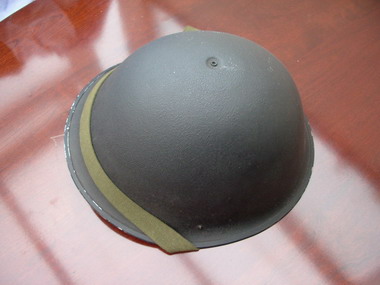
British MKIV Steel "turtle shell" Helmet introduced in 1945.
The helmet was painted black for use in Northern Ireland.
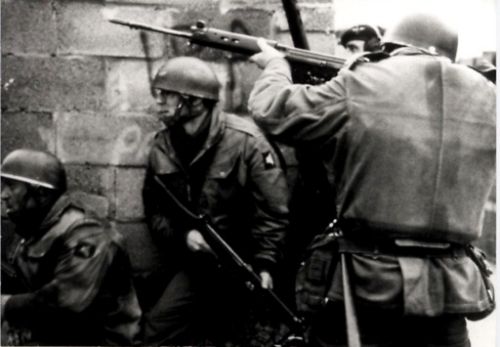
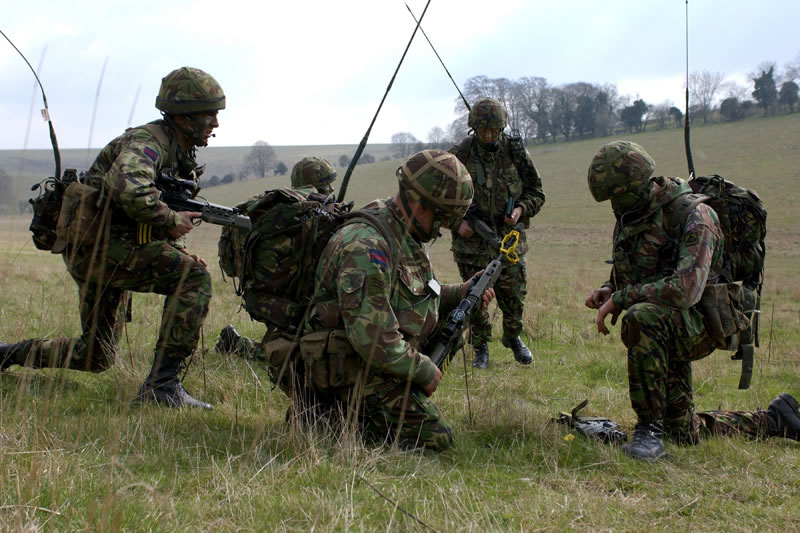
British soldiers in Northern Ireland
