
You have seen them. The guys are walking around town with their baggy pants low enough to show off the boxers underneath. The fitted baseball cap almost always perched on top of their head, some may even wear them backward. The entire ensemble appears to have been slept in or spent the last few days on top of Mount Laundry. Of course, the thought of shaving the twenty-four hour facial hair is forgotten as quickly as it entered the mind. The attire worn by the fairer sex is the complete opposite. The clothes are almost tight enough to have been painted on just before the evening’s festivities. Regardless, the women’s clothes appear to have cost a small fortune with the vibrant colors, sequence, low neck lines, and high hem lines. The make-up is put on with the precision and care of a surgeon. And this is just the beginning. Many of them have various body tattoos and / or piercings. Some own cars that have been modified and / or have stereos loud enough to host a private concert in an amphitheater. Background / Abstract Who are these individuals? This is the generation that has been in the workforce for around ten years now. These are the individuals that are beginning to take leadership positions at large corporations and make major decisions within our government. They are our future. They are Generation X. Also referred to as the "MTV Generation" they are hungry for success when it concerns their careers and with their determination, they will achieve it (Marston 1998). And probably in less time that it took the previous generations. But with all this determination and possible resulting success, why do members of the previous generations look unfavorably on members of Generation X? Why are they referred to as "lazy"? Generalizations are often made such as: "They don’t want to work hard," "They don’t have values," or "Their attention span is too short" (Myron and Truax 1998). This study is to prove that members of Generation X are not lazy. Outside of the office they may dress as described in the opening paragraph, however inside the walls of business, this generation has the determination to succeed. Keep in mind though, they won’t succeed by doing things the traditional way or your way, their success will be achieved their way (Hornblower 1997). This study will also attempt to identify how this generation defines success in their careers. Also, the motivation that leads to their achievements will be discussed. Literature Rev. & Theoretical Framework Besides the classroom textbook, all other documented research for this study was gathered from the Internet. Some of the sources are reputable and commonly known such as Time magazine, while other information was gathered from web sites containing the opinions of people unknown by the author. Surveys were also used to gather information from family members, friends, and acquaintances of the author. These surveys were distributed in hardcopy form when feasible, otherwise they were sent via email. All recipients of the surveys are considered members of Generation X according to most sources. As mentioned above, the goal of this study is to prove that the members of Generation X are not lazy, they do work hard and they have values. This leads to the questions, why are they diligent individuals? Why do they work hard? Where do their values come from? Parts of three theories from the classroom textbook will be used in conjunction with the author’s research to answer these questions throughout this study: Clayton Alderfer’s "ERG theory", David I. McClelland’s "Thematic Apperception Test", and Frederick Herzberg’s "Two-factor theory". As described in the textbook, the ERG theory contains three needs categories: "existence needs – desire for physiological and material well-being; relatedness needs – desire for satisfying interpersonal relationships; and growth needs – desire for continued personal growth and development" (Schermerhorn, Hunt, and Osborn, 2000). The "growth need" will be demonstrated in this study. The three needs associated with the Thematic Apperception Test are as follows: "need for achievement – the desire to do something better or more efficiently, to solve problems, or to master complex tasks; need for affiliation – the desire to establish and maintain friendly and warm relations with others; and need for power – the desire to control others, to influence their behavior, or to be responsible for others" (Schermerhorn, Hunt, and Osborn, 2000). The "need for achievement" will be demonstrated in this study as well. The Two-factor theory contains two factors or categories that can describe how employees feel about their jobs: hygiene factors – sources of job dissatisfaction; and motivator factors – the actual tasks an employee accomplishes each day while at work (Schermerhorn, Hunt, and Osborn, 2000). Finally, the "motivator factors" will play a significant part of this study. The reason this study was chosen and researched by the author was purely self-centered. As humans we enjoy learning and talking about ourselves. As a member of Generation X, the author wanted to learn more about himself and 45 million (Jackson 1999) of his closest friends. Research Methodology The survey used by the author for this study was distributed to fellow members of Generation X via email and hardcopies. It consisted of 15 questions, ranging from "Who do you consider your hero" to "What are some of your goals in your professional life". The respondents were instructed to answer as honestly as possible. If, for some reason, they felt uncomfortable answering a question, they were allowed to skip that question. Sixty percent of those who received the survey submitted answers. Those who did respond provided a wide range of opinions, stories, and insights into the world of Generation X. Before analyzing the survey results, here are some of the characteristics of the respondents:
Findings Causes / Analysis of the Problem
The careers of these Generation X respondents included Education, Information Technology, Graphic Art, and Medicine. These individuals had worked for their current employer for an average 3.7 years, ranging from 4 months to 13 years. Of those who answered and gave a definite number, none of them planned on staying any longer than three more years. Actually, the average length of time they planned to stay with their current employer was 1.5 years longer. When asked if there was anything that their current employer could do in order to get them to withdraw their resignation, the overwhelming response was increased salary. Other responses were that they would want opportunities for more training, more responsibilities, or fewer hours. A few respondents had also mentioned that their current employer could do nothing in order to keep them. Basically, once they had submitted their resignation, they were not going to relinquish their decision. The attitude can be summed up with, "If the boss won't provide a raise, stock options, extra time off, or whatever, then another one will" (Conlin, Coy, Palmer, and Saveri 1999).
From this survey, it appears that a resignation will be an inevitable part of any one person’s career. In the meantime though, while these individuals are working for their current employers, why do they stay and what motivates them to do a good job? What are some of their goals in their professional life? Many respondents stated that money is the motivation behind working at their current company. Others mentioned that receiving feedback helps to motivate them to perform well and accomplish their assigned tasks. A few had specific examples of motivations such as their own children or the well being of the children on whom they perform physical therapy. One individual stated she is motivated by "feeling needed – that I am contributing to something successful and it wouldn’t be quite as good without me". Some of the other goals mentioned by the respondents included the following: increased salary, eventually work for themselves, move into a management position, and gain more training or go back to school. As will be demonstrated later in this study most of these characteristics of the respondents reflects the majority of Generation X.
Outside their parents or God, the respondents of this survey do not have many heroes. Various reasons were given as to why they considered their parents to be heroes, such as: "…someone who eagerly helps another person get ahead without any plans for self-benefit", "(She) would always put her children’s needs before her own", "For her sacrifices, I am eternally grateful", and "He is such a pillar of strength in trying situations". Words such as loving, giving, compassionate, and strong were used to describe their parents, their heroes. As one individual stated, "the list could go on and on". One individual stated that God was his hero. With a statement like, "Even death didn’t stop Him from coming back to spread God’s word", who can argue with that? Another individual mentioned Stephen King as her hero, "he had an ordinary (dysfunctional) childhood like most of us and went on to be what I consider one of the best fiction writers of all time". Four individuals have no hero at all. Besides one person who mentioned Rosie O’Donnell (for her work with children), the other respondents stated a friend or other relative was their hero.
According to Merriam-Webster Online Dictionary, success is defined as a "degree or measure of attaining a desired object or end". How does that definition of success compare to the Generation X members who participated in this study’s survey? The overwhelming answer was happiness. Most of the respondents stated that happiness was a true measure of success. Another common answer was completing a task or achieving a goal that you had created for yourself. One respondent stated that money was a measure of success, however "money alone doesn’t define it completely so I guess happiness does play an important role". According to this study and contrary to the generalizations made by some members of the previous generations, it appears that Generation X does have values. However, this claim is not agreed upon by all members of Generation X. According to Time magazine, "a third of them agree that 'the only meaningful measure of success is money" (Hornblower 1997). These conflicting views will be discussed in more detail later in this study.
Regardless of the individual's willingness to stay with one employer or determination to succeed, it is not always the decision of the employee whether or not he / she remains employed. Within any business, companies are always looking for ways to increase profit and decrease debt. Sometimes this results in downsizing or lay-offs. However, are companies more likely to give their employees pink slips now than during previous generations? Or will companies work with their employees in order to keep them employed? In other words, during the dawn of the twenty-first century, as employees do we have the luxury of job security as did the parents and grandparents of Generation X? According to the survey responses of this study, two thirds of the individuals do not believe job security exists today as it did in the past. Comments such as the following were made in the survey: "companies… have no loyalty to their employees", "…business is built on profit…", "To think that a company or job will 'take care of you' is foolish", and "…employees are only company assets (and) we are totally expendable". The following comment probably sums up the feelings of the respondents, "I'm not sure anyone can ever have absolute job security. There is always someone above you who could take that security away due to outside factors." It is very seldom that you hear of an individual retiring from a place he / she has worked since the beginning of his / her career. Actually the "majority of graduates see their career at graduation not as a straight line of advancement in one company but as a zigzag path from company to company, job to job, skill to skill" ("Know Future" 2000). The individuals surveyed appear to agree that they will not retire from their current company. As mentioned earlier, on average they only plan to stay 18 more months with their current employer. But how important is job security or meeting a company's goals to a member of Generation X? According to The Business Journal of Charlotte, job security is not that important to this generation. "Generation X is all about 'what's in it for me'. They're not interested in meeting the company's goals; they're interesting in meeting their own" (Marston 1998). A few of the respondents believe that job security still exists today. Following are some of their comments from the survey: "That's probably the one thing that keeps me from quitting my current job is because of the security that I feel" and "Always strive to be the best at what you do (and) continue learning".
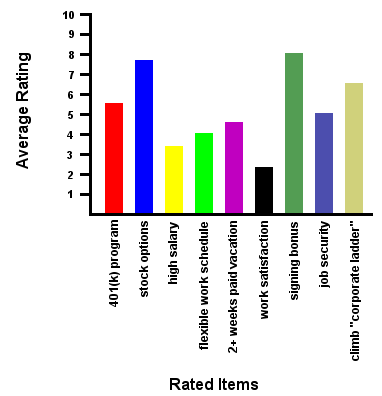
On the survey the respondents were asked to rate the following ten items from 1 to 10 in order of importance (one being most important and ten as the least important):
(These are listed in no particular order.)
To best illustrate the results of this question please refer to the following bar graph. Keep in mind that the lower the bar, the more important that item is to the respondents. Therefore, as you can see from the bar graph, on average the respondents rated "work satisfaction" very highly and "signing bonus" as the least important item. The "other, please specify…" item was removed after receiving the responses because very few individuals included it in their rating.
Finally, the last question to be discussed from the survey asks the respondents for their thoughts or feelings about Generation X in general. All of those who responded to this question provided very profound opinions about this generation. Following are a few of their insights into Generation X: "…there are an awful lot of lazy people in our generation. The sheer volume of information that is so readily available to us because of the Internet and the vast array of easily accessible 'tools' that personal computers offer have enabled us to get away from the simple need to learn… I don't think we have the drive to better ourselves that our parents had", "We are constantly having to overcome a negative reputation thanks to some 'slack' members of our generation (i.e. a declining work ethic, tremendous lack of morality)", and "People always talk about how bad our generation is as if we are 'evil', but there were children out of wedlock, adultery, murder, drinking, etc. in Biblical times!!!". One response that appears to sum the rest of the responses is as follows: "Every generation has their troublemakers and ours is not without the exception. However, typically our generation is compassionate, caring, and determined. Challenge us with a task and we'll complete it. Tell us that something is impossible and we'll prove you otherwise. Outside work we want to do, wear, and act the way we want. This is our time and we don't want to 'fit in'."
Discussion
Generation X was coined by a Canadian named Douglas Coupland. His book entitled, Generation X: Tales for an Accelerated Culture, contains stories about the lives of three main characters. Written in 1991, this book attempts to identify "the fundamentals of a GenXer namely friendship, honesty in communication, exploring the world and its diversity, and standing by your dreams". "Common ideas of success… and ‘normal’ living is challenged by the characters as they work to form their own existence working McJobs and living in… bungalows" (Valiant 2000). (A McJob is defined as "a low-pay, low-prestige, low-dignity, low-benefit, no-future job in the service sector" (Fink 1996).) Coupland described the characters as "underemployed, overeducated, intensely private and unpredictable" (Jochim).
Even though the attitude of the characters in Coupland’s book may have been an accurate description of the average Generation X member, not all of them are lazy or work in a McJob. They are confident, savvy, and committed. They crave success American-style (Hornblower 1997). This success begins with knowledge. The definition of success mentioned previously involved attaining a desired object or end. Before an individual is able to attain a desirable object or end, he / she has to realize that it exists. "To prepare for their future, Generation X is enrolling in college in ever-increasing numbers" ("X… The Next Generation"). And what are these individuals doing after college? As mentioned earlier, they want to achieve success their way. It is "estimated that nearly 10% of Americans are actively working on starting a business – a rate three times higher than for any other age group" (Ameln). Even though only 10% are starting a business, 87% would "receive greater satisfaction working for themselves" (Jurkiewicz 2000). One Generation X member in California stated, "With my own business, I could come in at 7 a.m. and leave at noon to play golf" (Hornblower 1997). Actually, one of the respondents of this study should be considered part of the above 10% who are starting their own business. Looking for a way to get out of "Corporate America", he is currently in the process of purchasing his own business.
If 10% of the members of Generation X are exploring the possibilities of starting their own business, that leaves 90% of that same group of individuals working for someone else or another company. Of course, before stepping into any company or business as an employee, individuals must submit a resume and go through the company’s interview process. "Today’s grads are bold enough to ask a prospective employer uncomfortable questions such as, ‘If I don’t like what my boss says, can I go to the next level?’" (Higgins 1999). This obviously demonstrates self-confidence and a boldness that was not demonstrated in the baby boomers' generation.
Obviously today’s job market is slightly different than the job market experienced by the previous generations. Individuals in today’s workforce are experiencing the "tightest labor markets in 30 years and unprecedented opportunities". Some of the "elite employees are making so much money so quickly and are juggling so many job offers that they live in constant fear of making the wrong decision and blowing their chance of getting their ‘two commas’ and retiring at age 40" (Conlin, Coy, Palmer, and Saveri 1999). Many companies are using bonuses and perks in order to keep their employees. For example, the restaurant chain Cheesecake Factory gives their managers new BMW 323’s for the duration of the individuals’ employment. Other companies give their employees $4,000 signing bonuses while others will give new Jeep Wranglers and $15,000 checks to employees simply for referring potential new employees (Conlin, Coy, Palmer, and Saveri 1999). Why are companies making these offers and willing to spend so much money of their employees today as opposed to years ago? As mentioned above, the current job market is very tight. There are more jobs today than qualified individuals. One comment from an executive in her 40’s stated that "she and many of her cohorts wanted the same things when they were in their 20’s that Xers want today. The difference: companies didn’t need their talent the way companies need GenXers today" (Coopersmith 2000). This is why members of Generation X can demand the high salaries, extra perks, or flexible work schedule immediately, while it took previous generations 30 years to achieve. "Companies that offer no more than a paycheck will attract employees who accept and give the minimum" (Luppert 1999).
Let's say you’ve already promised the high salary, paid the signing bonus, and set up the stock options for your new Generation X employee. Now how do you keep him or her excited about the job to avoid his or her resignation papers the following month? According to another study, there are three top factors in retaining staff (Nielsen 2001):
There are plenty of things a manager or supervisor can do in order to keep Generation X employees satisfied with their new position. Most of which will cost very little financially or nothing at all. Start with the existing management who will ultimately manage the Generation X employees. "Macy’s, a division of Federated Department Stores, (has begun) sending top managers to classes on supervising employees that included lessons on Generation X." Macy’s representative stated that "Some of the older management needed to recognize that life has changed. Who cares whether (members of Generation X) are good or bad? The bottom line is that they are the future" (Higgins 1999). The more upper management understands the behaviors and attitudes of Generation X, the more all employees are going to work well together.
Once management has been trained on the new generation of employees, you must concern yourself with the actual Generation X employee. From the very beginning of employment "open a dialogue with them… about how you want to keep them and how you are willing to work with them to make that happen" (Langdon 2000). These lines of communication should be informal (Jennings 2000). If an employee is comfortable talking with his or her manager or supervisor, he or she will be more likely to bring up small issues before they turn into large problems. Also, when talking with the Generation X employees consider the communication lines as a two way street, "listen, don’t dictate" (Marston 1998). "Communicate directly and openly. They’ll see through anything else" (Myron and Truax 1998). These employees will appreciate the directness because it also avoids "the minutiae of office politics" (Coopersmith 2000).
As previously stated, the first thing on the Generation X employee’s agenda is "what is this company going to do for me?" "The promise of lifetime security and a gold watch is a relic of the past. Still, companies cling to the language of loyalty, family and the sacred team…" (Luppert 1999). In contrast, they should "promise that employees will never leave with obsolete skills. A company that commits to training smart workers will have smart workers who commit in kind. When GenXers stop learning from one company, they start to look elsewhere for a new challenge" (Luppert 1999). In other words, training is very important to these employees. "Let them know that you will provide as much training as possible to help them develop new skills while they are there. Allow them some input into what training they will receive" (Langdon 2000). This is a good example of the growth needs part of Clayton Alderfer’s "ERG theory". This theory states that individuals have a "desire for continued personal growth and development" (Schermerhorn, Hunt, and Osborn, 2000). The previous generations had more stable jobs, "predictable career ladders, pension benefits, and if all else failed – Social Security". "For Generation X members their skills are the only visible safety net they have. If we keep investing in those skills while they’re with us, we’re giving them something that matters – both to them and to us. We’re giving them a compelling reason to stay, and the company a compelling reason to keep them" (Coopersmith 2000).
Along with training, members of this generation want an enjoyable and laid-back work environment. "Make the work environment fun and informal. Introduce them to others and encourage the development of workplace friendships" (Langdon 2000). In a Manhattan-based e-business consulting firm, employees are encouraged to bring their passions to work. One individual, a Senior Software Engineer, enjoys tightrope juggling. "On any given day… he can be seen practicing in his circus gear" (Conlin, Coy, Palmer, and Saveri 1999). Generation X wants a place "where play is taken as seriously as work" (Jackson 1999). Therefore, it is not unusual to find basketball courts or game and weight rooms in corporate buildings today. Play activities can help balance the monotony of day-to-day work related assignments and projects. This could be considered an example of half of Frederick Herzberg’s "Two-factor theory". The motivator factor refers to "the actual tasks an employee accomplishes each day while at work" (Schermerhorn, Hunt, and Osborn, 2000). The play activities would be the motivation to perform well on the work related assignments and projects.
These employees can work well in almost any type of group situation. "Provide opportunities for them to work in spirited team situations, but with opportunities for individual achievement and recognition" (Langdon 2000). "Generation Xers are adept at interaction with others and they are very productive in a team environment" (Coopersmith 2000). They are also fiercely independent, "working well alone but (they) require liberal doses of feedback" (Higgins 1999). The feedback provided by their managers and supervisors on their performance should be immediate. Keep in mind that these individuals were raised on instant gratification (Jennings 2000).
Speaking of instant gratification, "there is a need among Generation X for constant reaffirmation". "It is a positive step for managers to give frequent and specific feedback to Generation X employees" (Coopersmith 2000). As mentioned in a previous section of this study, a few of the respondents to the survey had stated that receiving feedback helps to motivate them to perform well and accomplish their assigned tasks. This trait can be found in many other members of Generation X. During their first day of training as new assistant buyers for the department store Macy’s, one Generation X employee walked up to the instructor and asked, "how am I doing?" "That took me back! We had only just come in and taken attendance," stated the instructor (Jackson 1999). Celebrate their success. "They enjoy nothing more than a good party for a job well done" (Coopersmith 2000).
Of course, in order to deserve and receive the feedback, this generation must work and accomplish their assignments and projects. There is no need to worry about that. "Generation X is committed" (Hornblower 1997). Challenge them and their creativity with a variety of work assignments. This generation is not motivated by and does not enjoy repetitive work assignments. "Generation Xers’ development in the Information Age led to the ability to complete numerous tasks simultaneously. Adding job variety and multiple tasks keeps their minds interested and focused on the completion of numerous projects that stimulate their intellects" (Coopersmith 2000). "Look for opportunities to engage them in short-term, goal-oriented projects" and "allow them to experience a daily sense of tangible achievement" (Langdon 2000). Earlier, one of the survey respondents stated, "challenge us with a task and we’ll complete it, tell us that something is impossible and we’ll prove you otherwise." As David I. McClelland’s "Thematic Apperception Test" states, individuals have a need for achievement, "the desire to do something better or more efficiently, to solve problems, or to master complex tasks" (Schermerhorn, Hunt, and Osborn, 2000). If that was ever the case for the previous generations, it is even more so with Generation X.
As the 1980 movie The Shining states "All work and no play makes Jack a dull boy". Generation X has subscribed to that belief. "Xers want time for themselves, for their families and for helping others." To this generation, "’having a good time’ is a legitimate goal." A separate study asked many members of Generation X "which is more important to them, their personal lives or their careers, the former wins hands down – 64% to 36%" ("X… The Next Generation"). Obviously this "generation is comfortable drawing the line at too much work". "They clearly reject the baby boomers’ workaholic ethic" (Jackson 1999). "Generation X employees seek to strike a balance between work and home priorities. Allow Xers the flexibility to do so" (Coopersmith 2000). "Keep in mind that unlike preceding generations, this one has a life" (Myron and Truax 1998).
Conclusion
The previous generation was called Baby Boomers because of the large numbers of children born during that time period. The generation known as Generation X may have a less descriptive name. The name may have been given to them as a derogatory title. However, "X" is just a letter. It doesn’t have a definition and it certainly has no numeric value (in algebra it is of an unknown value). This title may describe this generation better than any other title could possible come close. "X" allows this generation to define themselves. The individuals of this generation can forge their own paths. Virtually nothing stands in the way of their hopes and dreams. They are only limited by themselves. To each Generation X member, the "X" can stand for something entirely unique and personal.
Regardless of the differences between Generation X and the other generations, harmony can be achieved. "It is evident that different generations can complement each other in the workplace and work smoothly together if managed well. One example would be positioning (Baby) Boomers as mentors for GenXers, given the first group’s more positive attitudes, more consistent attendance, and greater practical knowledge, combined with the second group’s desire for strong mentors. Conversely, the more technologically proficient GenXers could serve to upgrade the skills of Boomers in this area" (Jurkiewicz 2000). "For the first time in history, children are more comfortable, knowledgeable and literate than their parents about an innovation central to society" ("Know Future").
Considering this generation’s attitude toward their careers; because of their desire to have a life outside of their careers, regardless of what the older generations want or believe; because 96% of them are confident that someday they will get where they want to be in life (Hornblower 1997); because GenXers are more competitive, risk-taking, and success-minded minded (Jurkiewicz 2000), there are two words that can accurately describe these individuals: No fear.
By ShananReferences / Bibliography
Ameln, Ron. "Managing Generation X: Are They Spoiled Brats? Or Talented Entrepreneurs?"
Conlin, Michelle, Peter Coy, Ann Therese Palmer, and Gabrielle Saveri. "The Wild New Workforce." December 6, 1999.
<
Coopersmith, Aryae. "Boomers & Gen X: Generational values transforming the workplace." February 16, 2000.
<
Fink, Jonny. "Douglas Coupland's Generation X Neo-logisms." March 29, 1996.
< http://www.scn.org/~jonny/genx.html > (March 29, 2001)
Higgins, Amy. "Generation X gets to work." February 8, 1999.
<
Hornblower, Margot. "Great Xpectations." June 9, 1997 vol. 149 no. 23.
<
Jackson, Maggie. "Generation X is bold, quick, computer-savvy; companies learning to cope." January 31, 1999.
<
Jennings, Andrea T. "Hiring Generation-X." February 1, 2000.
< http://library.northernlight.com/PN20000222020003570.html > (February 20, 2001)
Jochim, Jennifer. "Generation x defies definition."
<
Jurkiewicz, Carole L. "Generation X and the Public Employee." Spring 2000.
<
"Know Future." December 21, 2000.
<
Langdon, Jerry. "Young workers can thrive." December 27, 2000.
<
Luppert, Eve. "The ABCs of dealing with Gen X employees." April 16, 1999.
<
Marston, Cam. "The bottom line on motivating, retaining Generation X-ers." December 28, 1998.
<
Myron, Monique Reece, and Pamela Larson Truax. "Anatomy of the 'Generation x' consumer." April 24, 1998.
<
Nielsen, Jakob. "Retaining Key Staff: What High-Tech Employees Say versus What They Do." March 4, 2001.
<
Schermerhorn, John R., James G. Hunt, and Richard N. Osborn. 2000. Organizational Behavior. New York: Von-Hoffmann Press.
Valiant. "An Interesting Read Into A Collective Psyche." February 29, 2000.
< http://www.amazon.com/exec/obidos/ASIN/031205436X/o/qid=986313515/sr=2-1/107-0364052-3819734 > (March 29, 2001)
"X… The Next Generation."
<
| This section intentionally left blank. | |
 |
 |