HIS STORY
Shiva literally means "auspiciousness, welfare". He is the third god of the Hindu Triad (see Trimurti) and is the destroyer of all evil. He represents darkness (tamas), and is said to be the 'angry god'. However, according to Hinduism, creation follows destruction. Therefore Shiva is also regarded as a reproductive power, which restores what has been dissolved. As one who restores, he is represented as the linga or phallus (see Shivalinga), a symbol of regeneration.
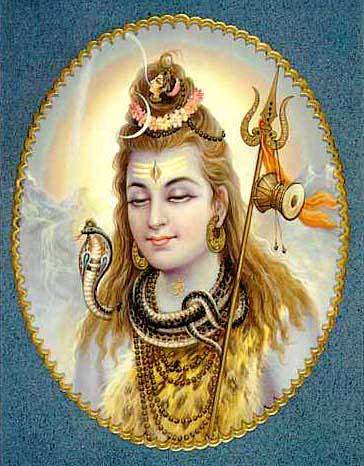
Shiva is believed to exist in many forms. His most common depiction is as a dark-skinned ascetic with a blue throat. Usually seated cross-legged on a tiger skin.
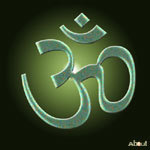
The name Shiva does not appear in the Vedas. However he is identified with the Vedic god Rudra, lord of songs, sacrifices, nourishment, the healer of diseases and provider of property. According to the Shiva Purana, Shiva is said to have five faces, corresponding to his five tasks, the panchakriya: creation, establishment, destruction, oblivion, and grace. His five faces are associated with the creation of the sacred syllable Om.
Shiva is said to live on Mount Kailash, a mountain in the Himalayas. His vehicle is Nandi the bull and his weapon, the trishul. Shiva's consort is Parvati, who is also believed to be a part of Shiva.
HIS HAIR
Shiva's hair is matted and coiled on his head, adorned with a snake and a crescent moon. Ganga is always depicted flowing out of his topknot. Shiva has four arms and three eyes. The third eye, in the middle of his forehead, is always closed and only opens to annihilate an evil doer. A garland of skulls, rudraksha beads, or a snake hang from his neck. Shiva also wears snakes as armlets and bracelets. The serpent race, despised and feared by all other creatures, found a place of honour on Shiva's sacred person, simply because he was moved by their plight.
HIS HANDS
In one hand, Shiva holds his trishul, the Pinaka. The trishul usually has a damaru or waisted drum tied to it. In another hand, he holds a conch shell (see Shankha), and in the third, a rudraksha rosary, a club, or a bow. One hand is usually empty, raised in a gesture of blessing and protection. The other points to his feet, where the devotee is assured of salvation. He wears a tiger or leopard skin around his waist, and his upper body is usually bare, but smeared with ashes, as befits an ascetic. His third eye is believed to have appeared when Parvati, in a playful mood, covered his eyes with her hands. Immediately, the universe was plunged into darkness and there was chaos. To restore order, Shiva formed another eye on his forehead, from which emerged fire to restore light. The light from this eye is believed to be very powerful, and therefore destructive. Shiva opens his third eye only in anger, and the offender is burnt to cinders.
HIS SKIN
When the demons and deities churned the Sea of Milk, 14 jewels surfaced. One of them was a poison, which neither the deities nor the demons would accept. Since the poisonous fumes threatened to devastate the world, Shiva drank the poison. The poison was so deadly that his throat became blue, which is why Shiva also earned the epithet Nilakantha, the blue-throated. To relieve Shiva from the burning sensation of the poison, he was given the moon, which had also come out from the ocean, to cool him down. Thus he wears the crescent moon from then on.
Drinking of this poison wasn't a big deal to Shiva. He is supposed to have said in the Linga Purana that there is still much poison in this world and those who could drink that poison are the real heroes. Both poison and nectar reside in the hearts of man and only when human souls are free from poison can they experience the joys of nectar.
HIS DANCE
Shiva is the creator of dance and of the first 16 rhythmic syllables ever uttered, from which the Sanskrit language was born. His dance of anger is called the Roudra Tandava and his dance of joy, the Ananda Tandava. All the gods and sages were present when he first danced the Nadanta Tandava, a characteristically vigorous dance, and they begged him to dance again. Shiva promised to do so in the hearts of his devotees and in a sacred grove in Tamil Nadu, where the great temple of Chidambaram was built, the only one in all India dedicated to Shiva as Nataraja, the lord of dance. It is believed that on the 13th day of each bright lunar fortnight (see Hindu Calendar), after 6 o'clock in the evening, falls a sacred hour called Pradosha. Worshipping Shiva at this time is akin to worshipping all the powers
His Websites ;-)
www.gurjari.net/ico/Mystica/html/shiva.htm
(strength, focus, awareness)
Om namah Shivaya
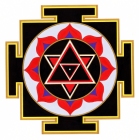
SHIVA'S YANTRA
DRUM/RATTLE/SOUND
MILK & HONEY
WHITE FLOWERS
THE ETERNAL MARRIAGE
THE GODS & GODDESSES
OM NAMAH SHIVAYA
A beautiful rendition, honouring Lord Shiva
Presented here with permission of the Author:
HP Len/Black Lotus