 SHAKTHI DAILY |
|||
|
The online edition of Kodagu's first daily |
|||
|
|
|||
| Thursday, 06 July 2006 | |||
|
NADEEM KASHMIRI IS FROM KODAGU;Madikeri July 6, 2006 Nadeem Kashmiri arrested in HSBC crime at Bangalore is a resident of Kodagu. Superintendent of police Ramachandra Rao confirmed that his father owns a chicken stall at Napoklu, a small town 29 kilometers from here. His father Abdul hameed has hailed from Kashmir and is running a chicken stall by name Amar Cold Storage. He has two sons and a daughter. Nadeem completed his PU study at Napoklu and was assisting his father in business. He migrated to Bangalore three years ago and joined HSBC. Nadeem is booked under IPC 408, 468, 420 of section 66 and 72 and is charged with the misuse of 2, 33,000 Pounds. COD has been inquiring many of his relatives to acquire more information. Nadeem was arrested on June 28. TWELVE ARRESTED;Kutta police arrested twelve persons in connection with the medical college waste being brought to Kodagu from kerala. Drivers of six Lorries, middlemen and owner of the land, Bharath of Kutta were arrested on charges of polluting the area by dumping hospital wastes. Bharath is charged under section 269 and 270 IPC. It can be recalled that residents of Kutta blocked six lorries carrying dumps from Kerala, two days ago.The lorries were later seized by police. Officials from pollution control board have arrived to kutta yesterday and taken the samples of the waste to Mysore for test purpose. The drivers of the lorries have confessed that they brought hospital and corporation waste from Kutta to be dumped at Bharaths place, who was charging per lorry. Bharath has alleged that he was cheated by agents who had promised to get vegetable waste to produce manure through recycling. KODAVA MAKES A BREAKTHROUGH IN PLANT SCIENCE;A resident of Kodagu, living in US since forty years, Dr.Bachettira Poovaiah has made a break though in plant science.He is the Professor for Center for Integrated Biotechnology and Department of Horticulture, Washington State University. It’s a story story related to a major breakthrough in plant science. This research was conducted jointly by Washington State University (Bachettira Poovaiah's laboratory and a team lead by Dr. Giles Oldroyd of the John Innes Centre, UK. The findings were published in the June 29, 2006 issue of the prestigious journal, Nature. This story has appeared in newspapers and television in Europe and the United States. The research revealed that manipulation of a gene that was first cloned in my laboratory at WSU in 1995 can induce spontaneous nodulation without the bacteria. This is a major milestone in understanding how plants fix atmospheric, inert nitrogen into a usable form. Legumes can fix their own nitrogen, but most field crops such as rice, wheat and maize cannot. So, there is a great interest in understanding this mechanism and making crops such as rice and wheat fix their own nitrogen, thereby eliminating the need for synthetic nitrogen fertilizerse- ______________________________________________________ PULLMAN, Wash. Legumes, such as beans, peas, and alfalfa, host billions of bacteria in tiny nodules along their roots. The bacteria convert, or “fix,” atmospheric nitrogen into a form the plants can use. In a joint study, researchers from Washington State University and the John Innes Centre, U.K., have discovered a way to make plants produce spontaneous nodules without the bacteria.The findings could someday allow the world’s farmers to decrease their dependence on nitrogen fertilizers, resulting in billions of dollars in savings and a reduction of run-off pollution that has turned some waterways into dead zones. Non-leguminous crop plants such as wheat and corn don’t form nodules or cultivate relationships with nitrogen-fixing microbes. They must be treated with nitrogen-rich fertilizers in order to grow and produce at peak levels. WSU lead investigator Bachettira Poovaiah said their work raises the possibility of someday producing non-leguminous plants that can form symbiotic relationships with nitrogen-fixing bacteria just as legumes do. “If major field crops such as wheat and corn can fix nitrogen from the atmosphere, it will help with two problems,” Poovaiah said. “You’re going to help the farmers, and help Mother Nature.” Their findings are reported in the June 29 issue of the journal Nature. Researchers Poovaiah, Shubho Chaudhuri and Tianbao Yang at WSU, and colleagues from the John Innes Centre in the United Kingdom, worked on a gene that plays a key role in nodule formation in legumes. Most non-leguminous plants also have the gene, called CCaMK (pronounced “see-kam-kay”). Poovaiah said the CCaMK gene, which his team first cloned in 1995, codes for a protein that influences many activities within the plant. His group’s work on the gene over the past decade laid the groundwork for the new findings. In the current study, Poovaiah’s team found that in biochemical tests, CCaMK from lily performs much like its counterpart in Medicago truncatula, a relative of alfalfa, even though lily cannot fix nitrogen. They then determined whether the lily gene could function the same way in a real-life situation, by removing the gene from Medicago and replacing it with the lily gene. They found that the replacement gene substituted for the missing one: when grown in the presence of nitrogen-fixing bacteria, the experimental plants developed nodules on their roots just like the nodules seen on normal plants. The researchers did a further experiment in which they removed parts of the CCaMK gene before inserting it into Medicago. When a certain region of the gene was deleted, the Medicago roots made nodules even if no bacteria were present. They did not, however, fix nitrogen; bacteria were still needed to do that. This result indicates that the segment of the CCaMK gene that was removed normally inhibits nodule formation. Poovaiah said in a normal legume, bacteria send a chemical signal that tells the root cells to allow CCaMK to become active so that nodules can form. He said it’s still a mystery why lilies and other non-legumes don’t make nodules or host nitrogen-fixing bacteria. Since they have a normal CCaMK gene, they are probably missing some other part of the pathway that leads to a legume-type symbiosis. Poovaiah said understanding the rest of the pathway could lead to the conversion of non-nodule-forming plants into plants that are able to host nitrogen-fixing bacteria, reducing the amount of fertilizer used. That would be a tremendous boon to farmers, for whom nitrogen fertilizers are a major expense. Such fertilizers are a petroleum by-product, so their price has skyrocketed along with the price of crude oil. There are also huge environmental costs to using nitrogen fertilizers. The nitrogen leaches from farm fields into groundwater and streams, at times reaching high enough levels to kill nearly everything in the water. According to The Nature Conservancy, thousands of square miles of the Gulf of Mexico are now a “dead zone” due to the 1.5 million metric tons of nitrogen fertilizer that are washed from mid-American farms into the Mississippi River every year. While more work is needed before farm-ready applications of his work are available, Poovaiah is optimistic that it could happen within the next decade. “We’re a research university,” Poovaiah said. “Our job is to open new doors, and this we have done.” 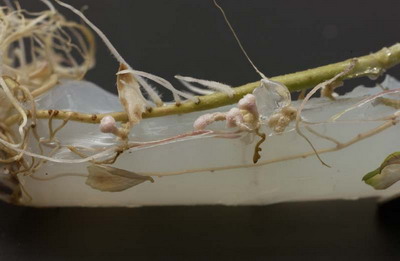 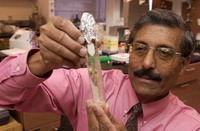 |
||
|
|
|||
|
Copyright © 2004-2005, Shakthi Daily, Madikeri, Kodagu District, Karnataka, India - 571201 [email protected] |